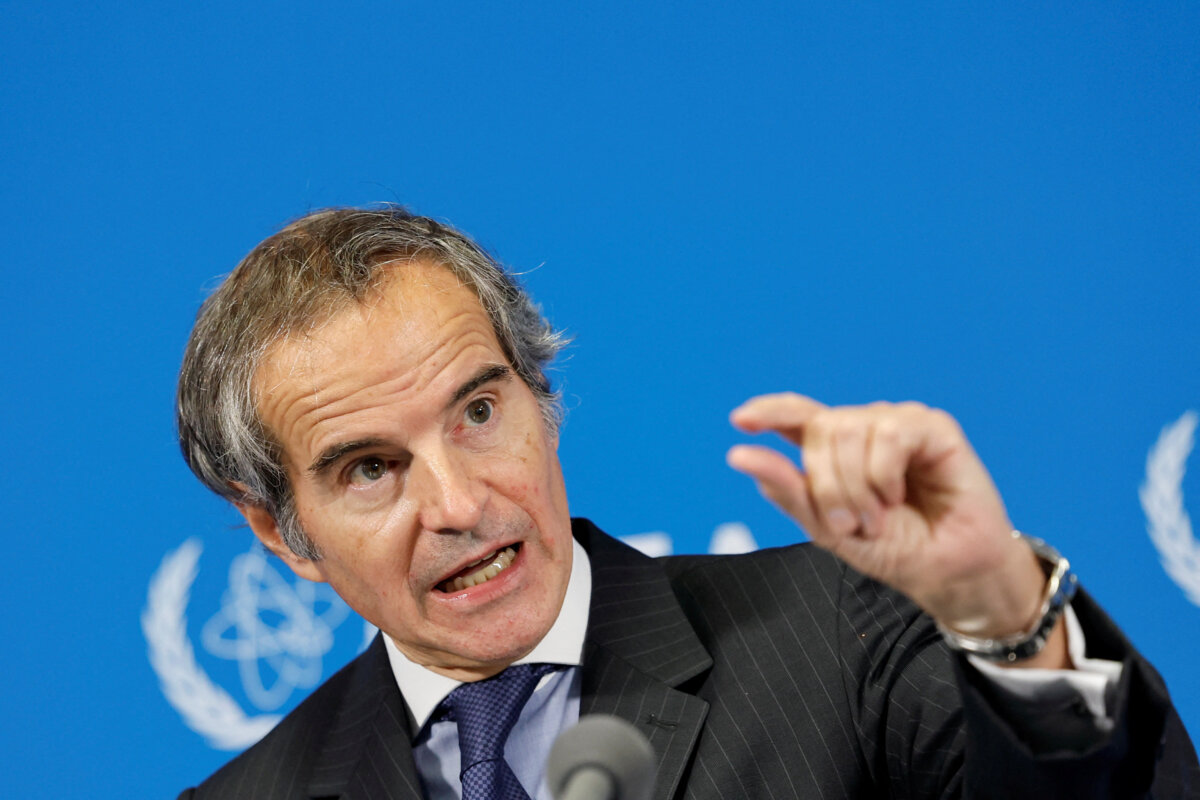
The director general of the International Atomic Energy Agency (IAEA), Rafael Grossi, said on Monday he is seriously concerned about Iran’s “rapid accumulation of highly enriched uranium.”
In a statement to the board of governors of the IAEA, which is meeting in Vienna this week, he said, “I call upon Iran urgently to cooperate fully and effectively with the International Atomic Energy Agency.”
In November, the IAEA’s board of governors passed a resolution that condemned Iran for failing to cooperate fully with the agency’s inspectors monitoring its nuclear program.
This week, the board of governors could censure Iran for noncompliance with inspectors, which would bring the issue before the U.N. Security Council.
Iran could then face “snapback”—the reimposition of all U.N. sanctions, which were lifted following the Joint Comprehensive Plan of Action (JCPOA) nuclear deal, signed in 2015.
In his first term in office, U.S. President Donald Trump unilaterally withdrew the United States from the JCPOA and imposed tough economic sanctions.
Iran and the United States are currently trying to negotiate a new deal. Trump has made it plain he will not allow Tehran to develop nuclear weapons.
Trump wrote in a post on his Truth Social account on Feb. 5, “I want Iran to be a great and successful Country, but one that cannot have a Nuclear Weapon.”
On May 31, White House press secretary Karoline Leavitt confirmed that U.S. special presidential envoy Steve Witkoff had relayed “a detailed and acceptable proposal to the Iranian regime,” adding that “it’s in their best interest to accept it.”
Iranian Foreign Minister Abbas Araghchi, in a May 31 post on the social media platform X, announced Omani Foreign Minister Badr al-Busaidi, who served as an intermediary in the recent U.S.–Iran talks, paid a short visit to the Iranian capital, Tehran, to relay the available details of the U.S.-backed proposal.
Iran’s supreme leader, Ali Khamenei, said on June 4 that the U.S. proposal “contradicts our nation’s belief in self-reliance and the principle of ‘We Can.’”
“The rude and arrogant leaders of America repeatedly demand that we should not have a nuclear program. Who are you to decide whether Iran should have enrichment?” Khamenei said.
Grossi, in his statement to the IAEA board of governors, said: “Unless and until Iran assists the agency in resolving the outstanding safeguards issues, the agency will not be in a position to provide assurance that Iran’s nuclear programme is exclusively peaceful.”
Grossi Pushes for Diplomatic Solution
He went on to say, “I am convinced that the only way forward goes through a diplomatic solution, strongly backed by an IAEA verification arrangement.”
The former diplomat from Argentina said he continues to support and encourage the United States and Iran “to spare no effort and exercise wisdom and political courage to bring this to a successful conclusion.”
In a quarterly report published on Nov. 19, 2024, the IAEA said traces of processed uranium had been found at two locations near Tehran—Varamin and Turquzabad—and at Marivan, and the resolution demanded that Tehran provide “technically credible explanations” for the presence of the uranium particles.
On Monday, Grossi—who said the Iran nuclear issue was a “difficult and delicate matter”—presented the board of governors with the latest quarterly report. He said it contained a comprehensive and updated assessment of Iran’s nuclear program.
Grossi said the IAEA had been seeking an explanation from Iran for the presence of these uranium particles, since November 2024.
He said: “Unfortunately, Iran has repeatedly either not answered, or not provided technically credible answers to, the agency’s questions. It has also sought to sanitize the locations, which has impeded agency verification activities.”
The diplomat said the IAEA had concluded that these three locations were part of an undeclared structured nuclear program carried out by Iran until the early 2000s.
Grossi said Iran’s actions had led to a significant reduction in the IAEA’s ability to verify whether Tehran’s nuclear program is entirely peaceful.
“The rapid accumulation of highly enriched uranium … is of serious concern,” he said. “Given the potential proliferation implications, the Agency cannot ignore the stockpiling of over 400 kg of highly enriched uranium.”
Israel Urged Not to Bomb Iran
Grossi also warned Israel that bombing Iran’s nuclear program could be counterproductive.
“A strike could potentially have an amalgamating effect, solidifying Iran’s determination, I will say it plainly, to pursue a nuclear weapon or withdraw from the Treaty on the Non-Proliferation of Nuclear Weapons [NPT],” Grossi said during an interview with The Jerusalem Post. “I’m telling you this because they have told me so directly.”
Last week, Trump said he had told Israeli Prime Minister Benjamin Netanyahu not to take any action that might disrupt the U.S.–Iran nuclear program talks.
Trump told reporters in the Oval Office: “I told him this would be inappropriate to do right now because we’re very close to a solution now. That could change at any moment.”
The Associated Press and Reuters contributed to this report.
 Friends Read Free
Copy
Facebook
Tweet
Friends Read Free
Copy
Facebook
Tweet