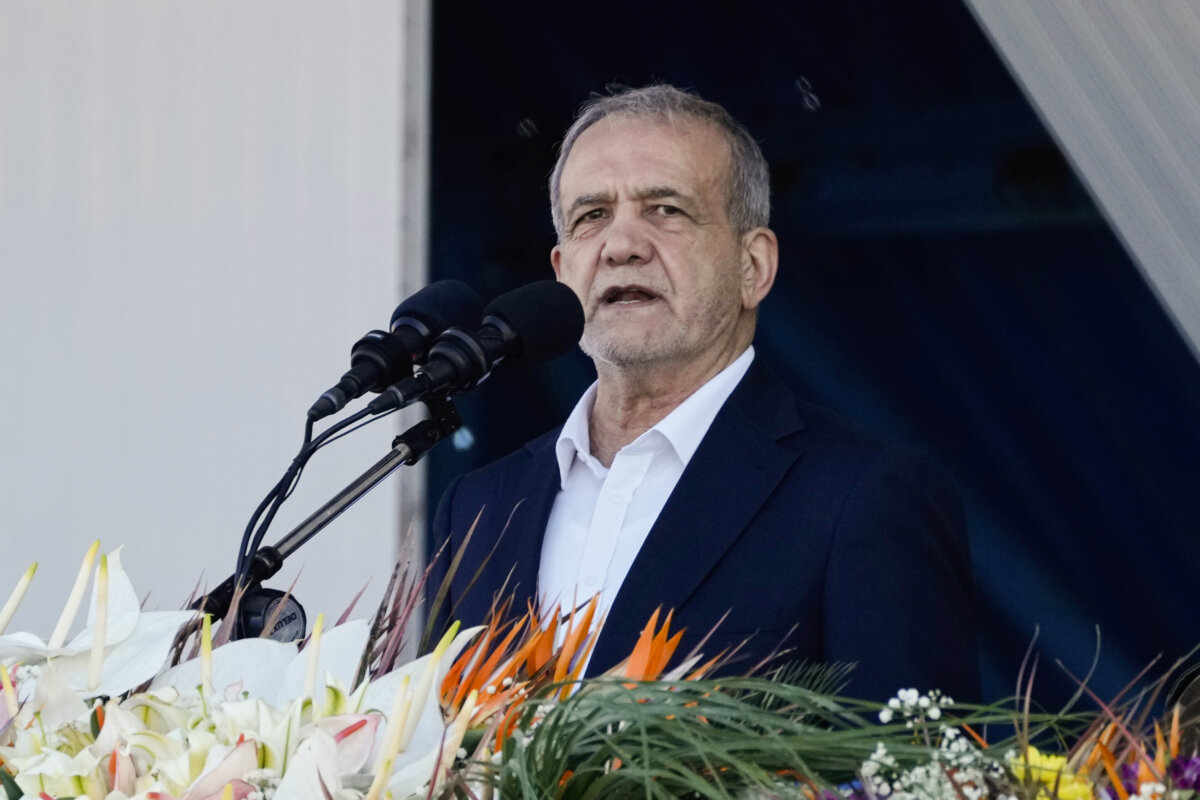

Iran’s president announced on Wednesday that the regime is ending all cooperation with the UN International Atomic Energy Agency (IAEA) following U.S. airstrikes on its nuclear facilities last month.
Iranian state-run media said that Iranian President Masoud Pezeshkian issued the order after Iran’s Parliament voted to suspend cooperation with the UN agency, claiming that IAEA Director-General Rafael Grossi acted in a biased manner.
Under the resolution reported by state-run television PressTV and Tasnim News, the IAEA cannot enter the country unless it can guarantee the security of Iran’s nuclear facilities. At the same time, state television said that Iran is considering banning Grossi from the country.
Iran has limited IAEA inspections of its facilities in the past during negotiations over its nuclear program.
Iran’s decision drew immediate condemnation from Israeli Foreign Minister Gideon Saar. In mid-June, Israel started a more than week-long airstrike campaign on Iran’s nuclear program and its military leaders and nuclear scientists before Iran responded by firing barrages of missiles at Israel.
A peace agreement was announced by President Donald Trump after U.S. airstrikes on three Iranian facilities.
“Iran has just issued a scandalous announcement about suspending its cooperation with the IAEA,” Saar said in a post on social media platform X, according to a translation. “This is a complete renunciation of all its international nuclear obligations and commitments.”
Saar urged European nations that were part of Iran’s 2015 nuclear deal to implement its so-called snapback clause. That would reimpose all U.N. sanctions on it originally lifted by Tehran’s nuclear deal with world powers if one of its Western parties declares the Iranian regime out of compliance.
The IAEA has said that Iran had been enriching its uranium to 60 percent, namely at the Fordow site that the U.S. bombed in late June. Last month, meanwhile, the IAEA said it had concerns about the roughly 900 pounds of enriched uranium, noting that under the 2015 deal, Iran was permitted to enrich its uranium to less than 4 percent.
Israeli and U.S. officials have long said that Iran is using its nuclear program to attempt to create nuclear weapons. Israeli Prime Minister Benjamin Netanyahu said in June that his country’s airstrikes were meant to prevent the regime from quickly obtaining such a device.
After the airstrikes, Defense Secretary Pete Hegseth, top U.S. intelligence officials, and Trump said that Iran’s nuclear enrichment capabilities were severely degraded.
Over the weekend, Grossi told CBS News’ “Face the Nation” that the facilities suffered “severe damage” but “not total damage” during the U.S. strikes a week before.
“Iran has the capacities there; industrial and technological capacities. So if they so wish, they will be able to start doing this again,” he stressed.
Iran’s move to suspend cooperation with the IAEA comes as Iranian Foreign Minister Abbas Araghchi signaled in a recent CBS News interview that Tehran still would be willing to continue negotiations with the United States.
As to Trump’s comments that talks could start as early as this week, Araghchi said, “I don’t think negotiations will restart as quickly as that.”
However, he added, “The doors of diplomacy will never slam shut.”
The Associated Press contributed to this report.
 Friends Read Free
Copy
Facebook
Tweet
Friends Read Free
Copy
Facebook
Tweet