
The United Arab Emirates (UAE) has faced attacks from 1,600 Iranian drones since the United States and Israel launched Operation Epic Fury against Iran’s Islamic regime on Feb. 28.
Iran’s official judiciary news agency, Mizan, alleged that U.S. forces were located in the UAE’s civilian ports of Khalifa, Fujairah, and Jebel Ali, thus making them “legitimate targets” for Iranian attacks. Dubai’s Jebel Ali port is the busiest in the Middle East.
Tehran specifically claimed, without providing evidence, that the United States used UAE ports to launch strikes on Kharg Island, which the United States said were limited to military targets while sparing its oil facilities.
Mizan also stated that people in and around those ports should evacuate immediately, saying the ports “may be targeted in the coming hours.”
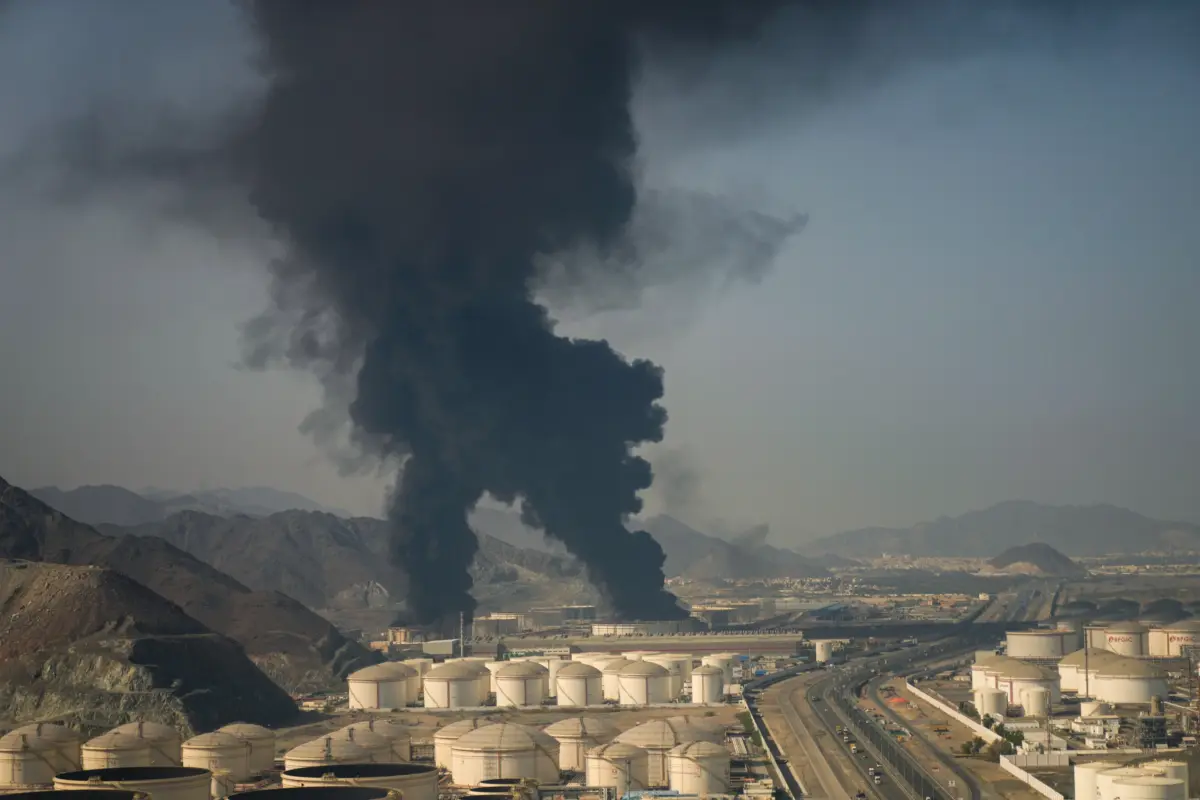
On March 14, a fire broke out near Fujairah’s port due to a drone interception. No casualties were reported.
Iran’s Foreign Minister Abbas Araghchi also took to social media on March 14, calling on its neighbors to “expel foreign aggressors.”
Between Feb. 28 and March 14, the UAE’s Ministry of Defense said that it engaged 1,600 unmanned aerial vehicles, 294 ballistic missiles, and 15 cruise missiles. That included 33 drones and nine ballistic missiles launched from Iran on March 14.
“The Ministry of Defence affirmed that it remains fully prepared and ready to deal with any threats, and will firmly confront any attempts to undermine State security in a manner that ensures the protection of its sovereignty, security and stability, and safeguards its national interests and capabilities,” the ministry stated on March 14.
The onslaught has resulted in six deaths and 141 cases of minor to moderate injuries.
Iran’s continued attacks come a week after Iranian President Masoud Pezeshkian issued an apology to his neighbors for the drone and missile attacks, stating his country’s leadership council had been in touch with the Revolutionary Guard and that “from now on, they should not attack neighboring countries or fire missiles at them, unless we are attacked by those countries. I think we should solve this through diplomacy.”
Gholam Hossein Mohseni-Ejei, a hard-line judiciary chief on the leadership council, however, suggested that Iran’s attacks would not change.
“The geography of some countries in the region—both overtly and covertly—is in the hands of the enemy, and those points are used against our country in acts of aggression. Intense attacks on these targets will continue,” he said.
Iran’s Islamic Revolutionary Guard Corps has also continued to launch drone and missile attacks against its neighbors, targeting oil fields, population centers, and critical infrastructure, as well as military facilities.
Kuwait’s Ministry of Defense announced that its air defense systems detected seven “hostile drones” since dawn on March 14. Three of them were destroyed, two “fell outside of the threat area,” and another two targeted Ahmed Al-Jaber Air Base, causing some material damage inside the military base. Three members of the armed forces sustained minor injuries and were in stable condition.
Later that day, Kuwait’s Civil Aviation Authority confirmed that a drone strike hit Kuwait International Airport’s radar system, though flights there have been shuttered since the start of the conflict.
Saudi Arabia’s Ministry of Defense has also confirmed it detected and intercepted several drones in the kingdom’s eastern region on March 14.
The Associated Press contributed to this report.
 Friends Read Free
Copy
Facebook
Tweet
Friends Read Free
Copy
Facebook
Tweet