A major Iranian opposition group, the National Council of Resistance of Iran (NCRI), said on Tuesday that the regime in Tehran has developed a “much more sophisticated” plan to maintain its secret nuclear weapons program.
The allegations were made as the board of governors of the International Atomic Energy Agency met in Vienna. The board could censure Iran for failing to comply with inspectors, which could bring the issue before the U.N. Security Council.
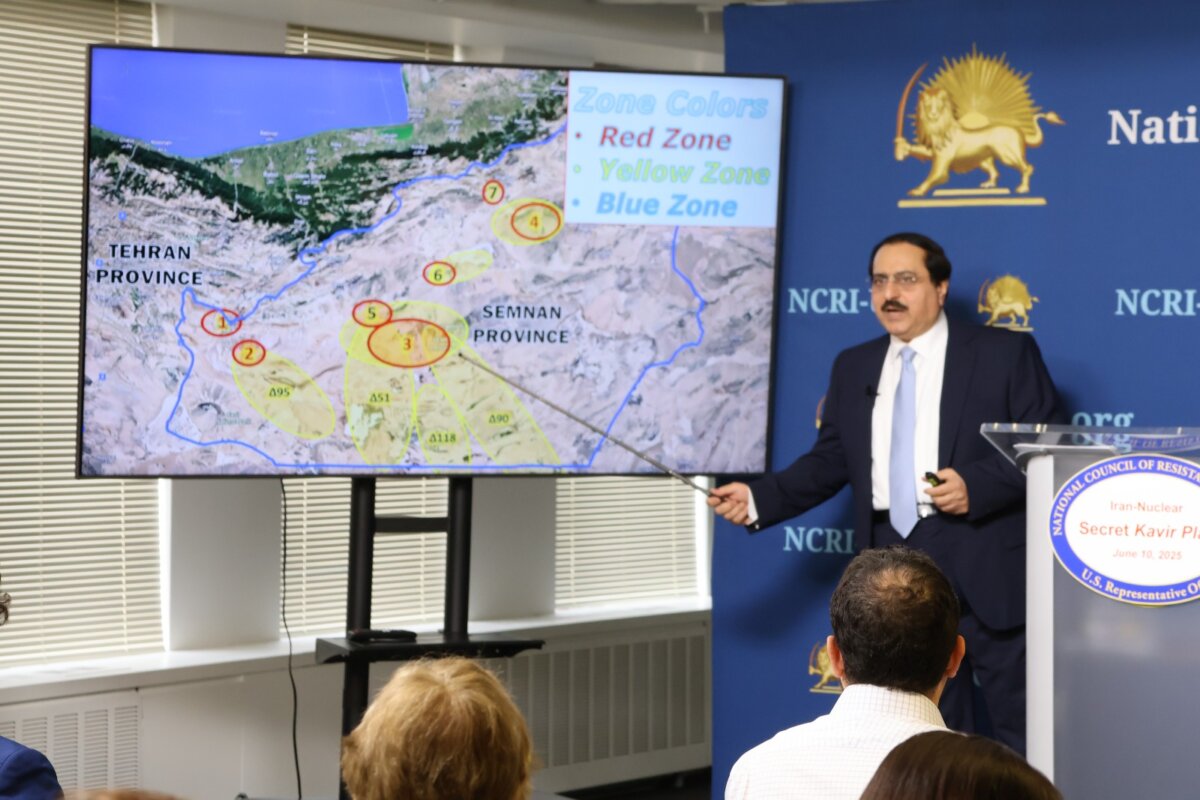
Alireza Jafarzadeh, deputy director of the NCRI, said at a news conference in Washington on June 10 that the regime has replaced its clandestine nuclear program, known as the Amad Plan, with a new initiative called the Kavir Plan.
Jafarzadeh said: “This plan is further enhanced, much more expansive, much more sophisticated, much higher level of protection and security for the sites. They have very plausible cover.”
He said it was “very clear that the nuclear weapons program of the Iran regime was never halted.”
“It was only escalated, elevated from the old, exposed, original Amad plan to the advanced Kavir Plan, the desert plan,” said Jafarzadeh, who claimed that a desert region in Semnan Province, in eastern Iran, had been designated by the regime to develop and test its nuclear capabilities.
He said the information he was releasing had been recently obtained by the NCRI’s supporters in Iran, including sympathizers within the regime itself.
The Epoch Times could not independently verify Jafarzadeh’s claims.
The NCRI is a coalition of opposition and dissident groups, the largest of which is the Mojahedin-e-Khalq (MEK), or People’s Mojahedin, which was established by Marxist students in 1965.
The MEK took part in the Iranian revolution against the Shah in 1979 but later came into conflict with Ayatollah Khomeini’s regime.
When the group revealed satellite images in April, which it said showed secret nuclear sites in Iran’s Semnan province, Iranian Foreign Minister Abbas Araghchi described the NCRI in a social media post as “Saddam’s Iranian henchmen.”
“They may come cheap, but hiring a literal cult only conveys utter desperation,” he said.
The director general of the International Atomic Energy Agency (IAEA), Rafael Grossi, said on Monday he is seriously concerned about Iran’s “rapid accumulation of highly enriched uranium.”
In a statement to the board of governors of the IAEA, which is meeting in Vienna during the week of June 9–13, he said, “I call upon Iran urgently to cooperate fully and effectively with the International Atomic Energy Agency.”
If the IAEA board of governors finds Iran noncompliant, the Tehran regime could face “snapback”—the reimposition of all U.N. sanctions, which were lifted following the Joint Comprehensive Plan of Action (JCPOA) nuclear deal, signed in 2015.
In his first term in office, U.S. President Donald Trump unilaterally withdrew the United States from the JCPOA and imposed tough economic sanctions.
Iran and the United States are currently trying to negotiate a new deal. Trump has made it plain he will not allow Tehran to develop nuclear weapons.
In Washington on June 10, Jafarzadeh said the Iranian regime had been trying to spread a narrative that it had not made a decision to develop nuclear weapons and that “everything is peaceful, everything is related to nuclear energy.”
In November 2024, Shahin Gobadi, a member of the NCRI’s foreign affairs committee, told The Epoch Times that the secret nuclear weapons program was initially called the Physics Research Center and then became known as the Amad Plan, and since 2011, had operated under the name Organization of Defensive Innovation and Research, a part of Iran’s Defense Ministry.
Gobadi said that in May 2003, after the NCRI exposed the existence of the secret Lavizan-Shian site in Tehran, which it said was the “command center for the nuclear weaponization project,” the regime razed it and dispersed its experts and equipment to other locations.
Jafarzadeh called for all nuclear sites of Iran to be shut down.
“The world should not waste time. … It took 20 years for the IAEA to ask questions and ask about the sources of traces of highly enriched uranium in Lavizan-Shian, and eventually they gave up,” he said.
“The role of the IAEA should be basically to monitor the closure of all of the sites of the Iran regime, because there’s no peaceful purpose for any of those … and the regime is going to stick to their program. They want to maintain their nuclear weapons program.”
The Iranian regime has not responded to the NCRI’s latest claims.
In a June 11 social media post, Araghchi said: “President Trump entered office saying that Iran should not have nuclear weapons. That is actually in line with our own doctrine and could become the main foundation for a deal. As we resume talks on Sunday, it is clear that an agreement that can ensure the continued peaceful nature of Iran’s nuclear program is within reach—and could be achieved rapidly.”
He said Iran’s nuclear enrichment program should continue under the full supervision of the IAEA and that sanctions should be terminated.
 Friends Read Free
Copy
Facebook
Tweet
Friends Read Free
Copy
Facebook
Tweet