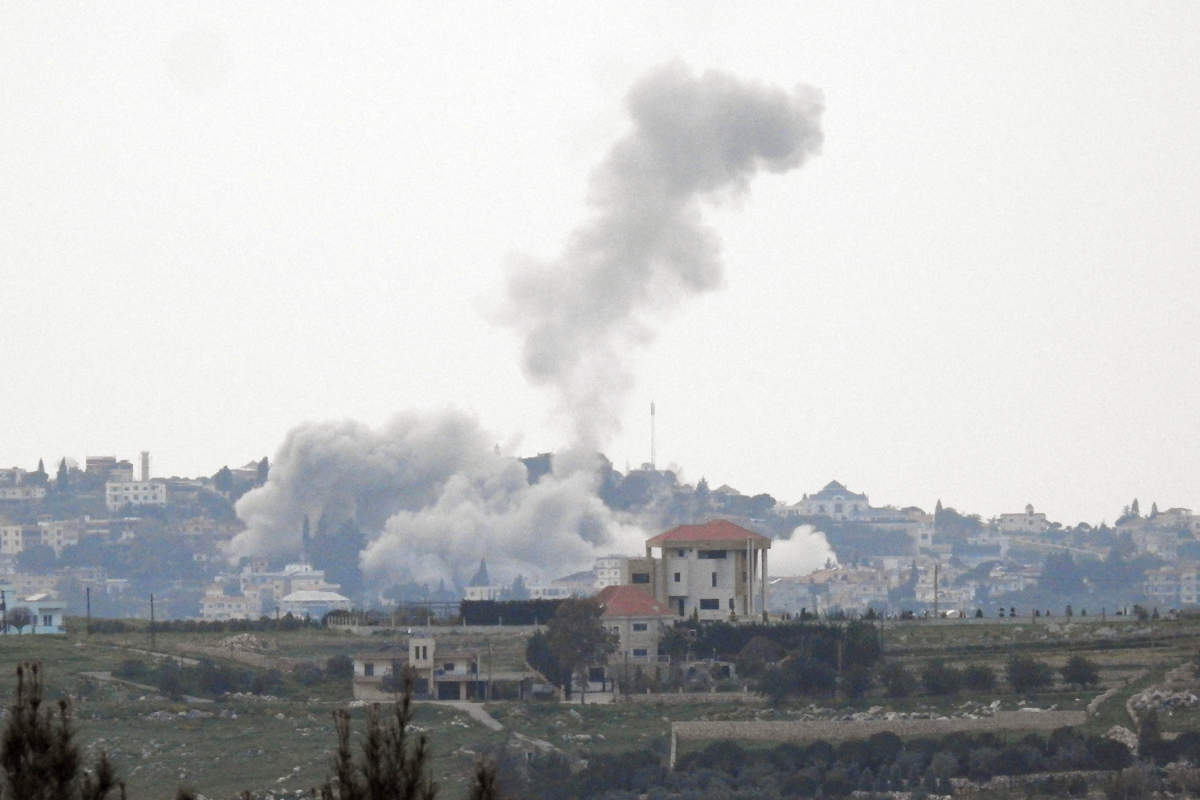

Israel has carried out strikes on Lebanon since the conflict with the Hezbollah terrorist group and Iran broke out last month, coming after Washington and Tehran agreed to a two-week cease-fire.
The Israel Defense Forces (IDF) said on April 8 that it had launched its largest coordinated strike in Lebanon and that more than 100 Hezbollah command centers and military sites were targeted in Beirut, the Beqaa Valley, and southern Lebanon.
“In 10 minutes, the IDF completed the largest coordinated strike across Lebanon since the start of Operation Roaring Lion,” the IDF wrote in a post on X. “The strike targeted 100+ Hezbollah headquarters, military arrays, & command-and-control centers in Beirut, Beqaa and southern Lebanon.”
The strikes targeted Hezbollah’s infrastructure of firepower and naval array, facilities used to launch missiles, and its aerial force, according to the IDF.
Confirming more strikes are coming against the Lebanese terrorist organization, an IDF official, Eyal Zamir, said in a statement that the IDF “will continue striking the Hezbollah terror organization and will utilize every operational opportunity.”
“We will not compromise the security of the residents of northern Israel,” the statement reads. “We will continue to strike with determination.”
Israeli military spokesperson Lt. Col. Nadav Shoshani said Israel’s largest strike on Lebanon since March 1 came as the terrorist group attempts to “scatter” its operations to populated civilian areas.
“We are seeing them move in a more dispersed way and try to embed their operations behind civilians more and more,” Shoshani said on April 8.
He also said that Hezbollah was moving away from its traditional areas of influence, including southern Lebanon and the Dahiyeh suburb of Beirut, and into areas deeper within civilian populations, including downtown Beirut.
The military said the operation on April 8 included 50 fighter jets, which launched 160 munitions at 100 targets in 10 minutes, causing widespread panic across the Lebanese capital during rush hour.
It came as U.S. President Donald Trump announced on the evening of April 7 a two-week-long cease-fire in the conflict involving the United States, Israel, and Iran in a bid to reopen the Strait of Hormuz, which has remained effectively closed since the conflict started on Feb. 28.
In the aftermath of the announcement, stock markets surged worldwide, and oil prices plunged back toward $90 per barrel.
Earlier in the week, Trump warned on social media that the “whole civilization” of Iran would end in the conflict if the country did not agree to his administration’s proposal, saying that bridges and power plants would be struck.
War Secretary Pete Hegseth declared victory over Iran early on April 8 as the U.S. military confirmed that more than 13,000 targets were hit by U.S. strikes in the five-week-long operation.
Iran must now hand over any enriched uranium that was buried, Hegseth said, warning that more strikes could be launched against the country.
“We reserve that opportunity,” he said.
At the same time, Iran declared victory over the United States and claimed that Washington was forced to accept its proposal to reopen the strait, according to state-run PressTV.
“Iran has achieved a great victory and has forced criminal America to accept its own 10-point proposal,” Iran’s Supreme National Security Council said in a statement.
The Associated Press contributed to this report.
 Friends Read Free
Copy
Facebook
Tweet
Friends Read Free
Copy
Facebook
Tweet