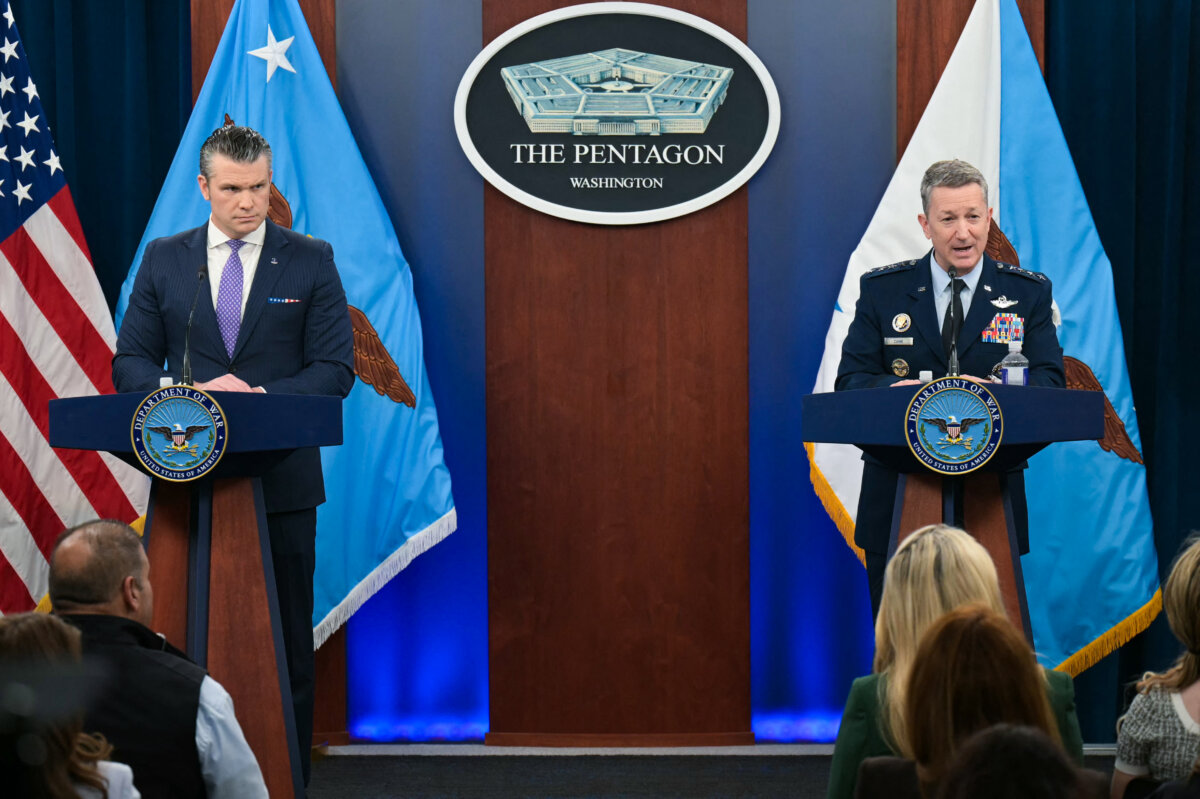

Department of War Secretary Pete Hegseth on the morning of April 8 declared that the United States won a “decisive military victory” over Iran, coming hours after President Donald Trump announced a two-week cease-fire to reopen the Strait of Hormuz.
Hegseth’s comment during a Pentagon news conference came after more than a month of U.S.–Israeli strikes on targets inside Iran, and as Tehran responded by firing rockets and drones at nearby countries. Iran also had been attacking civilian ships in the strait, a strategic waterway that usually carries about one-fifth of the world’s oil, prompting a surge in energy prices.
“To the precision campaign that obliterated Iran’s nuclear sites in Operation Midnight Hammer to the decisive military victory we just achieved in Operation Epic Fury—no other president has shown the courage and resolve of this commander in chief,” Hegseth said.
Operation Midnight Hammer was the summer 2025 conflict with Iran, while Operation Epic Fury is the current military operation.
Prior to the cease-fire agreement, Trump warned that the United States would start to strike Iran’s bridges and power plants by the evening of April 7 if Tehran did not agree to the United States’ terms. Several top Iranian officials and the Islamic Revolutionary Guard Corps (IRGC) had made public statements that their country wasn’t accepting a deal.
Speaking alongside Hegseth, Gen. Dan Caine, chairman of the Joint Chiefs of Staff, said more than 13,000 targets have been struck in operations against Iran, destroying 80 percent of Iran’s air defense systems and attacking 90 percent of its weapons factories.
Caine told reporters at a Pentagon briefing that more than 90 percent of Iran’s regular naval fleet has been sunk, “including all major surface combatants” with 150 ships now “at the bottom of the ocean.”
He also said that the operation included the consumption of “more than 6 million meals,” and by his estimate, “more than 950,000 gallons of coffee, 2 million energy drinks, and a lot of nicotine.”
As for Iran, Hegseth said, the country has no capacity to defend its power plants or bridges, and it would have taken “decades” to rebuild that infrastructure if it were struck.
The Pentagon chief stated that members of the Iranian regime “just happened to look at what happened” to their predecessors, referring to strikes that killed dozens of high-ranking officials in the country, including the former top leader, Ayatollah Ali Khamenei.
“The previous Iranian supreme leader: dead. The Supreme National Security Council secretary: dead. The supreme leader office adviser: dead. The supreme leader military office chief: dead. The defense minister: no longer with us. The IRGC commander: dead,” Hegseth said, listing some of the Iranian officials who were killed, among others.
According to the U.S. Central Command in an update on April 6, the U.S. military struck more than 13,000 targets inside Iran. More than 155 Iranian naval vessels were damaged or destroyed in the operation, it also said.
Operation Epic Fury was initiated on Feb. 28 after talks between the United States and Iran on the country’s nuclear program had failed to produce a result. Trump has said that Tehran cannot obtain a nuclear weapon, while U.S. officials have long said that Iran was working to enrich uranium to near weapons-grade potential.
State-run Iranian media, meanwhile, carried comments from officials claiming that Iran was the winner of the month-long conflict, while Iranian President Masoud Pezeshkian wrote in a post on X that the cease-fire was the result of collective internal unity.
“From today onward, we will also remain together. Whether in the field of diplomacy, whether in the field of defense, whether on the street scene, and whether in the arena of service provision,” the Iranian president wrote.
The Associated Press contributed to this report.
 Friends Read Free
Copy
Facebook
Tweet
Friends Read Free
Copy
Facebook
Tweet