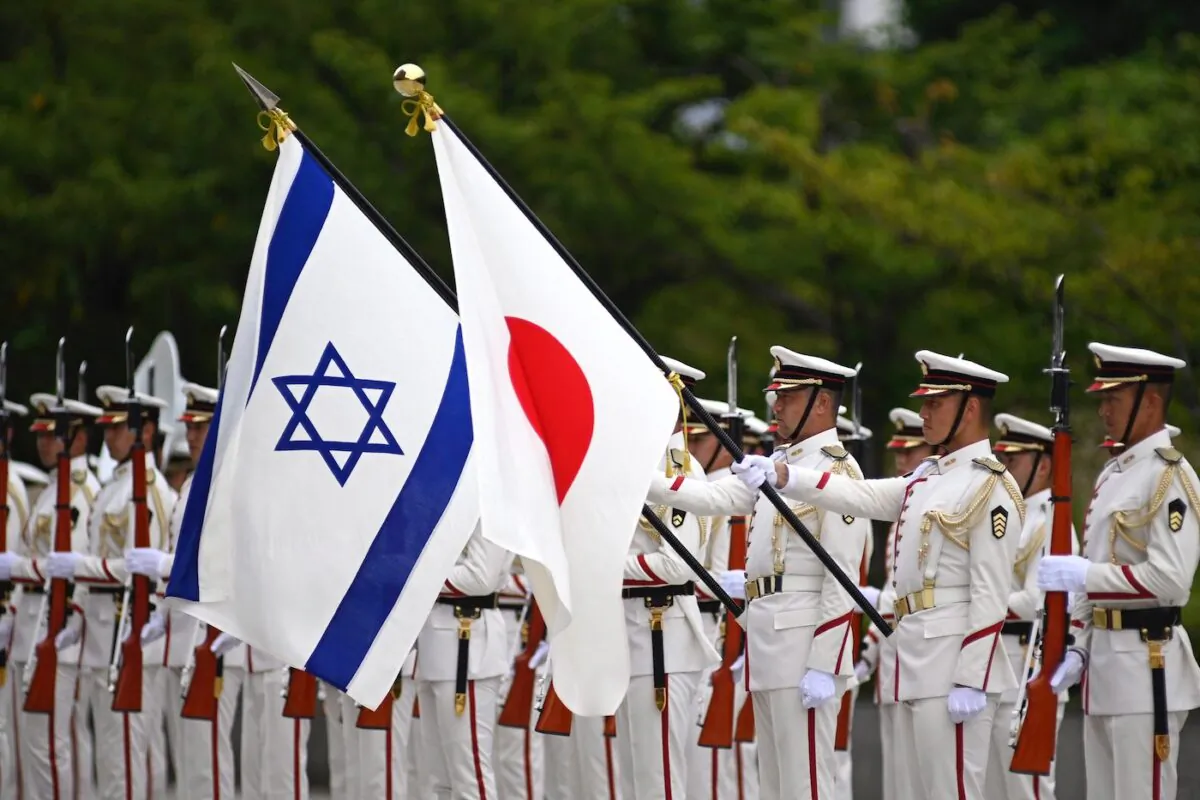
Japan and Israel signed a bilateral defense memorandum on Aug. 30 to bolster cooperation in technology and information sharing amid growing concerns over regional instability.
The agreement was made during a meeting between Japanese Defense Minister Yasukazu Hamada and his Israeli counterpart, Benny Gantz, in Tokyo, according to Japan’s Defense Ministry.
Hamada expressed Japan’s strong opposition to any unilateral attempt to change the status quo by force, citing concerns over the Russia–Ukraine war and rising tensions in the East and South China seas.
He told Gantz that Japan’s efforts to uphold a “free and open Indo-Pacific” would contribute to the development of the Middle East. The two ministers reaffirmed their cooperation to promote regional peace and stability.
Japan didn’t elaborate on the agreement’s details, but Gantz said it will allow the exchange of technology and information between the two countries. He also met with Japan’s foreign affairs minister during his two-day visit.
I was honored to be hosted by my Japanese counterpart, Minister Hamada at the @ModJapan_en. We signed a Memorandum of Defense Cooperation, which will enable Japan and Israel to expand defense ties in the defense equipment, technology and military arenas. pic.twitter.com/PhFpYn7oMy
— בני גנץ – Benny Gantz (@gantzbe) August 30, 2022
“Israel and Japan celebrate 70 years of diplomatic relations this year and we will work to strengthen and deepen security cooperation,” Gantz wrote on Twitter.
Boosting Military Cooperation
Japan has increased its military cooperation with its allies in the Indo-Pacific region and engaged in multinational drills, including the U.S.-led live-fire drill—Super Garuda Shield exercise—in Indonesia on Aug. 12 involving 14 nations.
The Japanese Maritime Self-Defense Force recently conducted its first joint navy drills with Tonga and Fiji to bolster defense cooperation with both island nations.
Japan is concerned about Beijing’s growing military presence in the East and South China seas, including in waters near Taiwan, where China increased military activities following U.S. House Speaker Nancy Pelosi’s visit to Taiwan.
“Combined with a lack of transparency of its national defense policies and military forces, recent military activities by China have become a strong concern for our nation, the region, and the international community,” Hamada said on Aug. 10, Kyodo News reported.
Israel, a strong U.S. ally, faces threats from Iran-backed groups and terrorist organizations, including Hamas, Palestinian Islamic Jihad, and ISIS-Sinai.
On July 14, a White House official said that U.S. President Joe Biden and Israeli Prime Minister Yair Lapid would sign a new joint statement reaffirming their bilateral security ties, saying the U.S. commits to “never allow Iran to acquire a nuclear weapon and to address Iran’s destabilizing activities, particularly threats to Israel.”
Raven Wu contributed to this report.
 Friends Read Free
Copy
Facebook
Tweet
Friends Read Free
Copy
Facebook
Tweet