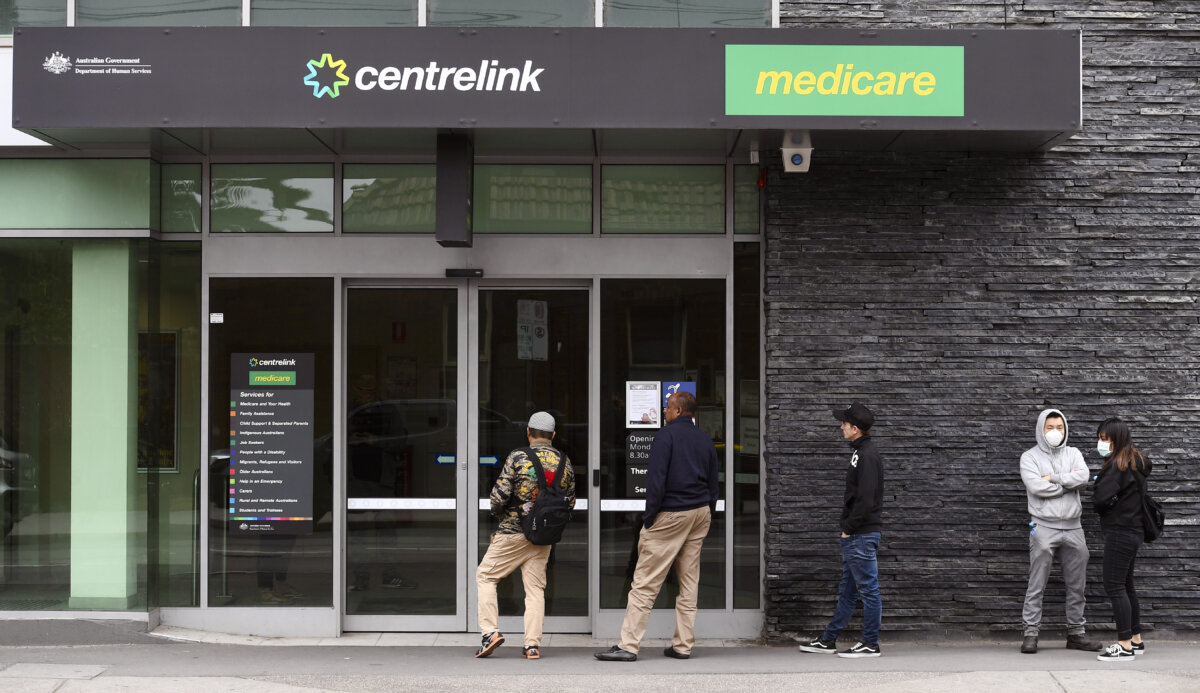

Australia’s unemployment rate remained steady at 4.1 percent in May, marking the third consecutive month without change, according to the latest figures from the Australian Bureau of Statistics (ABS) released on June 19.
The result comes even as total employment dropped slightly by 2,000 people.
Despite this monthly dip, employment remains 2.3 percent higher than in May 2024, outpacing the pre-COVID 10-year average of 1.7 percent.
“This fall in employment, combined with a drop in unemployment of 3,000 people, meant that the unemployment rate remained steady at 4.1 per cent for May,” said ABS head of labour statistics Sean Crick.
While total workforce participation edged down, the employment-to-population ratio fell by 0.1 percentage point to 64.2 percent, and the participation rate dipped to 67.0 percent. The female employment hit a historic high. The female employment-to-population ratio rose 0.1 points to 60.9 percent, setting a new record.
Total hours worked also rebounded by 1.3 percent in May, reversing earlier declines caused by Easter holidays and severe weather disruptions.
Fewer People Looking for Work, Smaller Job Gains
Though the headline unemployment rate appears stable, signs of cooling momentum were evident in other key labour market indicators.
The participation rate, which tracks the proportion of working-age Australians who are employed or actively looking for work, fell by 0.1 percentage points to 67.0 percent, suggesting fewer people were engaging with the workforce.
Similarly, the employment-to-population ratio declined to 64.2 percent, reinforcing the signal that overall labour market activity has slightly weakened.
Another concern is that monthly hours worked—a strong proxy for labour demand—have been rising more slowly than job growth since early 2025.
In May, hours worked increased just 0.1 percent in trend terms, indicating businesses may be cautious about adding hours or staff.
“These modest increases in hours worked suggest that while employment is growing, it’s not yet translating into significantly more work for existing employees,” Crick said.
Underemployment Eases, One in Ten
Still Underutilised
On a more positive note, underemployment—which includes people who want more hours than they are currently getting—fell slightly to 5.9 percent.
That is nearly one percentage point lower than May 2024, and 2.8 points below the March 2020 level when the pandemic hit.
The underutilisation rate, which combines both unemployment and underemployment to capture all unused labour capacity, dropped to 9.9 percent—but still means roughly 1 in 10 working-age Australians are not fully engaged in the labour market.
In trend terms, employment increased by 28,000 people in May and remains 2.3 percent higher than a year ago. However, monthly growth in hours worked remains weaker than job growth.
Private Sector Hiring Lifts, but Job Ads Remain Below Peak
Data from Seek showed a 1.8 percent increase in job ads in April after two months of declines. Queensland led the rebound with 7.6 percent growth, and South Australia’s listings were 5.6 percent higher than the same time last year.
Hospitality and tourism roles jumped 9.8 percent, likely due to seasonal hiring. Healthcare and medical jobs rose 3.8 percent, recovering from earlier downturns.
However, SEEK senior economist Blair Chapman noted the job market remains volatile.
“Looking through the recent month-on-month noise, we continue to see job ads stabilise in line with our expectations,” he said.
The annual rate of job ad decline eased to 5.7 percent—the smallest drop since December 2022—suggesting conditions may be stabilising, but are still weaker than during the peak labour demand in 2022.
 Friends Read Free
Copy
Facebook
Tweet
Friends Read Free
Copy
Facebook
Tweet