
In a last-minute dash before the year’s last parliamentary session ends, Labor and the Greens have struck a deal that should ensure passage of new environmental protection laws through the Senate.
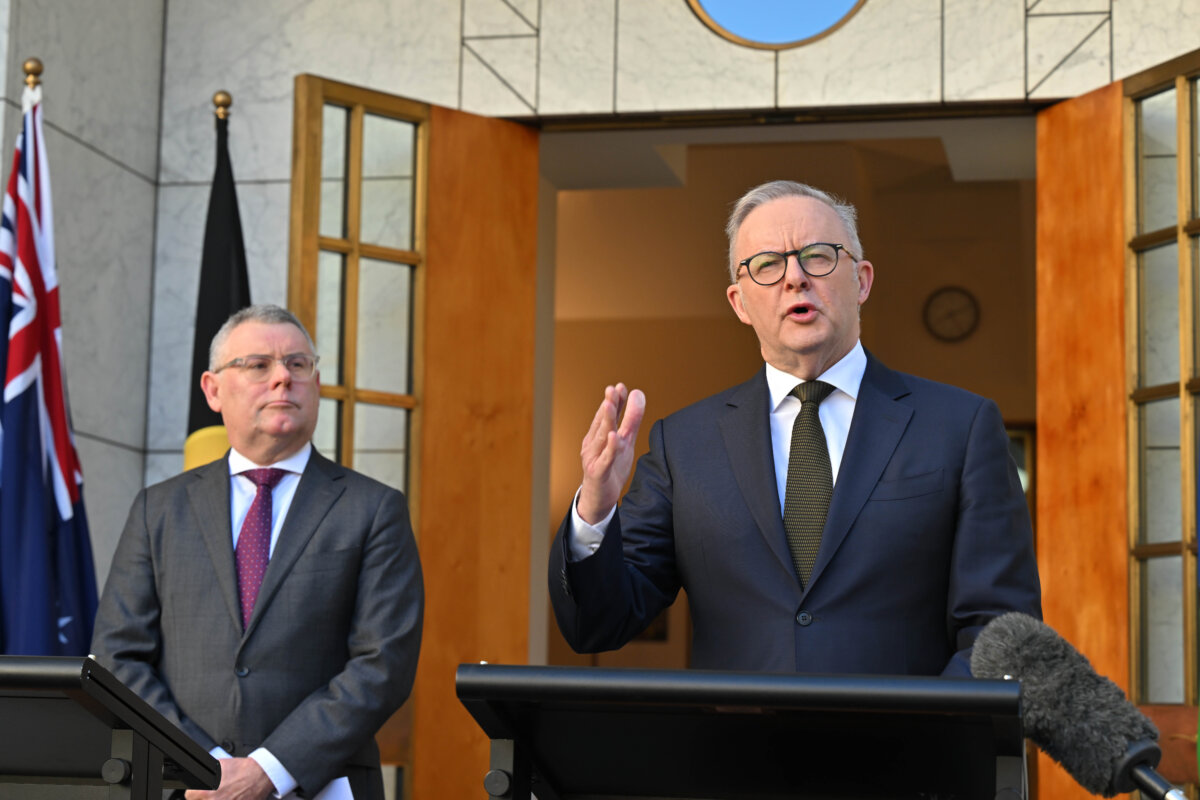
“Today, I can announce our government’s landmark environmental law reforms will pass the parliament today, heralding a new era for the environment and productivity in Australia,” said Prime Minister Anthony Albanese outside Parliament on Nov. 27.
Standing alongside him, Environment Minister Murray Watt said the Environment Protection Reform Bill would deliver faster approvals for industry.
“These reforms do respond to the major requests of the business community, which are all designed to speed up decision-making and lift productivity by giving business faster ‘yeses’ and faster ‘nos.’”
Greens leader Larissa Waters confirmed the deal from the Senate floor, saying she was “so pleased that after tough negotiations with the government, that the Greens were able to secure some important improvements to this package.”
Concessions Won by the Greens
As part of the agreement, the exemption for high-risk land clearing, which means more clearing activities—especially of older or sensitive vegetation—will now require federal approval instead of going under “continuing use” rules.
It will also sunset the carve-out for regional forest agreements, ending the long-standing special treatment that allowed native forest logging. Within 18 months, these agreements will need to meet tougher national standards or lose their exemption.
A third change is mandatory carbon disclosure for large-emitting projects, requiring big mines and industrial developments to publicly report their expected carbon emissions when seeking federal approval.
This adds transparency but does not automatically block projects.
The Greens also secured continued federal control of the water trigger for coal and gas operations, meaning Canberra—not the states—will keep the final say on whether these projects pose risks to rivers, aquifers, and groundwater.
Albanese said this was necessary because “the water table in areas like the Murray-Darling Basin obviously goes across state boundaries, and therefore the water trigger is absolutely essential.”
As part of the package, Albanese announced a $300 million forestry growth fund to support the industry as it adjusts to the higher standards.
Waters said the reforms deliver changes environmental groups have pushed for decades, including finally ending the broad forestry exemptions under federal law.
“Within 18 months, those regional forest agreements will have to meet higher standards than they ever have before, and logging operations everywhere will need to meet the new tests in these revised laws,” she said.
A New Federal Environmental Agency
The bill also creates a national environment protection agency for the first time—alongside existing state agencies and departments—with powers to monitor compliance and enforce environmental standards. Approval powers remain with the environment minister.
A new set of national environmental standards will guide assessments and clarify grounds for early rejection of proposals.
Labor has argued the changes will unblock delays that have seen major assessments blow out to more than 100 weeks.
The reforms adopt key recommendations from Graeme Samuel’s 2020 review (pdf), which warned the decades-old framework was failing nature and the economy.
Previous attempts to rewrite the laws collapsed when Sussan Ley was minister under the Morrison government, and again during the last term when Tanya Plibersek’s negotiations fell apart following late objections from WA Premier Roger Cook.
Albanese said he had spoken with Cook about the current agreement but did not elaborate.
Coalition Says laws ‘Rammed Through’ for End of Year
Liberal Senator Jonathon Duniam, who represented the Coalition in negotiations, condemned the deal as rushed.
“The legislation that’s before the chamber, which will now be rammed through in record time,” he said. “Of course, a pattern of behaviour at the end of every sitting year.”
Duniam accused the Greens of backing a bill, saying, “Despite significant wins for nature, the bill is still woefully short of what the climate needs.”
He said the Greens had previously insisted an existing Senate inquiry into the law run until March, and added that the Coalition had been willing to negotiate a measured alternative.
Industry Largely Disappointed
The Business Council of Australia (BCA) reacted sharply arguing the Bill misses a chance for Parliament to deliver durable reforms that can unlock investment and speed up major projects.
BCA Chief Executive Bran Black said the organisation will closely monitor how the changes are implemented and will work with the government over the coming year to ensure the promised productivity gains are realised.
“We have always said a sensible, stable reform backed by both major parties is what we need if Australia is to deliver the energy and renewables, critical minerals and infrastructure projects that underpin productivity and living standards,” Black said.
The Minerals Council of Australia labelled the outcome “inferior and disappointing,” with CEO Tania Constable warning that new emissions disclosure rules would “increase red tape.”
The National Farmers’ Federation said it was “bitterly disappointed” and the Bill still lacked clarity on how high-risk land clearing would be regulated.
It argues the promised “closer controls” on “high-risk land clearing” are vague and needs urgent clarification.
Lowering regrowth thresholds under the longstanding “continuing use” rule, it warns, will harm the environment, heighten bushfire risks, and disrupt routine vegetation work essential for productivity and weed control.
The NFF says the proposal shows a poor grasp of agricultural practice.
The Property Council, however, welcomed the overhaul.
“A broken system without friends is behind us … Large-scale housing projects that turn the dial on national supply will no longer languish in years-long approval queues.”
Last week, a coalition of 26 major industry groups warned the draft law could be slower and more confusing unless key sections were rewritten, citing concerns about vague terms such as “irreplaceable” and “seriously impair.”
 Friends Read Free
Copy
Facebook
Tweet
Friends Read Free
Copy
Facebook
Tweet