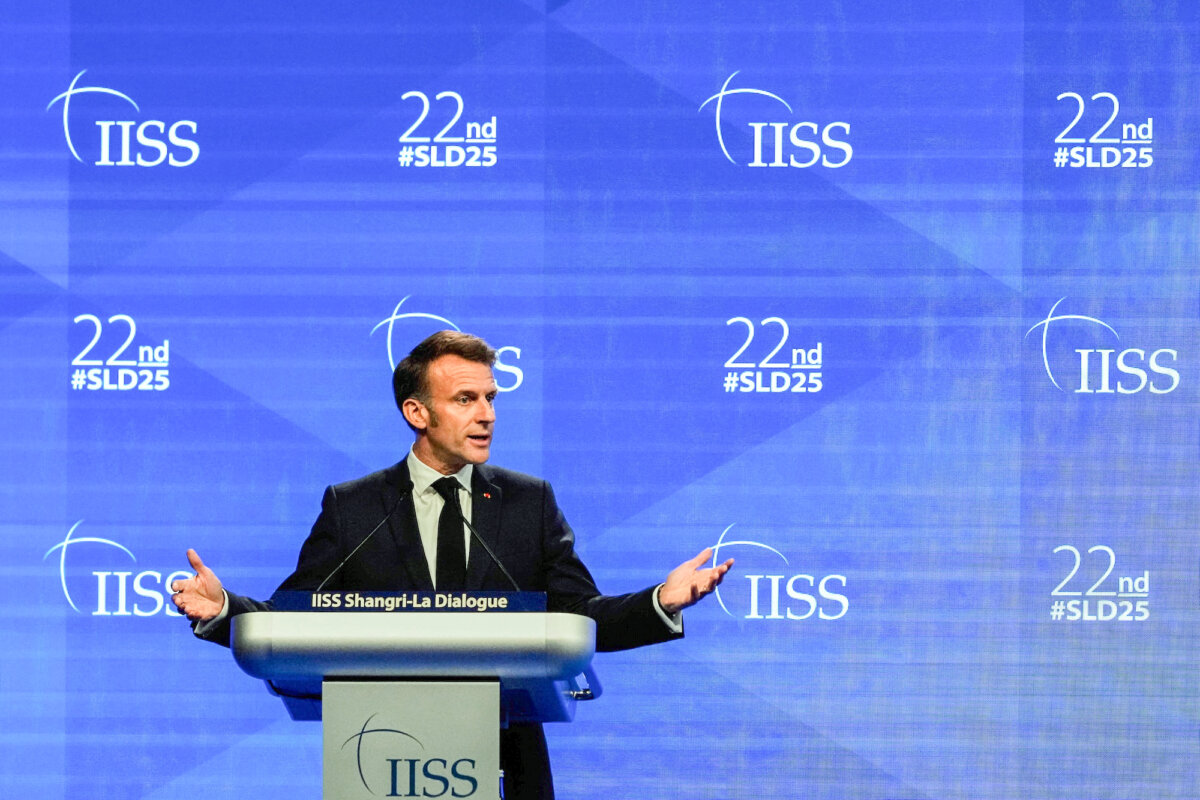

French President Emmanuel Macron said on Tuesday that he would push for the European Union to ban social media for children under the age of 15.
He added that if Brussels could not be moved to implement such a ban, he would institute one in France.
The move comes in the wake of a stabbing at a middle school in Nogent, Haute-Marne, eastern France, which left an employee at the school dead earlier on Tuesday.
Following the incident, police questioned a 14-year-old student over the killing of the 31-year-old worker, which occurred while a bag check for weapons was being conducted on the premises.
Macron told French television just hours after the stabbing that he would be pushing for regulation to stop children using social media in Brussels, and hoped to see results in the coming months.
“If that does not work, we will start to do it in France. We cannot wait,” he told France 2.
Macron argued that social media was one of the factors to blame for violence among young people.
After the interview, Macron said the regulation he was advocating for was supported by experts in the field.
“This is a recommendation from the Screen Commission experts,” he wrote on social media platform X. “I support banning social media before the age of 15. Platforms have the ability to verify age. Let’s do it.”
The Screen Commission was a body set up by Macron in January 2024 to evaluate the impact of exposure to screens on French Children.
The stabbing was the second in a matter of months in France.
In April, a high school student stabbed four other students at his school in Nantes, killing one and wounding three others before being arrested.
Prime Minister Francois Bayrou told parliament the incident was not an isolated case and said the government also plans to begin trialling security gates at school entrances.
“We cannot remain indifferent and watch this advancing wave with our arms lowered,” he said.
“The government intends to move towards experimenting with security gates at the entrance to schools.”
Bayrou said he wanted to ban certain bladed articles, as currently “a certain number of these knives are not considered weapons.”
Fatal violence in schools not only occurred in France on Tuesday, with the school stabbing in Nogent happening the same day as a deadly school shooting in Graz, Austria, that resulted in the deaths of nine people.
Macron’s calls for restrictions on social media use for children are not alone in the world, with many countries either implementing or considering similar measures to curb youngsters’ habits online.
Along with France, across Europe, Spain, Greece, and Denmark have all argued for an age of “digital majority” to be introduced. Most are calling for the age to be set at 15, while Madrid has suggested 16.
Further afield, in November 2024, the Australian Parliament passed a law banning children under 16 from using social media, the first of its kind in the world.
The law will make platforms including TikTok, Facebook, Snapchat, Reddit, X, and Instagram liable for fines of up to 50 million Australian dollars ($32.6 million) for failing to prevent children below that age threshold from holding accounts.
New Zealand and Norway are considering similar laws, as is the Canadian province of Quebec.
In the United States, legislation that would have banned anyone under the age of 18 from using or creating social media accounts in Texas stalled in the Senate last month after lawmakers failed to vote on it.
Utah passed a similar bill earlier this year. California is also set to make it illegal for social media platforms to knowingly provide addictive feeds to children without parental consent, beginning in 2027.
Florida passed a similar law last year banning social media accounts for children under the age of 14 and requiring parental permission for 14- and 15-year-olds, but a federal judge barred state officials from enforcing it earlier this month while a legal challenge continues.
 Friends Read Free
Copy
Facebook
Tweet
Friends Read Free
Copy
Facebook
Tweet