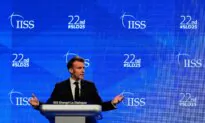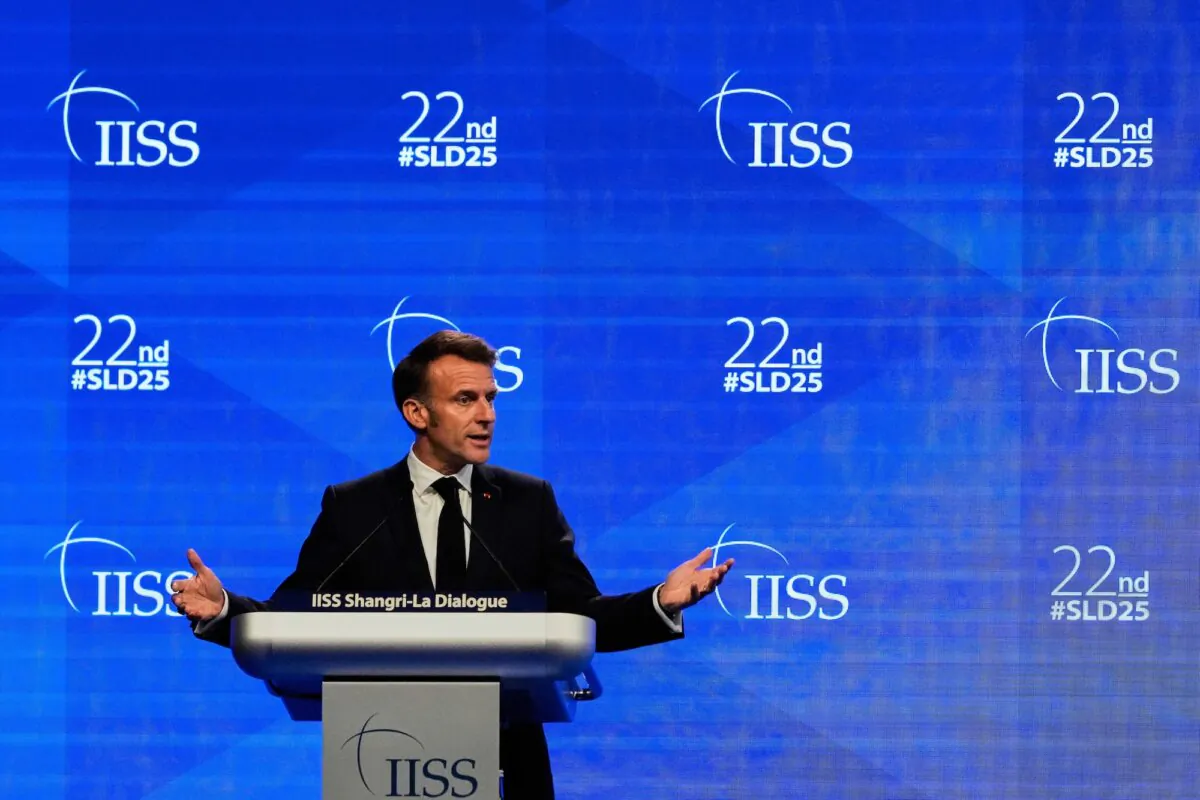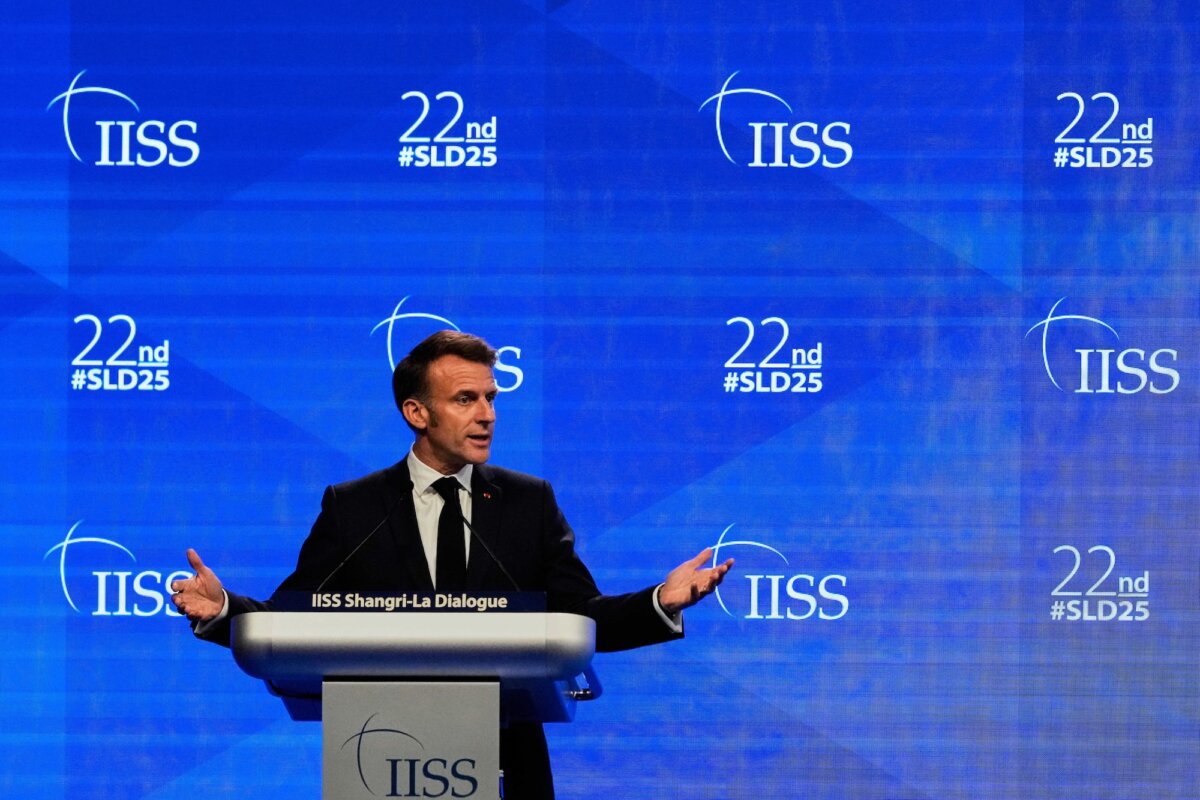

French President Emmanuel Macron said on May 30 that growing tensions between the United States and China threaten to destabilize the “global order” and urged Asian and European countries to form a “coalition of action” to uphold shared principles and push back against coercive behavior by major powers.
Speaking at the Shangri-La Dialogue defense summit in Singapore on May 30, Macron described competition between the United States and communist China as the greatest geopolitical challenge facing the world today—and said smaller countries should not be forced to take sides.
“The time for non-alignment has undoubtedly passed, but the time for coalitions of action has come and requires that countries capable of acting together give themselves every means to do so,” he said.
While acknowledging the shifting global landscape, Macron suggested that France wants to maintain strong relationships with both Washington and Beijing. He said Europe and Asia share a common interest in preventing the erosion of international norms and institutions established after World War II.
“I will be clear, France is a friend and an ally of the United States, and is a friend, and we do cooperate—even if sometimes we disagree and compete—with China,” he said. “We are neither China nor the U.S.; we don’t want to depend on any of them.”
Macron’s three-nation Indo-Pacific tour—including his stop in Singapore—reflects France’s push to boost strategic and commercial ties in the region while complementing U.S. efforts to confront global challenges.
France, which has 1.6 million citizens in overseas territories in the Indian and Pacific oceans, has recently expanded its military presence, underscoring its status as a resident Indo-Pacific power.
The French leader’s remarks come amid rising friction in the Indo-Pacific, where China’s military buildup, territorial assertiveness, and deepening ties with Russia have unsettled many regional players.
At the same time, the United States has reaffirmed its commitment to a “free and open Indo-Pacific,” urging allies to bolster cooperation in maintaining peace and freedom of navigation in strategic waterways such as the Taiwan Strait and South China Sea.
U.S. Defense Secretary Pete Hegseth, also in Singapore for the summit, said the Trump administration’s posture is aimed at deterring a Chinese invasion of Taiwan—an island the Chinese regime claims as its own. Beijing has not ruled out the use of force to annex the self-ruled democracy.
“We seek no conflict with anybody, including the communist Chinese,” Hegseth told reporters before boarding his plane for Singapore.
“We will stay strong for our interests. And that’s a big part of what this trip is all about.”
While the European Union has taken a more trade-oriented approach to the region, several member states have increasingly participated in security operations. France recently concluded a five-month deployment of a carrier strike group through the region in support of freedom of navigation missions.
Reuters and The Associated Press contributed to this report.
 Friends Read Free
Copy
Facebook
Tweet
Friends Read Free
Copy
Facebook
Tweet