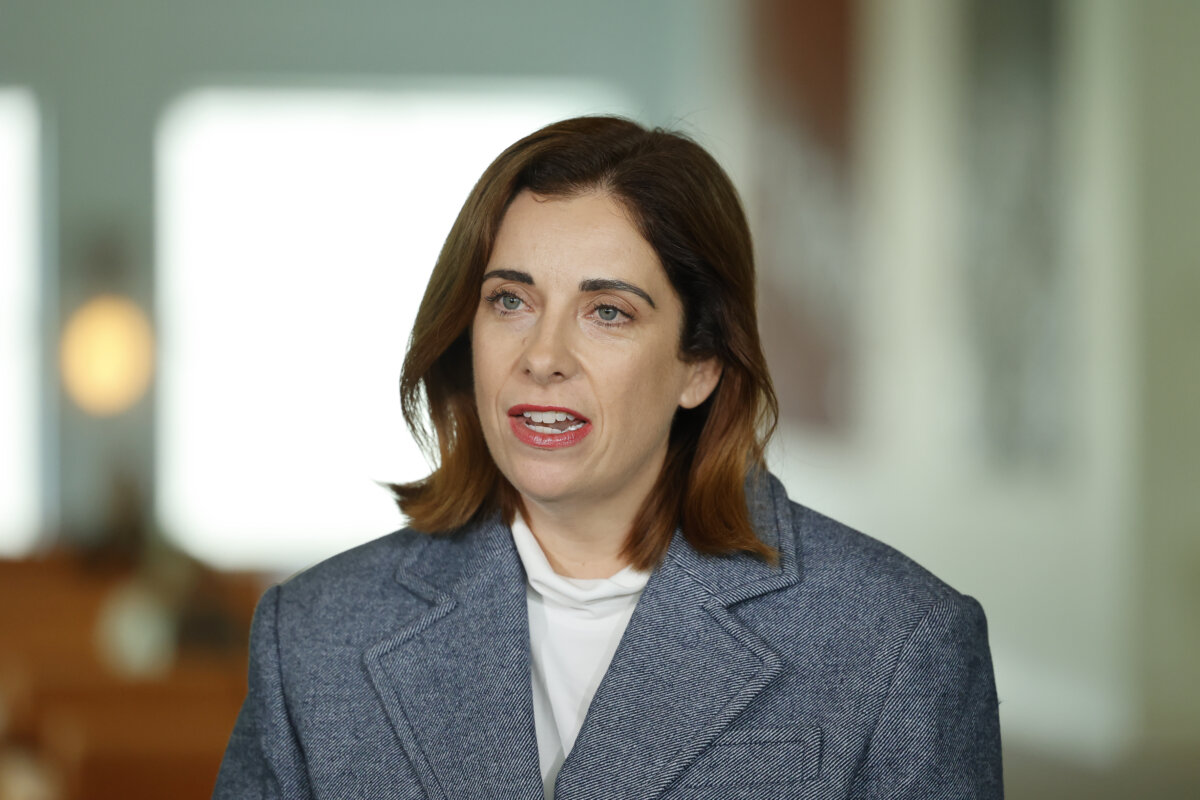
Communications Minister Anika Wells has detailed cases of alleged online abuse involving children while defending her government’s impending digital “duty of care” bill.
Speaking at the National Press Club on Oct. 15, Wells outlined two cases she said had been brought to her attention as minister.
“Let me tell you about a 14-year-old girl in Western Australia,” she said.
“An adult found her on Roblox, praised her gameplay. He kept her company. He suggested they move across to [online platform] Discord. He asked her for photos. He blackmailed her. He told her to write his name in her blood, to self-harm, and to live-stream her suicide.”
The case, she said, was brought to her attention recently.
Meanwhile, in another incident, Wells says a 13-year-old boy was lonely and ended up falling in with a virtual crowd of artificial intelligence (AI) chatbots, some of which steered him towards self-harm.
Wells said the eSafety Commissioner estimates around one in five Australian children using AI had a harmful interaction.
What’s in the Digital Duty of Care Laws?
On Sept. 8, the federal government first released a draft of its proposed Digital Duty of Care laws, aimed at shifting greater responsibility for online safety onto digital service providers.
The proposed laws were introduced into the House of Representatives on Oct. 15 and consolidate a series of voluntary industry codes.
The proposed reforms would require online services to identify and mitigate risks of harm to users, establishing minimum safety standards for their platforms.
Under the proposed “My Feed, My Way” initiative, social media users aged 16 and over would be able to choose whether their default feed includes personalised content recommended by an algorithm or shows content only from accounts they follow.
Digital service providers would also be required to assess risks on their platforms, and implement measures to identify harm and document their responses.
The eSafety Commissioner Julie Inman Grant would oversee compliance and have powers to enforce the proposed requirements.
The draft legislation would also expand the eSafety Commissioner’s powers to issue removal notices for certain content, including nudifying apps and websites.
“Some have questioned why we need to shift from the current codes and standards to a digital duty of care,” Wells said.
“There are currently 17 codes and standards. This old-fashioned approach, where industry write their own rules, and these rules are not subject to parliamentary scrutiny, doesn’t stack up against the harms that we are seeing online.”
The proposed changes come off the back of the government’s under-16s social media ban, which it says has demonstrated an improvement in sleep, exercise and mental wellbeing outcomes for young Australians.
Power to Define Harm Axed … For Now
During her speech, Wells said the government had heard concerns “loud and clear” about plans to give the minister the power to define “new harms.”
The provision will be axed.
Critics of the condition were concerned it, in future, be used to silence political opposition by declaring rivals as “harms.”
“In response to concerns we heard during the exposure draft consultation, and to make this abundantly clear, we have removed the ministerial rulemaking power to define new harms in the final bill,” Wells said.
“New harms can be added by parliament through legislative amendment.”
Power to Create Fake Accounts
The government’s proposed legislation also provides authority to create so-called “sock puppet” accounts—fake online identities—to test whether Big Tech companies are regulating content. These sock puppets can also use AI generated content.
“These test accounts are not policing what people say online,” Wells said.
“They give the eSafety Commissioner the ability to go undercover and make sure Big Tech is complying with the law.”
US Investigator Attends Press Club Amid Concerns
U.S. academic and investigator Michael Shellenberger, who is in Australia, attended the Press Club address and continued airing concerns about fake profiles.
He is concerned they can be used to propagate government views, pointing out that the “legislation says in black and white that the eSafety Commissioner can use them in unlimited ways for ‘educational’ and ‘promotional’ purposes.”
Shellenberger said he asked the minister if there was any guarantee the powers would not be misused in anyway.
“She refused to answer,” he claimed.
“A man who said he was from the National Press Club stepped in front of me and said I could interview her afterward.
“But that wasn’t possible because they rushed her out the back to avoid any difficult questions.”
Shellenberger also raised concerns about Well’s statement that similar schemes were operating in the UK, France, and Spain.
Meanwhile, One Nation leader Pauline Hanson has called for the bill to be ditched.
“They also want the ability to use hordes of AI powered government bots to feed you propaganda and watch what you do and watch what you do online,” Hanson said.
“There is no amendment that can fix their Digital Duty of Care bill.”
 Friends Read Free
Copy
Facebook
Tweet
Friends Read Free
Copy
Facebook
Tweet