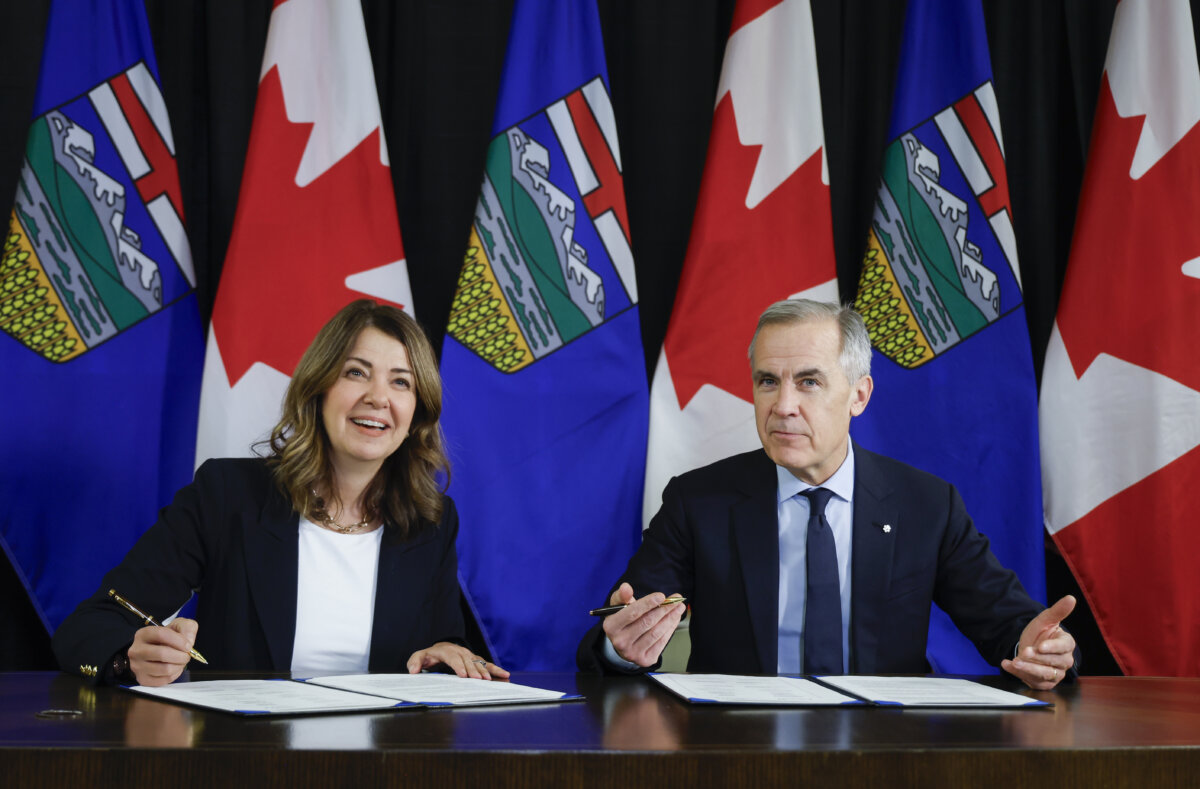

The deal inked by Prime Minister Mark Carney and Alberta Premier Danielle Smith late last month that paves the way for a new West Coast pipeline is largely supported by Canadians, a newly released poll suggests.
An Abacus Data survey conducted within 24 hours of the agreement being signed on Nov. 27 found that 55 percent of Canadians polled support the concept of a pipeline to the West Coast, while 18 percent oppose it. Fifteen percent of the 1,802 adults surveyed said they were neutral on the issue and 12 percent were uncertain about their stance.
Abacus Data CEO David Coletto said awareness of the memorandum of understanding (MOU) between Ottawa and Alberta was “relatively strong,” as 58 percent of those surveyed reported having heard about the agreement. He noted awareness was particularly high in Alberta and British Columbia.
“Support is overwhelming among Alberta respondents and Conservative voters, but it is not confined to them,” he wrote in a Dec. 3 post on the findings. “Support outpaces opposition among 2025 Liberal voters by roughly two to one. In every region of the country, more people support than oppose the concept.”
Support for the pipeline was most prominent in Alberta, with a rate of 74 percent, significantly exceeding that of the other provinces. Ontario ranked second with 59 percent support, closely trailed by Saskatchewan and Manitoba, both at 58 percent, and Atlantic Canada at 55 percent.
Even in British Columbia, where there has been more opposition to pipelines, 53 percent expressed support for the idea, while 30 percent were opposed, the poll found. The remaining 18 percent were either neutral or uncertain.
Support was lowest in Quebec at 42 percent, and opposition was recorded at 26 percent. The rest of the respondents were either neutral or unsure.
Factors in Alberta’s deal with Ottawa, such as a carbon capture pipeline, indigenous co-ownership, and a commitment to achieving net zero by 2050 all garnered greater support than opposition, Coletto noted.
“In short, the package looks like a compromise that many Canadians can live with,” he said. “That does not mean it is risk free. It does help explain why the initial reaction has been relatively soft.”
Consequently, the survey said that the Ottawa-Alberta agreement had minimal influence on the political landscape.
Fifty-four percent of Canadians surveyed said the deal appears to be a valuable trade-off that may yield economic advantages, even if it means rolling back some environmental commitments. Only 24 percent considered the deal made by Prime Minister Mark Carney and Alberta Premier Danielle Smith to be a betrayal of environmental policy and a contradiction of Carney’s previous comments about energy and the environment.
The application for the pipeline is scheduled to be submitted to the newly created Major Projects Office (MPO) on or before July 1, 2026, according to the MOU. This office aims to expedite regulatory approvals for projects recognized as being of national significance by the federal government.
The advancement of a future pipeline project is linked to the establishment of the suggested Pathways Alliance carbon capture project, which aims to compress CO2 into a liquid state, transport it via a pipeline, and store it in a facility located more than 1,000 metres underground.
Top Concerns
Meanwhile, the survey indicated that the escalating cost of living continues to be the top concern by a significant margin, with 64 percent of respondents identifying it as the primary issue in Canada.
The economy, housing, health care, and dealing with U.S. President Donald Trump rounded out the top five concerns for respondents. Each of these issues was identified as a major concern by between 38 percent and 34 percent of people polled.
Climate change and the environment was eighth on the list cited by only 13 percent of respondents as a concern. It came in behind immigration, job security, and crime and public safety.
 Friends Read Free
Copy
Facebook
Tweet
Friends Read Free
Copy
Facebook
Tweet