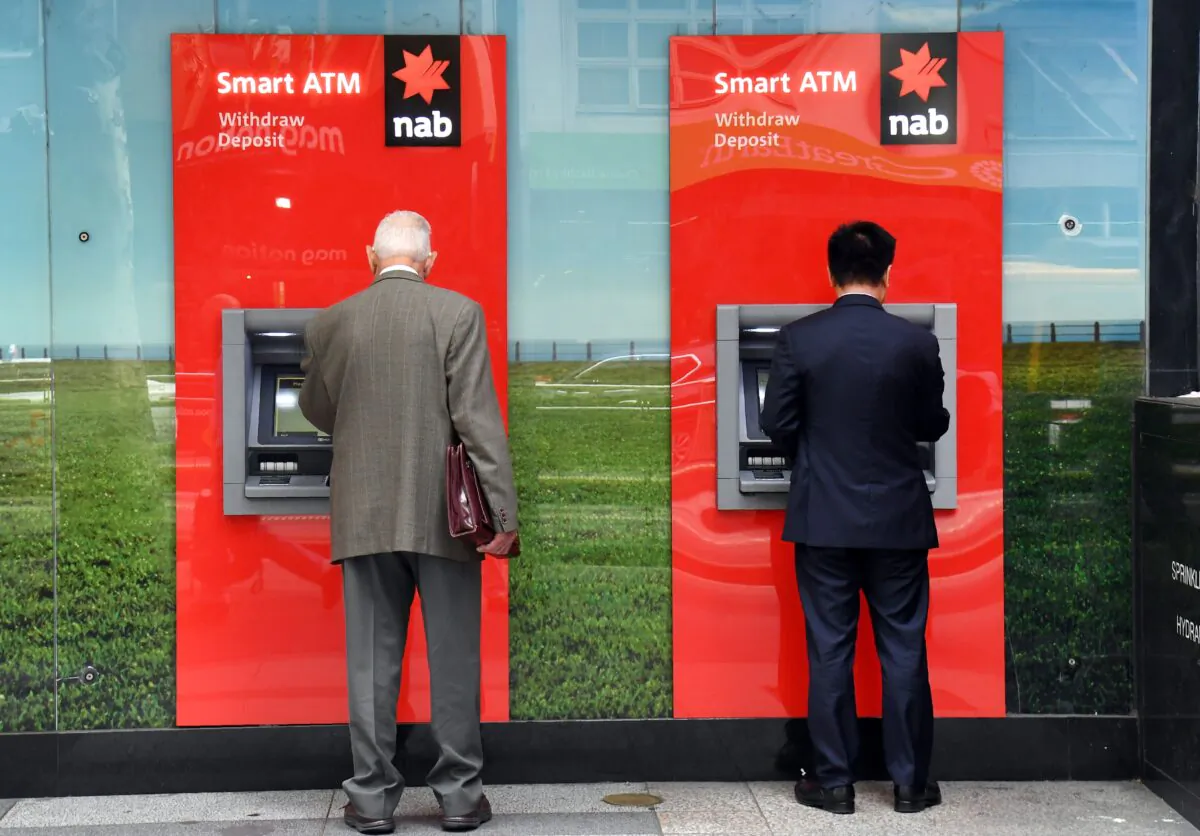

Businesses will need to continue accepting cash or face penalties, under a new bill being pushed to get physical tender alive.
The move comes as Australians increasingly opt for digital payments, and eschew cash-based transactions, which have plummeted over the last two decades.
Meanwhile, a significant number of banks have phased out cash and cheque services in regional and remote areas, with 11 percent of Australia’s bank branches vanishing in 2023, sparking fears that rural communities could be at a disadvantage.
In a bid to halt Australia’s transition—predicted by the Commonwealth Bank to happen as soon as 2026—independent federal Members Andrew Gee (Calare), and Bob Katter (Kennedy) introduced the private member’s bill, Keeping Cash Transactions in Australia Bill 2024.
“Australians should have a choice as to how to spend their hard-earned dollars,” Mr. Gee said in a media release.
What Does The Bill Entail?
The bill (pdf) would require businesses operating in face-to-face settings to offer, and accept, cash payments for transactions that do not exceed $10,000. Businesses that don’t comply could face maximum civil penalties of $5,000 for $25,000 for companies.
The law would not apply for payment that would pose a reasonable security risk for the person, would violate another law, or could be contrary to government health advice.
Currently, the Australian Competition and Consumer Commission allows businesses to choose what type of payment they will accept for a transaction, as long as they make customers aware of this before the transaction takes place.
Massive Bank Surcharges
Speaking at Parliament, Mr. Gee said that Australians are losing about $1 billion a year in surcharges when they pay by card, adding that many businesses “don’t like those merchant fees and surcharges either.”
According to an analysis by the Reserve Bank of Australia, Australians are losing $960.26 million a year in bank surcharges.
“Many Australians are now understanding that banks and financial institutions charge merchant fees for card transactions, which can then be passed on to consumers,” he said.
“It’s an insidious tax that is added to transactions just for tapping a card.”

Many senior Australians find managing accounts and cards online “stressful and confusing.”
Cash is also “vital” during power and internet outages, which tend to happen in the countryside, he added.
“In many regional and rural areas, reliable internet access does not exist,” Mr. Gee noted. “Cash remains a dependable means of exchange that does not rely on electricity or internet access.”
In a video on Facebook, he asked, “How are we going to teach our children financial literacy and the value of money if they don’t even know what money is?”
“It’s a matter of choice. It’s a matter of freedom.”
Privacy is another issue, as some people “just don’t want corporations knowing every single thing they buy,” Mr. Gee noted.
Concerns About Centralisation Of Power
The sentiment was echoed by Mr. Katter, who warned a shift to a cashless society means Australians would “relinquish our control to a handful of CEOs who run the banks.”
He said this centralisation of power is a “direct threat to individual freedoms.”

“Imagine a scenario where you cannot buy a loaf of bread without the bank’s permission. This is not a dystopian fantasy; it is a very real possibility if we allow cash to disappear,” he said in the media release.
He added that removing cash from the equation would exacerbate social inequality and marginalise vulnerable groups, such as elderly citizens, those in remote areas, and individuals without the means or skills to navigate digital platforms.
Some Argued Cashless Society Has Benefits
However, some have argued that the move to a cashless society is inevitable as many countries such as Sweden, Finland, the UK, China, Australia, Japan, and Singapore are among the frontrunners in digital payments.
Meanwhile, Angel Zhong, associate professor of finance at RMIT University, said the “astonishing speed at which Australians have embraced digital payments places the country among the top users of cashless payments globally, surpassing the United States and European countries.”
She argued government legislation is important to reduce the risk of fraudulent activities and money laundering, promote fair competition, and provide data protection.
A cashless society, according to an article published by Walden University in the United States, would enhance convenience, crime prevention, and stability.
“Swiping a credit card or scanning your phone makes buying things quick and simple,” the article noted.
“It’s also convenient for retailers. They don’t have to deposit as much cash every day and can more easily balance their books, since electronic-transfer-based sales can immediately and seamlessly enter computer systems.”
 Friends Read Free
Copy
Facebook
Tweet
Friends Read Free
Copy
Facebook
Tweet