
The Trump administration’s special envoy for peace missions, Steve Witkoff, said on Dec. 21 that the previous three days of negotiations between the United States and Ukraine have been “productive and constructive,” with a focus on timelines and “sequencing of next steps.”
“Our shared priority is to stop the killing, ensure guaranteed security, and create conditions for Ukraine’s recovery, stability, and long-term prosperity,” Witkoff wrote on social media. “Peace must be not only a cessation of hostilities, but also a dignified foundation for a stable future.”
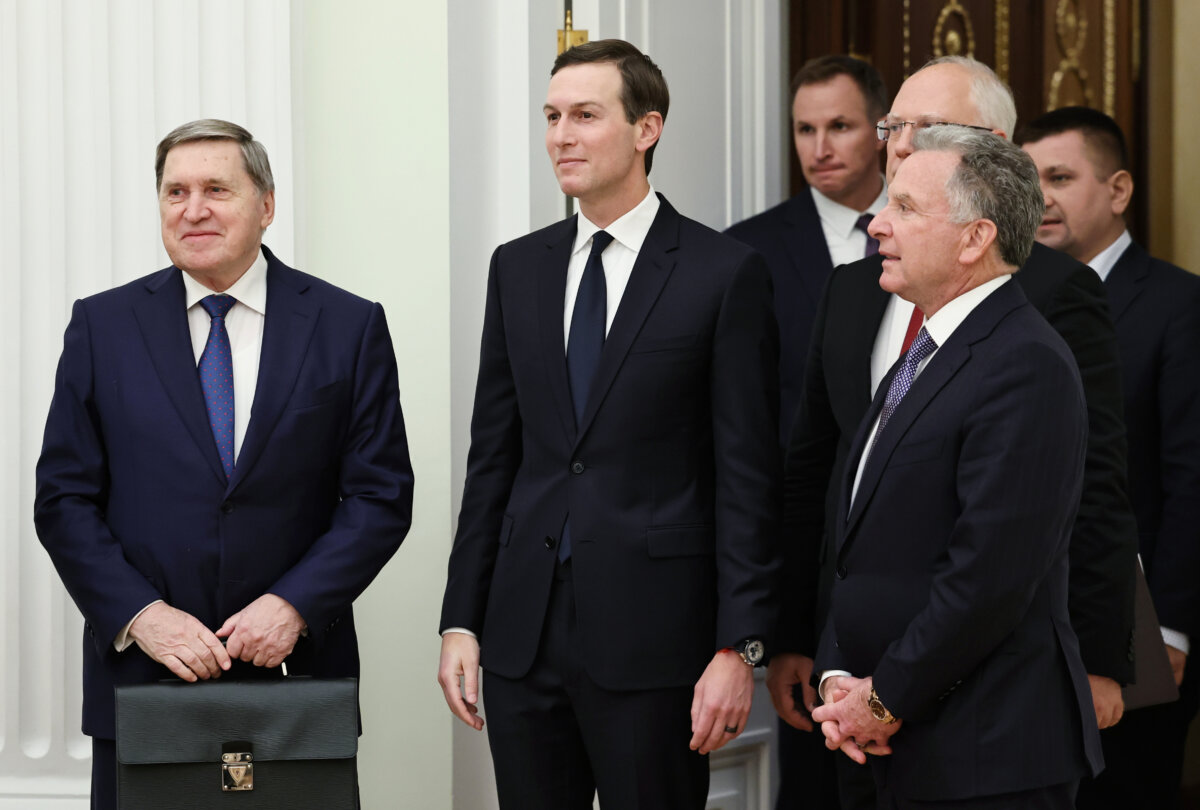
Witkoff said he was joined by U.S. President Donald Trump’s son-in-law Jared Kushner and White House staff member Josh Gruenbaum, while Ukraine’s delegation included secretary of the National Security and Defense Council of Ukraine, Rustem Umerov, and Lieutenant General Andriy Hnatov, the Chief of the General Staff of the Armed Forces of Ukraine.
The U.S. and Ukrainian teams were also joined by key European national security advisers who took part in the negotiations to “align on a shared strategic approach between Ukraine, the United States, and Europe,” Witkoff said.
Additionally, Witkoff described hosting a separate “constructive meeting” in a “U.S.–Ukraine format” in which the teams focused on four key documents outlining further development of Trump’s 20-point plan, aligning interests on a multilateral security guarantee proposal and on a U.S. security guarantee framework for Kyiv, and developing an economic and prosperity deal.
“Ukraine highly values the leadership and support of the United States and the continued close coordination with its partners in the next stages of this important work,” he said.
Kremlin envoy Kirill Dmitriev said on Saturday that peace talks on the United States’ proposed plan to end the Russia–Ukraine war were moving forward constructively with the U.S. and Ukrainian teams in Florida.
Ukrainian President Volodymyr Zelenskyy said the discussions were moving quickly to end the nearly four-year-long war.
“The discussions are proceeding constructively. They began earlier and will continue today, and will also continue tomorrow,” Dmitriev told reporters in Miami on Dec. 20, discussing U.S. President Donald Trump’s proposal to end the war that triggered a trilateral meeting among the Russian, U.S., and Ukrainian teams over the weekend.
The Russian envoy met with Witkoff and Kushner, according to Russian state news agency RIA Novosti.
After seeing the new U.S. proposal, Zelenskky did not offer details but expressed skepticism that the plan could yield new results.
“We had meetings in Turkey in this format, although there was a result—and that was exchanges,” he said, describing the three rounds of negotiations conducted in Istanbul between May and July with U.S. and Turkish mediators.
After the U.S.-proposed plans to end Russia’s war were leaked to the media last month, European and Ukrainian delegations suggested they were too one-sided toward Moscow while expecting Kyiv to concede too much.
In the time since, European and Ukrainian teams have met with Trump’s negotiators to add their proposals to the U.S.-drafted plans, although exact details of those additions have not yet been publicly disclosed.
Kremlin foreign policy aide Yuri Ushakov told reporters in Moscow on Dec. 21 that Russia considers the changes Europe and Ukraine are “trying to make” to the Trump administration’s peace proposals to be counterproductive.
“I am sure that the proposals that the Europeans and Ukrainians have made or are trying to make definitely do not improve the document and do not improve the possibility of achieving long-term peace,” Ushakov said, according to Russian news agencies, although he has not yet seen the details of the proposals on paper.
The Miami meeting among Dmitriev, Witkoff, and Kushner followed a summit on Dec. 19 with U.S., Ukrainian, and European officials.
It’s not yet clear whether Russian President Vladimir Putin will agree to the U.S.-proposed plan to end the war, particularly if changes were added by the European and Ukrainian teams.
The deal will determine how to end Europe’s deadliest war since World War II, the future of Ukraine’s borders and sovereignty, and the interests of Kyiv’s European neighbors.
Zelenskyy said on Dec. 20 that his nation would support the U.S. trilateral negotiations if they yielded more prisoner exchanges and led to more meetings for national leaders.
Russia has accused European leaders of attempting to hinder the peace talks with conditions that are unacceptable to Moscow, while Ukraine and Europe have said Russia cannot be allowed to succeed in attempting what they’ve described as an imperialist annexation of land.
In a Telegram post on Dec. 21, Zelenskyy said the negotiations were “moving forward quite quickly,” and he said the Ukrainian team had been working with the U.S. team in Florida.
Additionally, French President Emmanuel Macron said on Dec. 21 that his office would decide how to proceed “in the coming days” on potential direct talks with Putin.
“As soon as the prospect of a ceasefire and peace negotiations becomes clearer, it becomes useful again to speak with Putin,” Macron’s office wrote in a statement. “It is welcome that the Kremlin publicly agrees to this approach.”
Putin had said that he is willing to hold discussions with Macron if there is mutual political will between the two leaders.
Macron’s office said such dialogue would aim “to contribute to a solid and lasting peace for Ukraine and Europe, in full transparency with President Zelenskyy and [France’s] European partners.”
Bill Pan, The Associated Press, and Reuters contributed to this report.
 Friends Read Free
Copy
Facebook
Tweet
Friends Read Free
Copy
Facebook
Tweet