
The Alberta government has introduced sweeping legislative changes that would reduce timelines for citizen-initiated petitions and place restrictions on political party names.
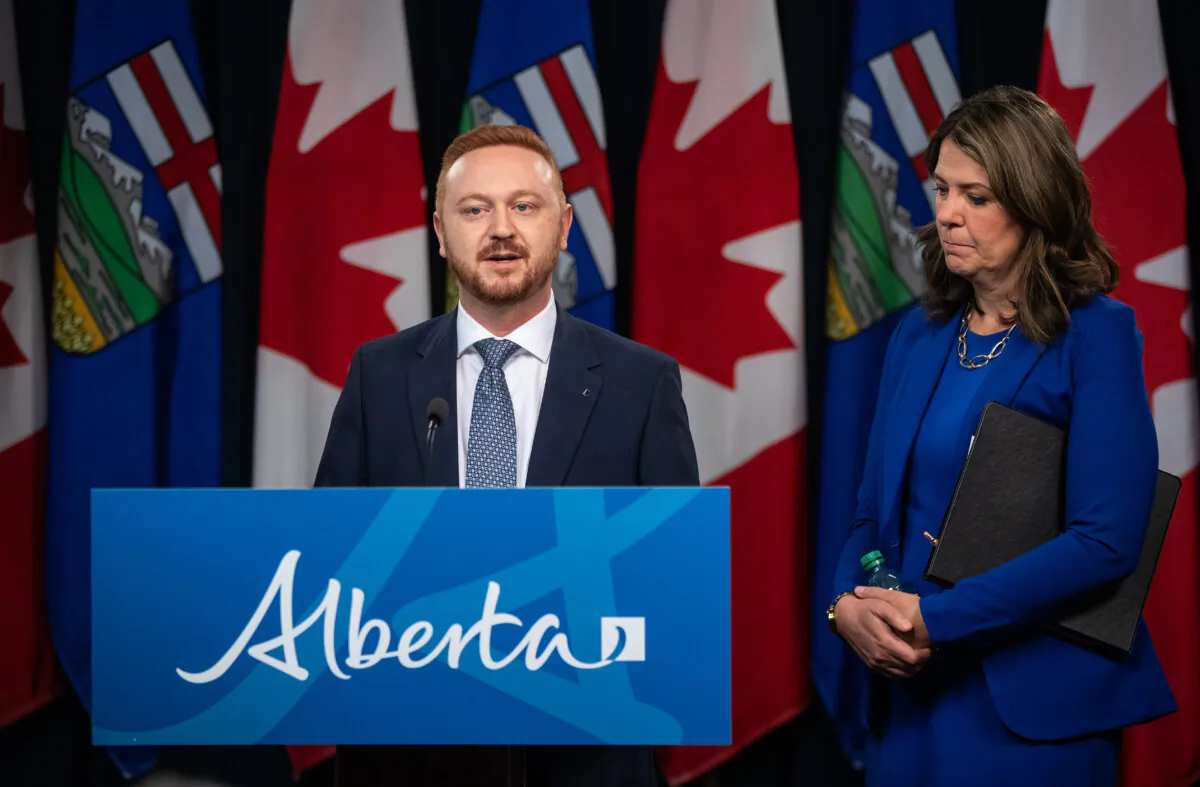
Bill 14, the Justice Statutes Amendment Act, 2025, was tabled in the legislature on Dec. 4 by Justice Minister Mickey Amery. It contains a range of proposed amendments to current legislation that Amery says will facilitate direct democracy, reduce voter confusion, and restore public confidence in the electoral processes.
One proposed change would remove the province’s chief electoral officer’s ability to refer citizen-initiated questions to the courts, transferring that authority to the justice minister. Another would halt any active court cases brought by the chief electoral officer in relation to citizens’ initiatives. This comes as the provincial chief electoral officer has referred a proposed petition question on Alberta’s separation to the court.
Less than a day after the province tabled the bill, Court of King’s Bench Justice Colin Feasby, who was hearing arguments on the constitutionality of the proposed separation-referendum question from the sovereignty advocacy group Alberta Prosperity Project (APP), ruled that the question contravenes the Constitution.
Had the bill passed before the final decision was released, it would have halted the legal review of the APP’s question. The APP filed its application in early July, but the process had been delayed after Alberta’s chief electoral officer Gordon McClure in late July referred the proposed question to the court to assess its constitutionality.
“When a citizen submits a citizen initiative proposal, we want to ensure that process is free from delays,” Amery said during a Dec. 4 press conference.
“We’ve always said that the Act itself was intended to create a permissive environment for Albertans to bring forward their important issues,” he added, referring to the Citizen Initiative Act, which outlines referendum rules.
Bill 14 also proposes an amendment to the Referendum Act establishing that the Alberta government is not required to implement the results of a referendum if doing so would contravene the Constitution.
Commenting on the province’s proposed changes, Feasby said that ending the court case on the constitutionality of the APP’s question before a ruling would have amounted to silencing the court.
“Legislating to pre-emptively end this court proceeding disrespects the administration of justice,” Feasby wrote in a Dec. 5 decision.
“Attempting to change a new law that was amended earlier this year after the many participants in this matter have made significant expenditures of time and money to litigate on an accelerated basis is contrary to the rule of law.”
When asked whether the timing of the amendments was intended to benefit the Alberta independence movement, Amery said on Dec. 4 that the changes are meant to support direct democracy, regardless of the petitioner’s cause or political affiliation.
“I’m clearing the way for all Albertans; I’m clearing the way for anybody from any political stripe or any ideology or any position to be able to put that question to Albertans,” he said. “It is the purest and simplest form of direct democracy, and it has nothing to do with the separatists.”
Heather Jenkins, press secretary to Amery, said on Dec. 5 that the government of Alberta “strongly disagrees” with Feasby’s decision, and that once Bill 14 passes, the judge’s ruling would have no “practical impact.”
“That bill will clarify and simplify the rules relating to citizen-initiated petitions, making the process more efficient, and encouraging citizen participation in our democracy,” Jenkins said.
She added that Feasby’s comments on a proposed legislation that is currently before elected representatives interferes with the principle of the separation of powers and the democratic process.
“Justice Feasby’s decision includes comments that are critical of a bill currently before the Legislative Assembly. The separation of powers is an important constitutional principle. The Assembly has been elected by the people of Alberta to freely debate and pass legislation in the public interest. Judicial statements about the merits of a proposed bill before the legislative branch interfere with well-established democratic processes,” Jenkins said.
Political Party Names
Bill 14 also proposes amendments to the Election Finances and Contributions Disclosure Act that would place restrictions on political party names.
The changes would direct the chief electoral officer to refuse to register a party if its name uses a distinctive word or phrase associated with another political party or predecessor to a registered party, such as “conservative,” “democratic,” “green,” “liberal,” “reform,” and “wildrose,” according to the Bill.
Amery said the measure aims to reduce voter confusion and recognize a party’s track record. He cited the longest-ballot protest during the recent Alberta federal byelection, where Conservative Leader Pierre Poilievre was elected from a list of more than 200 candidates, many of whom were registered under parties with the same or similar names.
“There are people who will, undoubtedly, based on what we’ve seen in the long-ballot protests, try to take the goodwill and the hard work of political movements all across this province, and we think that’s wrong,” he said.
“Within the name, there is a balance that needs to be found between the hard work and the goodwill of established political parties in this province, and the ability to allow them to be recognized for that work, their political ideologies, and positions.”
The new restrictions on political party names also come after the governing United Conservative Party (UCP) filed a lawsuit against two former MLAs, Peter Guthrie and Scott Sinclair, who want to form a party under the Progressive Conservative banner. Guthrie and Sinclair were expelled from the UCP caucus earlier this year.
The UCP says the branding legally belongs to the UCP because the party was created by merging the former Progressive Conservative and Wildrose parties, and that its use would mislead voters.
Guthrie criticized Bill 14, saying it is meant to reduce political competition for the UCP.
“Under this bill, ‘conservative’ becomes exclusive property of the UCP,” Guthrie said in a Dec. 5 social media post. “Healthy democracies don’t ban their opponents from using words.”
When asked if he was concerned that Bill 14 might be seen as an attempt to block efforts to revive the former Progressive Conservative Party, Amery responded that the law applies to many terms beyond just the Conservative brand.
“If I point you to the list [in the Bill], you will see a long list of names that have nothing to do with the Conservative Party,” he said. “I think it’s important to keep in mind that the purpose of providing for the list was to recognize the goodwill of those existing political movements here in this province.”
Limiting Mandatory Training for Lawyers
Bill 14 also seeks to amend the Legal Profession Act to limit the mandatory training imposed by the Law Society of Alberta on lawyers.
If the Bill is passed, the law society may only require training or education on Canadian law, bar admission courses, or training resulting from disciplinary proceedings.
All mandatory training must also comply with the recently tabled Regulated Professions Neutrality Act, which prohibits regulators from requiring “cultural competency, unconscious bias, or diversity, equity and inclusion training.”
 Friends Read Free
Copy
Facebook
Tweet
Friends Read Free
Copy
Facebook
Tweet