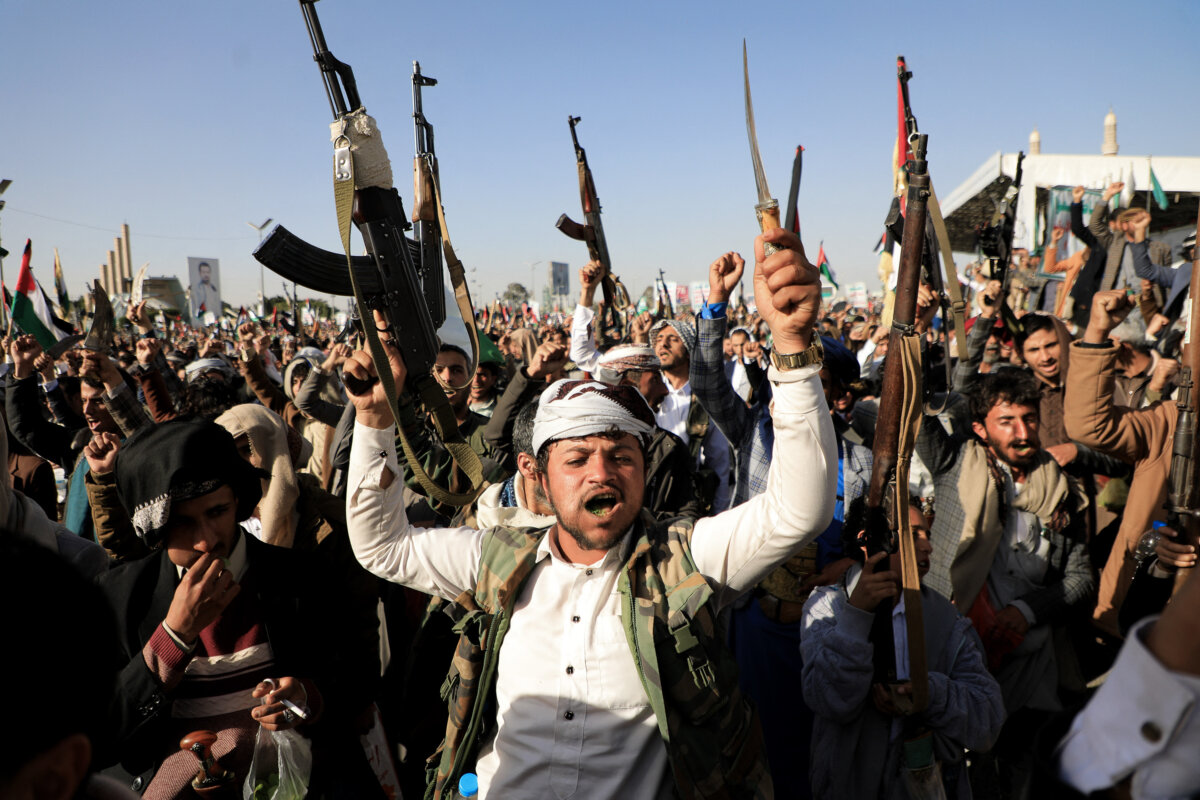

Following weeks of clashes with the internationally recognized Yemeni government, the Iran-aligned Houthi insurgency mounted a sweeping offensive that netted them control over the southern port city of Mokha and the outlying Perim Island.
Also known as Ansar Allah, the Houthis are a designated foreign terrorist organization that has struggled for control over Yemen for years.
These recent territorial gains position the Houthis to exert significant control over the Red Sea and the adjoining Bab al-Mandeb Strait, which has historically accounted for about 15 percent of international maritime trade. The Houthi threat expanded to the waterway amid a multi-month standoff between U.S. and Iranian forces, which has caused significant traffic disruptions through another key Middle East waterway, the Strait of Hormuz.
Here’s how the recent Houthi advances add to an already tense dynamic across the Middle East.
Houthi Gains Undermine Embargo
The Houthis began as a predominantly Zaidi Shia movement in northwest Yemen, opposed to the internationally recognized Yemeni government. The insurgent group entered the Yemeni capital city of Sanaa in late 2014 and ousted the government there by early 2015.
Since April 2015, the United Nations has worked to implement an arms embargo against Houthi-controlled areas of Yemen. Despite this embargo, the Houthis have worked to maintain smuggling routes connecting with Iran.
Prior to their latest offensive, the Houthis had accumulated control over an area of northwest Yemen covering about 80 percent of the country’s population. Following their recent offensive, they’ve since expanded their territorial control to virtually all of the country’s Red Sea coastline.
Michael Horton, a fellow at the Jamestown Foundation who has studied the conflicts with the Houthis, said these latest territorial gains provide the Houthis with improved avenues to smuggle in goods from places such as Djibouti and Somalia.
“The real gain is that they now have full access to more of the coast,” Horton told The Epoch Times.
The pro-government National Resistance Forces (NRF) had used Mokha as a hub for counter-smuggling operations, but were quickly routed when the Houthis marched on the port city.
Even with his years of experience studying the region, Horton said he was shocked by the speed at which the Houthis captured Mokha.
“I thought it would take, you know, weeks, a couple months; not four days,” Horton said.
Saudis Boxed In
Even before their latest advances, the Houthis had demonstrated the ability to launch missile and drone attacks throughout the Red Sea. In recent weeks, the Yemeni insurgent group has targeted vessels linked to Saudi Arabia.
Horton said the recent territorial gains don’t provide much added positional advantage to threaten shipping, as they had already demonstrated the ability to reach targets at the northernmost points of the Red Sea.
Brent Sadler, a senior research fellow on naval warfare for the Heritage Foundation, offered a similar assessment.
“This is a remarkable change of the frontlines in Yemen, but does not alter, significantly, the threat to shipping,” Sadler told The Epoch Times.
Sadler said increased control over Yemen’s Red Sea shoreline could give the Houthis more points from which to launch attacks or install sensors, but said this represents “a modest improvement over what they were able to do before.”
Houthi military spokesman Yahya Saree said last week: “Maritime navigation is safe for all companies except for Saudi vessels, which have already been subject to a blockade.”
Further, Saree described Houthi efforts to disrupt Saudi shipping as a retaliatory measure for Saudi efforts to blockade Houthi-controlled areas of Yemen.
Despite these Houthi assurances, Sadler urged caution.
“This statement that only Saudi ships are threatened is hollow, as they have attacked neutral shipping before and will likely renew even explicit threats to others’ shipping,” he said.
Even without a full Houthi blockade of the Bab al-Mandeb Strait and the Red Sea, oil flows through the region are facing disruptions.
Amid the U.S.-Iran conflict, Saudi Arabia and other Middle Eastern states have had to contend with the threat of Iranian attacks on commercial ships attempting to transit the Strait of Hormuz, a key waterway for the export of oil and other global commodities.
With maritime traffic through the Strait of Hormuz in doubt, Saudi Arabia has worked to re-route oil exports to its Red Sea ports via its East-West Pipeline. Now, with the Houthis increasingly targeting Saudi oil exports, Riyadh faces being boxed in.
In addition to staking a claim to new territory in Yemen in the past week, the Houthis have also launched attacks that have shut down the East-West Pipeline.
Oil prices climbed more than 2 percent on Sept. 14, following escalating Houthi attacks on Saudi Arabia, strikes on commercial shipping in the Strait of Hormuz, and the shutdown of a key Saudi oil pipeline, as traders weigh the risk of broader disruptions.
US–Houthi Ceasefire Holds, for Now
President Donald Trump could order a military intervention to counter the Houthis, but that could divide the attention of U.S. forces in the region.
In March, as the Houthis threatened attacks on Israel, Trump directed U.S. forces to bomb the Yemeni-based insurgency in a 52-day effort known as Operation Rough Rider. That U.S. bombing campaign concluded with a ceasefire between the United States and the Houthis.
For now, that U.S.–Houthi ceasefire remains intact.
Over the past week, reports emerged that Saudi Arabian leaders had reached out to the Trump administration requesting a U.S. military intervention. Responding to a request for comment on those reports, the White House told The Epoch Times that the United States will continue to protect its interests, including ensuring freedom of navigation in the Red Sea, “while empowering our regional partners to take the lead in managing and resolving regional security challenges.”
“The United States expects the Houthis to continue to uphold the terms of the ceasefire,” the White House added. “The Houthis saw during Operation Rough Rider that the United States and President Trump will take necessary action to protect freedom of navigation and U.S. commercial shipping from Houthi terrorist attacks.”
Speaking with reporters on Sept. 14, Vice President JD Vance said the Trump administration has been in contact with Saudi Arabia, the United Arab Emirates, and other regional partners regarding the recent Houthi territorial gains.
“We’ve also been engaged in direct conversations with the Houthis themselves,” Vance said.
“It’s a very fluid and dynamic thing, but we’re going to keep on monitoring it, making sure that Americans’ best interests are represented.”
Evgenia Filimianova contributed to this report.
 Friends Read Free
Copy
Facebook
Tweet
Friends Read Free
Copy
Facebook
Tweet