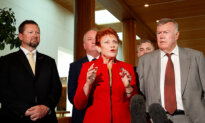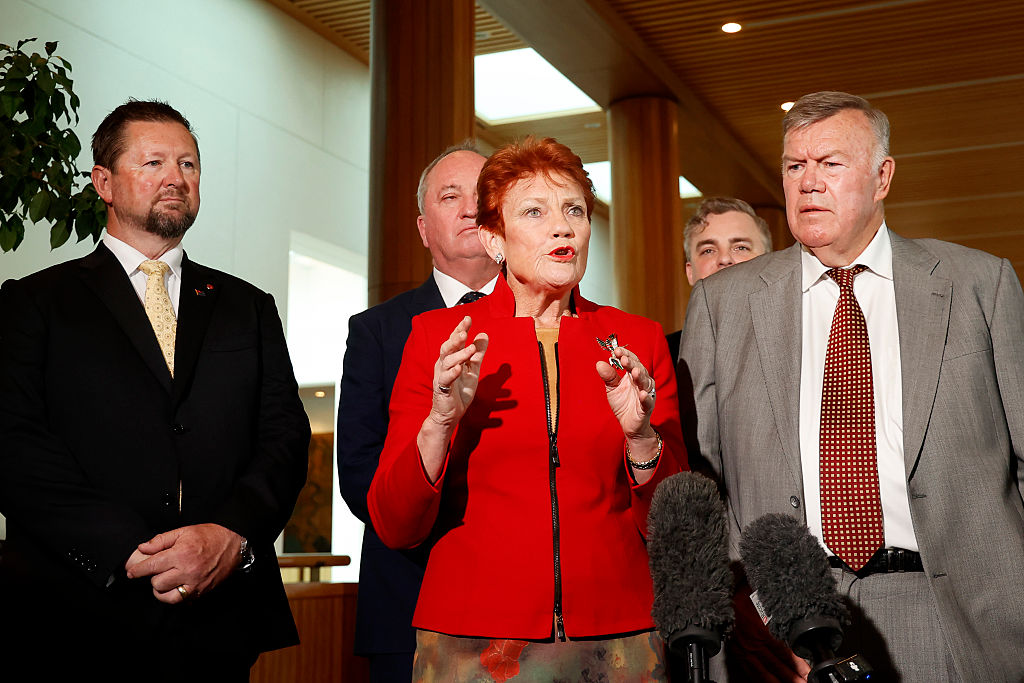

One Nation Leader Pauline Hanson has voiced strong objections to the federal government’s May 12 budget, accusing Labor of worsening inflation and making it harder for Australians to get ahead.
The criticism centres on the government’s major overhaul of wealth creation channels.
One policy is the removal of the 50 percent capital gains tax (CGT) discount so that those selling investment assets like shares, crypto, and property will be liable for a higher tax.
Another is removing negative gearing from property investments, meaning investors can no longer deduct losses from their property against their taxable income, except for new builds.
While the third major change is a new flat 30 percent tax on income going into a discretionary trust, a legal vehicle often used by families and small business owners to help “split” income and reduce their own tax burden.
Hanson called the budget “Marxist, socialist, communist,” saying it would take away opportunities from future generations.
“What they’ve done is strip this away from the future generations,” she told Sky News Australia.
“A budget basically that says … we’re going to strip wealth, we want to disperse wealth right across [society].”
Meanwhile, One Nation Senator Malcolm Roberts rejected Treasurer Jim Chalmers’ argument that global instability was driving inflation, saying the government’s own spending and policies were to blame.
“Inflation is 4.6 percent and 13 percent across his government’s four years. Don’t blame Iran or Ukraine. It’s the government itself that’s the leading cause of inflation,” he told the Senate on May 13.
Roberts pointed to Australian Bureau of Statistics data showing the cost of government services had increased faster than headline inflation over the past year.
According to the senator, property rates and charges were up 6 percent, water and sewerage up 7 percent, followed by postal services (8 percent), secondary education (7 percent), and preschool and primary education (5 percent).
He said wage growth was failing to keep up with rising costs, with average private sector wages increasing by 3.7 percent and public sector wages by 3.9 percent in the past 12 months.
“If it feels like you’re going backward while working harder, it’s because you are. That’s why 56 percent of the public in a recent Freshwater poll think the country is going in the wrong direction,” he said.
“We need infrastructure spending, smaller government … and stop flooding this country with more people than we can build homes for,” he said.
Opposition Leader Angus Taylor also criticised the budget, calling it “an assault on aspiration” and accusing Prime Minister Anthony Albanese of breaking promises made to voters before the election.
“Anthony Albanese looked us in the eyes and promised no new taxes on Australian homes and savings. Now Labor is about to do the exact opposite. Why should Australians ever trust a commitment this Labor government makes?” he said on X.
Chalmers Defends ‘Hard Decisions’
Chalmers defended the government’s budget strategy, framing the changes as necessary to deal with worsening global economic conditions.
“I’d rather defend a shift in policy than leave a broken status quo in place to do more damage, to marginalise more people over time,” he said during an address at the National Press Club of Australia on May 13.
“We made a different, more difficult choice in this budget to accelerate reform and not just absorb the shock.”
The treasurer said the government had been forced to recalibrate its economic outlook after the outbreak of the Iran conflict.
“The war began on the last day of summer, and we started recalibrating a bit on the first day of autumn,” he said, noting that oil prices had surged by more than 45 percent.
“The war fundamentally reshaped the budget forecasts.
“Treasury is now assuming the oil price will stay at around US$100 ($138) a barrel until the end of June, and then gradually come back to US$80 this means inflation will be higher, household spending will be lower, and growth will be slower than we thought at the start of the year before the conflict.”
 Friends Read Free
Copy
Facebook
Tweet
Friends Read Free
Copy
Facebook
Tweet