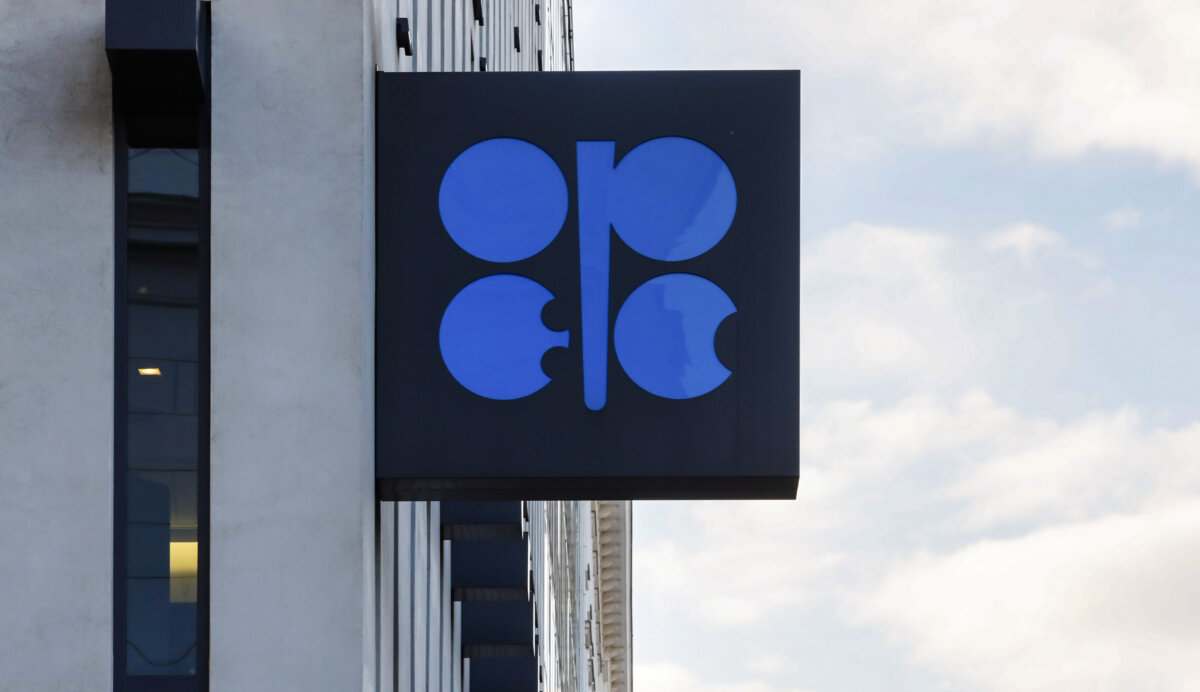

OPEC+ said on Jan. 4 that it would keep oil output consistent, maintaining a decision that eight members agreed to in November 2025 to pause increases in oil production throughout January, February, and March.
The consortium, which produces roughly half of all oil worldwide, consists of members of the Organization of the Petroleum Exporting Countries (OPEC)—Algeria, Congo, Equatorial Guinea, Gabon, Iran, Iraq, Kuwait, Libya, Nigeria, Saudi Arabia, United Arab Emirates, and Venezuela—and other oil-producing nations such as Russia, Mexico, and Kazakhstan.
The eight OPEC+ members that met virtually on Jan. 4 are Saudi Arabia, Russia, Iraq, the United Arab Emirates (UAE), Kuwait, Kazakhstan, Algeria, and Oman.
“The eight participating countries reiterated that the 1.65 million barrels per day may be returned in part or in full, subject to evolving market conditions and in a gradual manner,” OPEC wrote in a statement.
OPEC said the eight members will continue monitoring and assessing market conditions and stability while “adopting a cautious approach and retaining full flexibility to continue pausing or reverse the additional voluntary production adjustments” that it had announced earlier this year.
The decision comes after oil prices fell by more than 18 percent in 2025, the highest yearly drop since 2020, leading to concerns among some members about a growing oversupply of oil.
Increasing geopolitical friction between some member nations, particularly after a group aligned with the UAE seized territory in Yemen from its Saudi-backed government, is also affecting OPEC+. The decade-long conflict between Saudi Arabia and the UAE, which were previously close allies, has contributed to the most critical split between the two OPEC+ members.
The fate of Venezuela—one of the founding members of OPEC in 1960—is also largely uncertain after U.S. forces captured Venezuelan leader Nicolás Maduro on Jan. 3. U.S. President Donald Trump said the United States would assume control of the South American nation until a transition to a new government is complete, but he did not elaborate on what exactly that would entail.
Venezuela has the most oil reserves of any nation, including OPEC leader Saudi Arabia, but its output has diminished following sanctions and internal mismanagement.
It’s unlikely that there will be another significant boost in crude oil output for years, analysts have said, even if American oil companies invest billions into Venezuela’s oil industry as Trump indicated on Jan. 3.
“We’re going to have our very large U.S. oil companies, the biggest anywhere in the world, go in, spend billions of dollars, fix the badly broken infrastructure, oil infrastructure, and start making money for the country,” Trump said.
Jorge Leon, the head of geopolitical analysis at Rystad Energy and a former OPEC official, said that the oil markets are currently being driven “more by political uncertainty” and “less by supply-demand fundamentals.”
“And OPEC+ is clearly prioritizing stability over action,” he said.
Although OPEC+ previously said its member nations had agreed to oil output hikes in August and September 2025, on Nov. 2, 2025, the consortium said it would increase production again in December 2025 by 137,000 barrels per day but that it would “pause the production increments in January, February, and March 2026.”
The group has encountered various political crises over the years, including the Iran–Iraq War in the 1980s and the United States’ sanctions on Russian oil exports after Moscow ordered an invasion of Ukraine in 2022.
Reuters contributed to this report.
 Friends Read Free
Copy
Facebook
Tweet
Friends Read Free
Copy
Facebook
Tweet