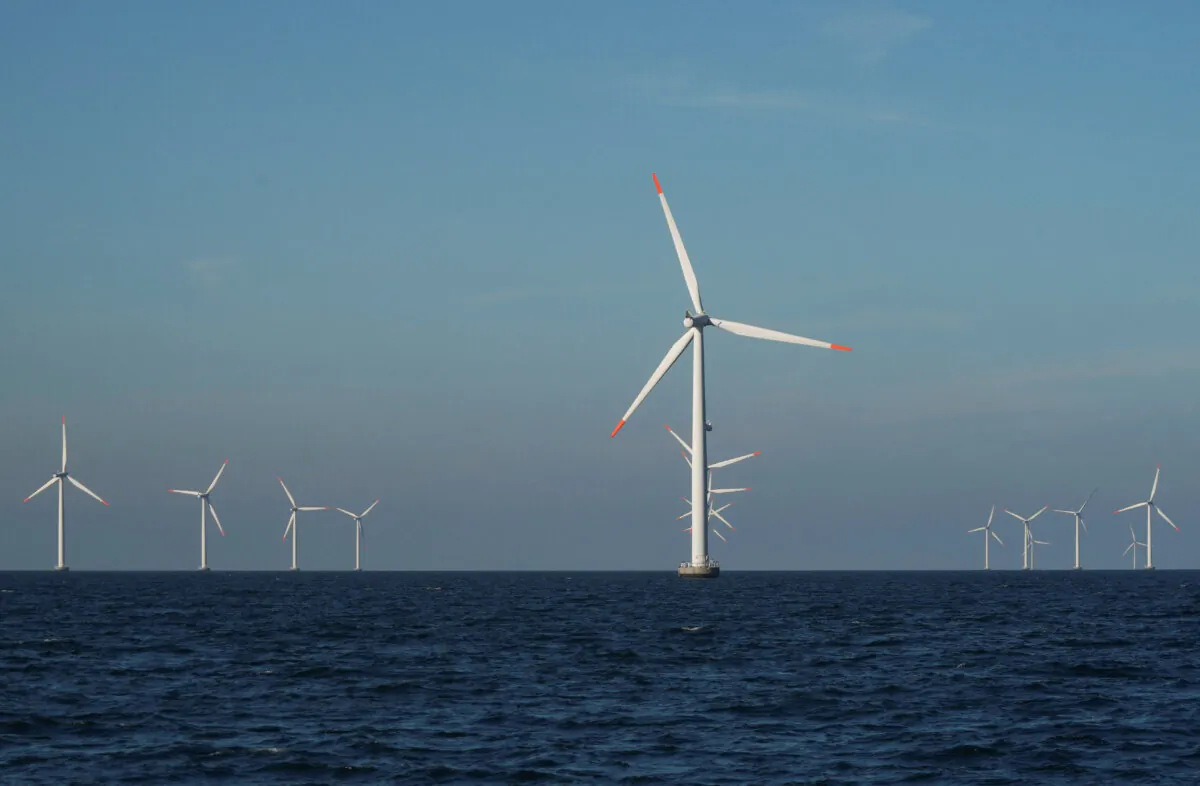
Shares in Orsted plunged to a record low as the giant wind farm developer asked shareholders for $9.4 billion to help fund a project in the United States.
Orsted shares slid over 30 percent on Aug. 11 in response to the rights issue announcement, of which two-thirds of the capital will be used to fund the construction of Sunrise Wind, one of its two remaining projects under development off the East Coast of the United States.
Orsted, which is Denmark’s largest energy company and the world’s largest offshore wind developer, is 50.1 percent owned by the Danish government.
The company develops, constructs, and operates offshore and onshore wind farms, solar farms, energy storage facilities, renewable hydrogen and green fuels facilities, and bioenergy plants.
Denmark’s Finance Minister Nicolai Wammen told broadcaster TV2 on Monday: “Orsted is an extremely important company in the green transition, and then there is also a security policy dimension where we must be independent of energy from Russia, and that is also why the state owns more than half of Orsted.”
Orsted CEO Rasmus Errboe said that following “recent material adverse developments in the US offshore wind market, it is not possible for us to complete the partial divestment and associated non-recourse project financing of our Sunrise Wind project on terms which would provide the required strengthening of our capital structure in order to support our investment programme and business plan.”
Potential co-investors have been bearish on U.S. wind farm projects, especially since the Trump administration in April ordered a halt to the development of the Norway-based company Equinor’s Empire Wind project.
However, New York Gov. Kathy Hochul announced in May that the Trump administration agreed to lift the stop-work order on the major project. The Biden administration approved the project in 2023, with construction beginning last year.
Trump had pledged to maximize U.S. oil and natural gas production and suspended offshore wind leases on his first day in office.
Trump’s action is a shift from the Biden administration’s four-year effort to expand wind-power leasing, which aimed to build 30 GW of offshore wind power by 2030, and another 15 GW of floating offshore wind power by 2035.
“The U.S. offshore wind market was crippled after Trump took office. But things started going badly for Orsted before Trump,” Sydbank analyst Jakob Pedersen said.
“The company is in really bad shape. A capital increase was the last resort. It was not just the right decision, it was the only option they had left in their toolbox.”
Funding challenges and rising costs have slowed down Europe’s offshore wind industry despite record public and private investment, strong government support, and locked-in climate laws
In May, Orsted said it was discontinuing work on a giant UK project in its current form because of rising costs and the risk of delays.
Orsted announced on May 7 that it is pulling out of its flagship 2.4-gigawatt (GW) Hornsea Project 4, which was granted a contract only last year.
The news was a blow to UK Secretary of State for Energy and Climate Change Ed Miliband, who is pursuing a goal to decarbonize the whole economy, which will need to increase offshore wind capacity from 14.7 GW to 43–50 GW in 2030.
The site was being proposed in the North Sea, approximately 42 miles off the Yorkshire Coast.
In February, the Danish company stated that it was cutting its 2030 investment program by 25 percent.
Orsted operates 12 offshore wind farms in the UK, including Hornsea 1, which held the title of the world’s largest wind farm until its sister project, Hornsea 2, came into operation with 165 turbines in August 2022.
In the past two years, industry giants such as Siemens Energy and Vestas have also been forced to reassess their investment strategies in renewables.
In February, Siemens Energy’s wind subsidiary, Siemens Gamesa, said that it anticipated a loss of 1.3 billion euros ($1.4 billion) this year.
Vestas, the world’s largest wind turbine manufacturer, said in February that despite a record-high order backlog, “ongoing geopolitical and trade volatility is expected to cause uncertainty.”
Sweden’s Markbygden Ett, one of Europe’s largest wind farms, owned by China General Nuclear Power Group Europe Energy and BNR Infrastructure, ran into financial trouble last year when it failed to generate enough electricity to fulfill its agreement with Norway’s Hydro, and had to pay 248 million euros ($271 million).
Jacob Burg, Aldgra Fredly, and Reuters contributed to this report.
 Friends Read Free
Copy
Facebook
Tweet
Friends Read Free
Copy
Facebook
Tweet