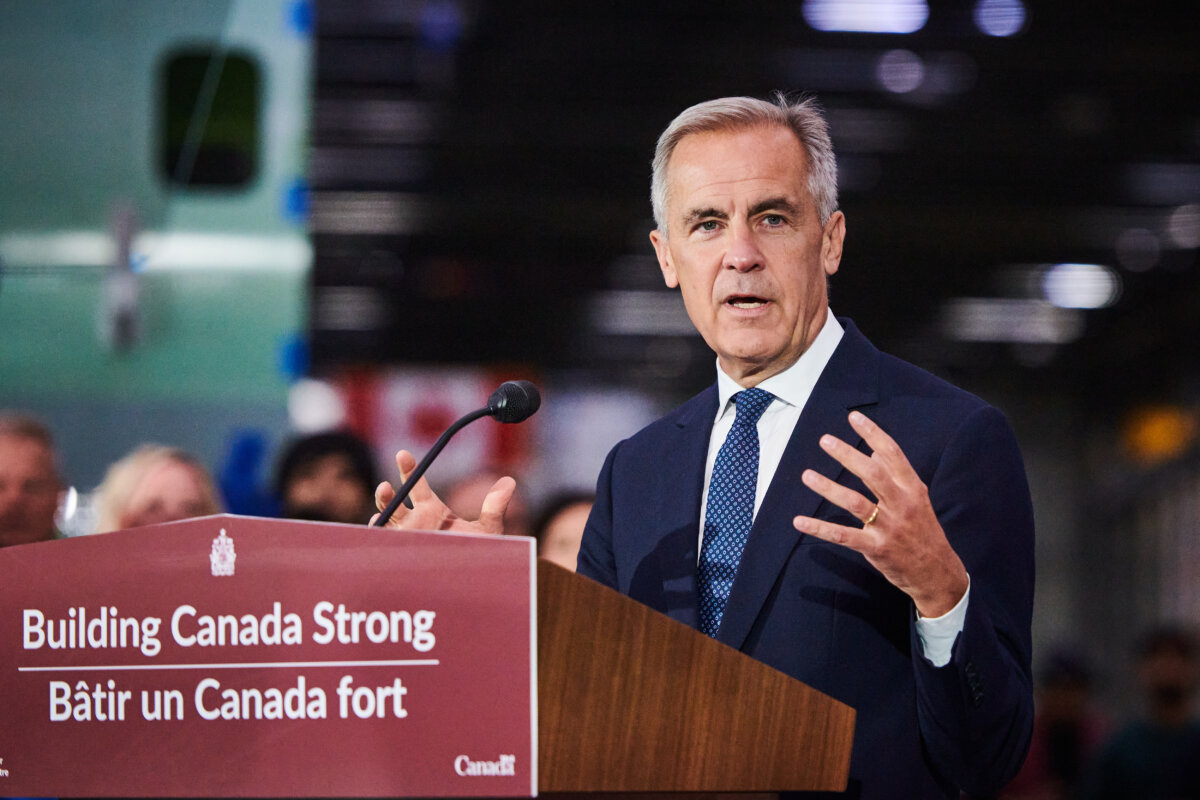

The federal government’s plan to incrementally impose electric vehicle (EV) sales on car manufacturers and importers will be delayed, Prime Minister Mark Carney says.
Carney made the announcement on Sept. 5 after two days of meetings with his cabinet in Toronto.
He said the EV mandate is adding “liquidity issues” for car manufacturers in the current economic climate.
“The financial challenges that these producers have, they’ve got enough on their plate right now,” he said.
The prime minister said 2026 model year vehicles will be waived from the Electric Vehicle Availability Standard requirements. An immediate 60-day review of the EV mandate will also be launched and Ottawa will explore options to bring more affordable EVs to Canada.
The move was announced along with other measures seeking to help sectors of the Canadian economy that have been most impacted by the sectoral tariffs imposed by U.S. President Donald Trump. Those tariffs have targeted steel, aluminum, automobiles, and copper.
Ottawa’s EV mandate, initially introduced under former Prime Minister Justin Trudeau, was set to kick in starting in 2026. It would have required car manufacturers to make 20 percent of their sales electric vehicles, under threat of penalties managed through a credit system.
EV sales targets were set to increase to 60 percent by 2030 and 100 percent by 2035. The mandate was conceived as part of the Liberal government’s climate plan seeking to reach net-zero emissions by 2050.
Ottawa has identified the transportation sector as accounting for about half of Canada’s total greenhouse gas emissions, with light-duty vehicles producing half of the emissions in the transportation sector.
The federal subsidy program for the purchase of EVs, which provided a rebate of up to $5,000, was paused in January this year after the program ran out of money. Environment Minister Julie Dabrusin said earlier this year a rebate would be brought back, but no details on the future program have since been shared.
Regarding his plan to have more affordable EVs in Canada, Carney was asked by reporters whether he is considering lifting the 100 percent surtax on Chinese EVs that was implemented by the Trudeau government in October 2024. This surtax and others targeting Chinese steel and aluminum have led to retaliatory measures from Beijing against Canada’s agricultural and seafood industries.
Carney didn’t say whether he would lift the tariff on Chinese EVs but said there’s been increasing discussions with China regarding its trade actions against Canada.
“We have begun more intense engagement with China with respect, first and foremost, to canola and other agriculture and seafood products,” he said. “I’m sure those discussions will branch out, but it’s too early to come to any conclusions on those.”
EV Sales
Carney’s announcement comes as demand for EVs and support for the mandate is falling in Canada.
Statistics Canada said in May that EV sales had dropped 44 percent compared to the previous year. Meanwhile, a recent Léger poll found little support for the mandate among Canadians, with 71 percent of respondents saying banning the sale of new gas cars by 2035 is “unrealistic” and that the plan should be rolled back.
Car manufacturers in Canada have pressed Ottawa to abandon the EV mandate in recent months. The CEOs of Stellantis Canada, GM Canada, Ford Canada, and the Canadian Vehicle Manufacturers’ Association (CVMA) met with Carney in July to make that request.
“The targets that have been established cannot be met, and that will be part of the discussion,” CVMA CEO Brian Kingston told reporters before the July 2 meeting.
Conservatives are also opposed to the EV mandate and announced a “nationwide campaign” in August to have it repealed. Tory Leader Pierre Poilievre said Canadians should have the “right to decide what car they can afford and what car works for them.”
Tories say EVs are expensive and impractical for rural areas due to their range and performance in cold weather.
Seeking to address these concerns, Ottawa had previously noted that EVs “can be driven in very cold weather,” pointing to their widespread adoption in Norway.
 Friends Read Free
Copy
Facebook
Tweet
Friends Read Free
Copy
Facebook
Tweet