
News Analysis
The large-scale war of June 2025 is now behind us. The United States and Israel dealt a heavy blow to Iran’s nuclear program, and it seemed that chapter—at least for the time being—had closed.
Buildings were bombed, facilities were damaged, and the message was unmistakable: Tehran’s path to a bomb had been blocked.
Yet beneath the surface—almost literally—a more complicated picture began to emerge. Iran resumed activity, not necessarily through the well-known sites that had already been attacked but through remnants, laboratories, relocated infrastructure, rebuilt sites, and scientists who remained active. As in the aftermath of an earthquake, someone inside the rubble was trying to gather the pieces and reassemble a dangerous mechanism.
According to Andrea Stricker of the Foundation for Defense of Democracies (FDD), an expert in nuclear proliferation and counterproliferation who specializes in Iran’s nuclear program, that was the moment when Israel and the United States went back into action. No longer a single strike on a famous, well-known facility, but a series of precise, almost surgical attacks on roughly five locations so far.
One of them is a covert site known as Minzadehei, northeast of Tehran—an underground complex where, according to Israeli assessments, a critical component for a nuclear weapon was being developed.
Senior security officials said a team of nuclear scientists was operating there, reassembled from among those who had survived, and working to accelerate the so-called Weapon Group project—an effort aimed at developing the bomb’s detonator and adapting it for installation on a ballistic missile.
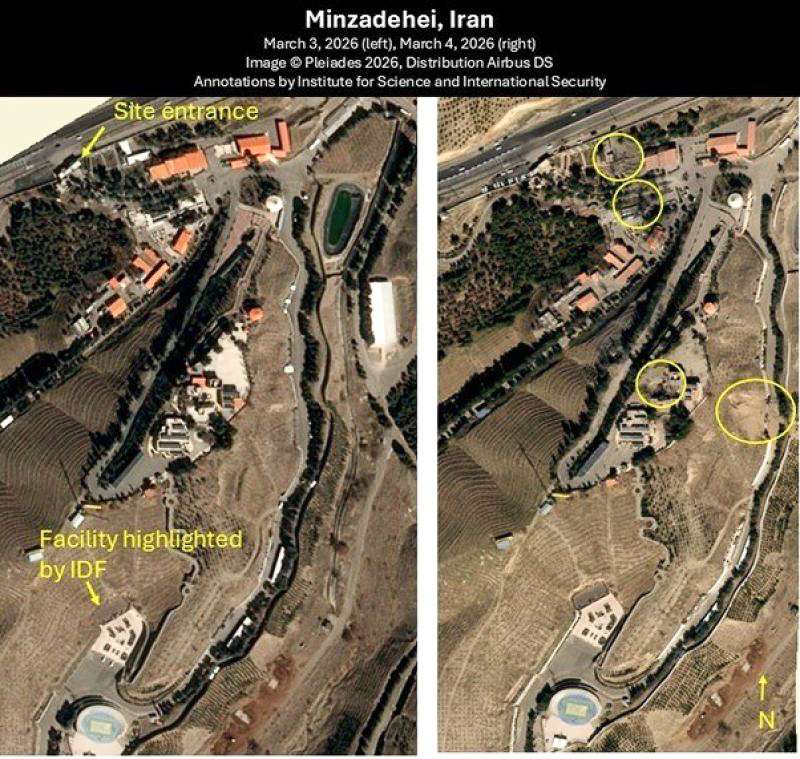
“The Iranians appear to have begun using this site for nuclear weapons purposes after the strikes of June 2025, so Israel may not have seen a need to attack it earlier,” Stricker said in an interview with Epoch Magazine in Israel.
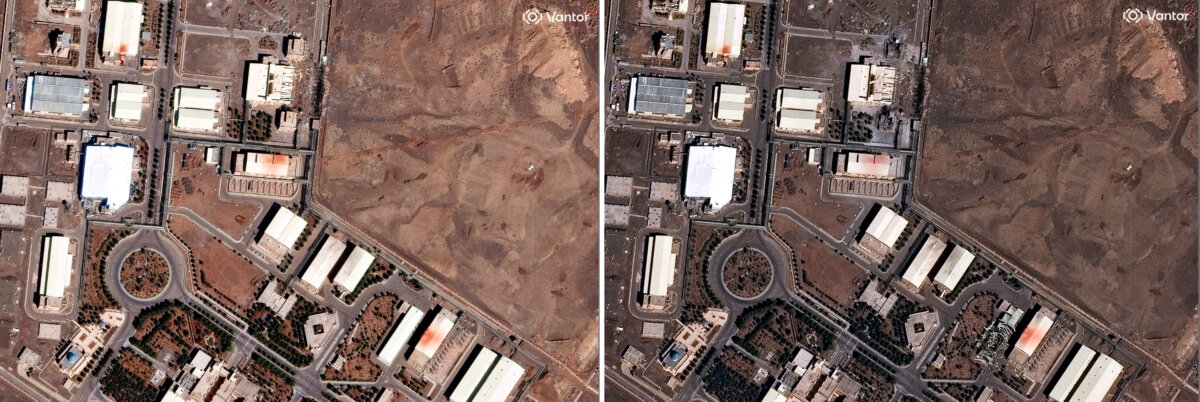
At the same time, Natanz was hit—but not the heart of the facility, rather its entrances. That detail made the episode especially intriguing. Late in the June 2025 war, the United States struck the Natanz enrichment plant with two bunker-busting Massive Ordnance Penetrators, or MOPs, a move that likely rendered the underground portions of the site inoperable.
So when three entrances to the complex were struck in early March, the goal, Stricker explained, was not necessarily to destroy the core again but most likely to block access.
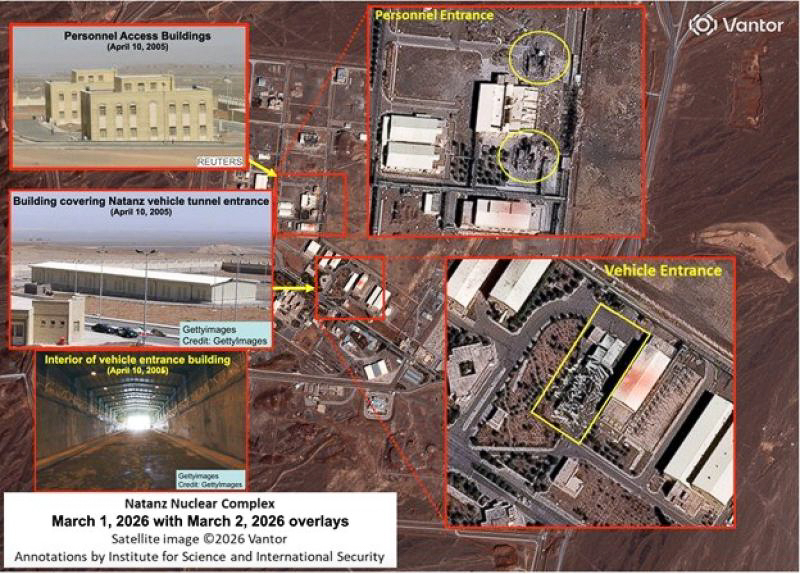
“The objective appears to have been to prevent Iranian personnel from entering in order to move equipment or nuclear material into or out of the facility,” she said. “Israel may have been trying to prevent the removal of centrifuge equipment, or even enriched uranium that may have survived in canisters.
“It also sends a clear message to Iran to stay away from these facilities, since Israel is watching from the sky.”
Stricker said that in a possible scenario of regime collapse in Iran, there is also a risk that these assets could fall into the wrong hands.
“Fuel for a nuclear weapon could wind up with terrorist organizations or other actors seeking to sell it on the black market,” she said. “Israel and the United States also have to take into account proliferant states—countries that might try to obtain such materials.”
Then there is Isfahan. Satellite imagery from the latest strike has not yet been published, but Stricker noted that key buildings for uranium conversion, uranium metal production, and nuclear fuel manufacturing were already hit there in June 2025—core links in Iran’s nuclear production chain.
“It is hard to say what remains vital there, since the key facilities have already been destroyed,” she said. “But the Isfahan complex contains many buildings. Israel may have identified new activity there, or it may not have fully eliminated all the troubling activity at the site in June 2025.”
Finally, Lavisan 2/Mojdeh—a site of particular interest because of its connection to the Organization of Defensive Innovation and Research, or SPND, the body responsible for research and procurement related to nuclear weapons and their delivery systems. According to the Institute for Science and International Security, a U.S. research organization that tracks Iran’s nuclear program, a “laboratory-like building” there was destroyed. It housed facilities belonging to SPND’s administrative leadership in a structure Tehran had recently begun restoring.
Commando Forces
But that is only half the picture. The other half concerns not what has already been struck, but what remains intact. And here Stricker pointed to the most troubling target of all: Pickaxe Mountain, near Natanz—a complex buried at a depth of up to roughly 100 meters below ground.
This is not just another facility that can be easily identified in satellite imagery and destroyed from the air. It is a site that appears to have been designed from the outset to withstand an attack from the outside world, and so it was buried exceptionally deep.
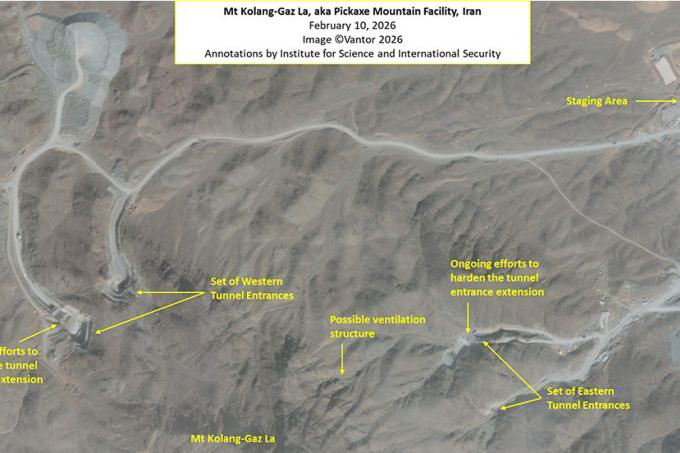
According to the assessments Stricker cited, the site is comparable in depth to Fordow—estimated at roughly 80 to 90 meters underground—and may be deeper still. If a decision is made to neutralize it, she said, standard munitions will not suffice. It would require B-2 bombers carrying GBU-57 bunker-busters. And perhaps even commando teams capable of penetrating the complex and destroying it from within.
“Western intelligence fears that the facility at Pickaxe Mountain could serve as a new Fordow-style enrichment plant—only one protected even more deeply,” she said.
“Iran, for its part, claims that it is a new centrifuge assembly plant intended to replace the aboveground assembly facility at Natanz that was destroyed in 2020.”
A November 2025 report by the Institute for Science and International Security states that the Israeli and U.S. strikes in June 2025 did not damage the site.
“My assessment is that the United States and Israel left it untouched because it was not yet close to becoming operational,” Stricker said. “But construction has continued since then, and the Iranians have strengthened security and the entrances to the complex.”
If Washington and Jerusalem can penetrate the facility and destroy it from the inside, she said, that may prove more reliable than relying exclusively on MOPs, because it would allow them to ensure that all the assets inside were destroyed.
In fact, Stricker noted, the same uncertainty applies to Fordow and Isfahan.
“It is still unclear whether highly enriched uranium survived at Fordow and in the Isfahan tunnels,” she said.
Beneath the surface complex at Isfahan, an underground site had been operating, carved into the adjacent mountain. Reuters reported on Feb. 27 that some of the uranium enriched to levels of up to 60 percent was stored there. According to the report, the information was based on a confidential report that the International Atomic Energy Agency sent to member states and that Reuters obtained.
Stricker estimated that the United States and Israel intend to eventually address those sites, as well as other assets, that have not yet been dealt with.
“At this stage, they prefer to focus on the immediate threats—missiles, drones, launchers, the military, and the leadership,” she said.
To ensure that the path to a nuclear weapon has been closed for good, she said, all “nuclear assets” will have to be secured—materials, facilities, equipment, and documentation.
“This may be a multiyear process of locating them and ensuring their elimination,” she said. “It is also necessary to consider redirecting Iranian scientists into civilian work and preventing nuclear expertise from leaking to other states or to terrorist organizations.
“Fortunately, the IAEA and other international bodies have succeeded in similar missions in Iraq, Libya, South Africa, and the former Soviet Union.
“There is therefore accumulated experience in dismantling nuclear weapons programs and handling sensitive assets of this kind.”
 Friends Read Free
Copy
Facebook
Tweet
Friends Read Free
Copy
Facebook
Tweet