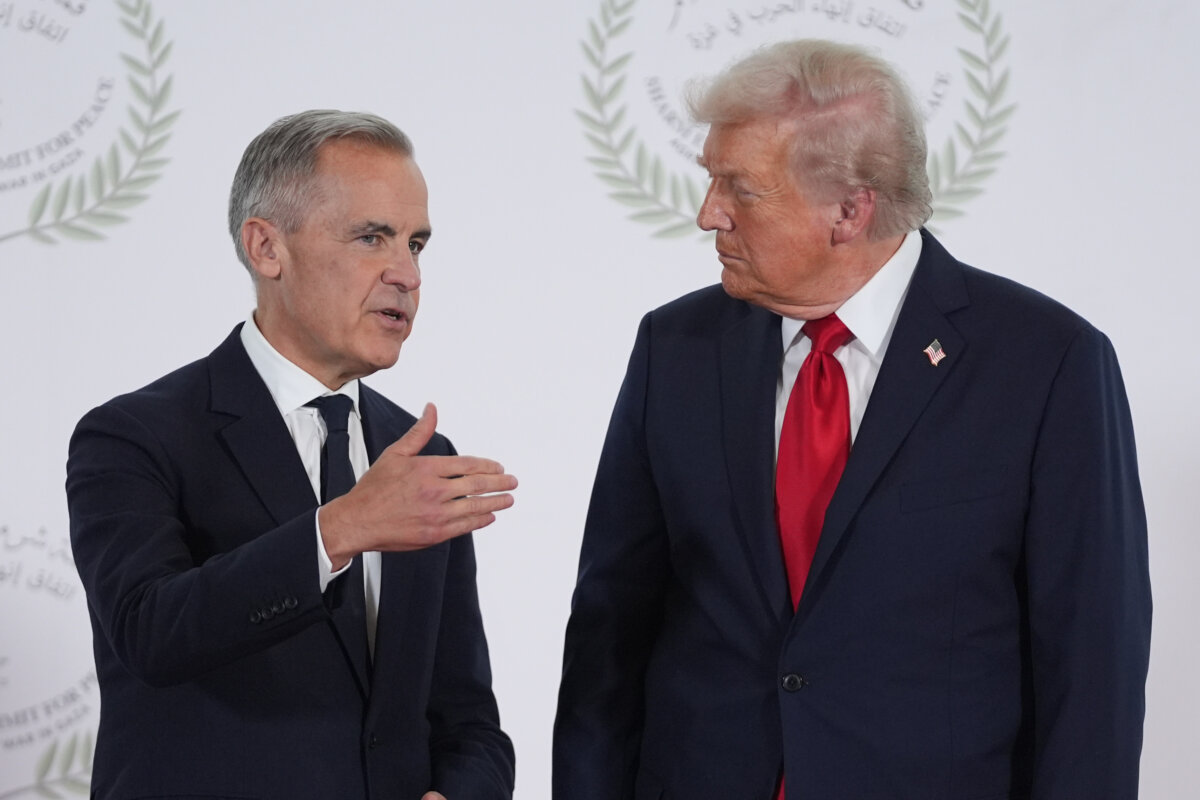

U.S. President Donald Trump announced that he paused the 50 percent tariffs that were set to take effect on Aug. 19 for a period of three days, as Ottawa and Washington reached a trade deal.
“I have paused the 50% Tariffs against Canada, that were scheduled to kick in tomorrow morning for a three day period, based on the fact that Canada and the U.S.A., subject to the finalization of documents, have a DEAL!” Trump announced on Truth Social Aug. 18, less than two hours before the tariffs were set to kick in at midnight.
Trump added that the Keystone XL Pipeline, which had been cancelled by former U.S. President Joe Biden in 2021, “may be awoken from the grave.” Trump signed an order in April to authorize the revival of part of Keystone XL by granting a permit for a 1,038-kilometre pipeline, beginning near the Canada–U.S. border in Montana and ending in Wyoming.
There is currently no word on any specific concessions that Canada has made to the United States. Washington has been seeking for Canada to end its “discriminatory” trade practices against U.S. exports such as automobiles, alcohol, and dairy products, in exchange for the current tariffs on Canada being lowered.
Speaking to reporters on Aug. 19 at the White House, Trump said he had a “very good conversation with the prime minister last night,” and Canada had given the United States “the points that we had to have.”
“The tariffs will be non-existent for our farmers. Our farmers were paying tremendous tariffs into Canada, and those tariffs are going to be totally eviscerated—down to zero,” Trump said.
When asked if the current U.S. tariffs on Canada would be lowered, Trump said, “we’re reducing it a little bit.”
“It’s good for everybody, but our farmers are going to be thrilled. Our manufacturers are going to be thrilled,” he said.
A presidential proclamation dated Aug. 18 says Canada has expressed a “commitment to remove the discriminations or unreasonable and unequal impositions at issue,” prompting Trump to suspend the new tariffs for three days.
The United States Trade Representative said on X that the deal would include “comprehensive market access for all American goods,” as well as economic security commitments, alignment on digital trade, and “many important provisions that will continue to protect our market and American workers, along with our Canadian partners.”
Trump issued three proclamations on July 20 to impose 50 percent tariffs on certain Canadian goods beginning on Aug. 19. The new tariffs were to apply to certain Canadian alcohol, dairy products, honey, cement, wood and paper producers, hockey equipment, and dozens of other goods. The tariffs would have impacted about 5 percent of Canada’s total exports to the United States, or around $28 billion worth of goods.
The United States previously imposed several rounds of tariffs on Canada, such as sectoral tariffs on steel, aluminum, and copper; vehicles and auto parts; and upholstered furniture, kitchen cabinets, and vanities. Canada responded with its own retaliatory tariffs, and while most of those were lifted in September 2025, it retained counter-tariffs on certain U.S. goods in response to Washington’s sectoral tariffs on automobiles, steel, and aluminum.
U.S. Trade Representative Jamieson Greer said on Aug. 14 that Canada needed to end its retaliatory measures in order to avoid additional tariffs, and said Ottawa’s retaliatory tariffs were “the kind of things that China would do.”
Prime Minister Mark Carney and Trump had spoken over the phone on the afternoon of Aug. 18, but the Prime Minister’s Office did not provide any additional details such as what was discussed or whether an 11th hour deal to avoid the new tariffs could be reached.
Carney and Trump had also spoken on Aug. 17 about trade negotiations. Earlier that day, the prime minister told reporters that the two leaders would have a “good discussion about the opportunities together,” and that he would tell the president that Canadians were “masters in our own home.”
“Negotiations are very intense and delicate. This is not the time to talk about negotiations in public … We have options in Canada, here in Newfoundland, in Quebec, across Canada,” Carney added.
Canada-U.S. Trade Minister Dominic LeBlanc and Canada’s chief trade negotiator Janice Charette have been in Washington to discuss trade between the two countries for the last few days. On Aug. 14, LeBlanc said in a social media post that he and Charette had updated the provincial and territorial Ministers of Trade, as well as to the Advisory Committee on Canada-U.S. Economic Relations, on the “latest developments in our trade negotiations with the United States.”
LeBlanc and Charette met with Greer and Commerce Secretary Howard Lutnick on Aug. 17, and meetings have continued on Aug. 18.
LeBlanc’s office said that he and Charette will meet with Greer at 11:15 a.m. ET on Aug. 19.
 Friends Read Free
Copy
Facebook
Tweet
Friends Read Free
Copy
Facebook
Tweet