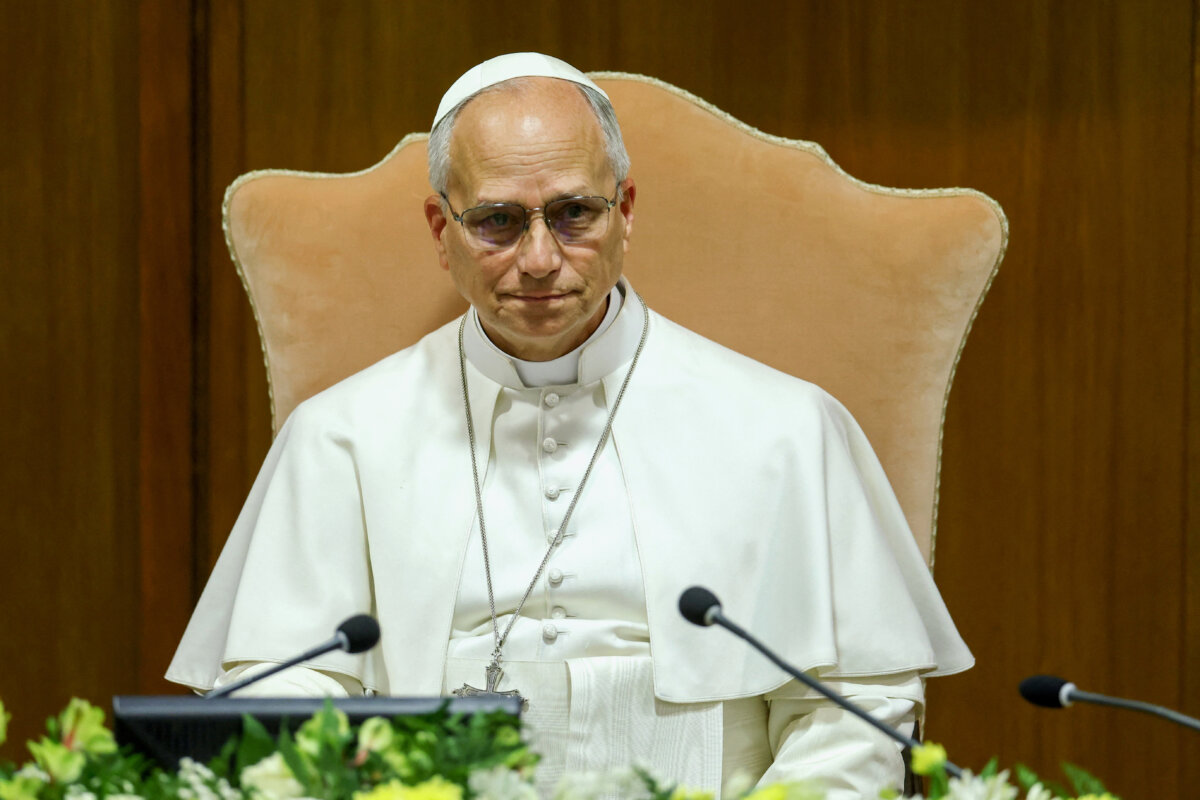
Pope Leo XIV, on July 2, excommunicated a group of Catholics after they went ahead with their plan to consecrate four of their priests as bishops, in direct defiance of his order.
The Society of Saint Pius X, better known as the SSPX, had warned the Vatican of its intent after talks between its leaders and Vatican official Cardinal Victor Fernández broke down earlier this year.
In an open letter to its leadership, Pope Leo praised the group for its “apostolic zeal and desire for fidelity to Tradition,” but asked that they refrain from the “schismatic act” they were about to undertake.
“In this spirit, and filled with Christian affection, I plead with you and ask you with all my heart: please turn back!” the pope said in his June 29 letter.
The group’s superior general, Fr. Davide Pagliarani, responded by insisting the SSPX was not separated from the church and asking for the pope’s blessing.
Here’s what to know about the SSPX and the excommunications.
Happened Before
The friction started after the Second Vatican Council, held from 1962 to 1965. Archbishop Marcel Lefebvre participated in that event but later became troubled by some of the changes that followed.
Those included what he saw as relaxation on issues such as religious liberty, and the church’s decision to change the form of its primary worship service, the Mass.
In 1969, he formed a society of seminarians and priests who pledged to reject the new Mass in favor of the Traditional Latin Mass, which had existed for more than a millennium, and was codified by St. Pius V in 1570 as the official form of the Mass.
His efforts drew the ire of the Vatican and his local bishop; he was sanctioned in 1975 but continued his activities nonetheless.
In 1988, Lefebvre made an agreement with then-Pope John Paul II: The SSPX would be given bishops so the society could continue ordaining new priests after he died.
But he broke the agreement shortly after signing it, and consecrated four SSPX priests as bishops.
Automatic Excommunication
Just like under Pope John Paul II, the four priests consecrated as bishops on July 1 are all automatically excommunicated under church law. The same applies to the bishops who performed the consecrations.
However, that doesn’t make the consecrations invalid—the bishops are considered bishops, just consecrated illegally.
The Vatican took a further step this time, declaring all the society’s clergy excommunicated and cautioning that the faithful who formally adhere to the schism run the same risk. Its sacraments, such as Confession and marriage, will no longer be valid.
The SSPX has spread around the world since its formation, and currently has more than 700 priests—with hundreds more in training at its seminaries—and nearly 400 religious nuns and monks. An estimated 600,000 people attend the society’s Masses worldwide.
Excommunication is a censure declaring that a person or group is cut off from communion with the rest of the Catholic Church and deprived of its blessings. The penalty is intended to be medicinal, by forcing the excommunicated to recant from some error or action.
The SSPX has argued that, in 1988 and now, the excommunications are invalid because their actions were necessary to preserve tradition and were motivated by a love of the Catholic Church.
But Fr. Gerald Murray, a canon lawyer, said their interpretation is not the deciding factor.
“The Pope is both the law-giver and the authoritative interpreter of Church law,” he told The Epoch Times.
“He has stated that the illegal ordination of four new bishops is a schismatic act. The refusal by the SSPX to recognize this determination changes nothing. The ordination was an act of schism, which canon law describes as ‘the refusal of submission to the Supreme Pontiff.’”
Previous Popes Tried to Reconcile
Pope Benedict XVI, who had negotiated the 1988 agreement when he was still just a cardinal, repeatedly tried to bring the SSPX back into full regularity with the church.
In 2007, Benedict issued a document granting broad permission for priests to say the Latin Mass, a move applauded by Catholics who wanted to hold on to traditional views without joining the SSPX.
In 2009, he lifted the previous excommunication against the four bishops Lefebvre had consecrated.
At the time, Benedict said he hoped the move would facilitate a reconciliation with the SSPX. That never happened.
His successor, Pope Francis, went further in 2016 by extending permission to hear Confessions to the group. But a series of controversies surrounding the Argentine pope—who often appeared to depart from traditional Catholic viewpoints—made reconciliation difficult.
Francis’s decision to greatly restrict the Latin Mass in 2021, and a later document permitting blessings of homosexual couples—while making it clear the Church does not consider their unions a marriage—may have muddied the waters further. A May statement submitted to the Vatican by the SSPX referenced the blessings, among other issues.
Alternatives
After the 1988 consecrations, a group of 12 SSPX priests split off and formed another organization, determined to remain in good standing with Rome.
That group, the Priestly Fraternity of St. Peter, has also spread around the world, providing an alternative for Catholics seeking the traditional Mass and sacraments but uncomfortable with the SSPX position.
Other groups, such as the Institute of Christ the King, are also available, along with a scattering of local Catholic parishes that still offer the traditional Latin Masses with permission.
But some SSPX attendees are distrustful of those groups and prefer to stick with what they know.
“I think there’s an apparent crisis in the Church that directly affects the faith—how it is passed down and relayed in the vast majority of parishes,” one attendee told The Epoch Times on condition of anonymity.
“And I think that attending the SSPX Mass and being part of those communities is an assured way of protecting my family.”
Murray, who has previously expressed concerns about the statements and actions of Church leadership, said there is another way.
“Catholics who share the concerns of the SSPX about doctrinal deviations should make their concerns known while remaining faithful to the Church,” he said.
Correction notice: A previous version of this article misstated the extent of Pope Benedict XVI’s lifting of excommunications incurred by Archbishop Marcel Lefebvre. The Epoch Times regrets the error.
 Friends Read Free
Copy
Facebook
Tweet
Friends Read Free
Copy
Facebook
Tweet