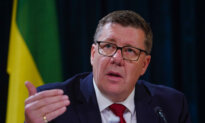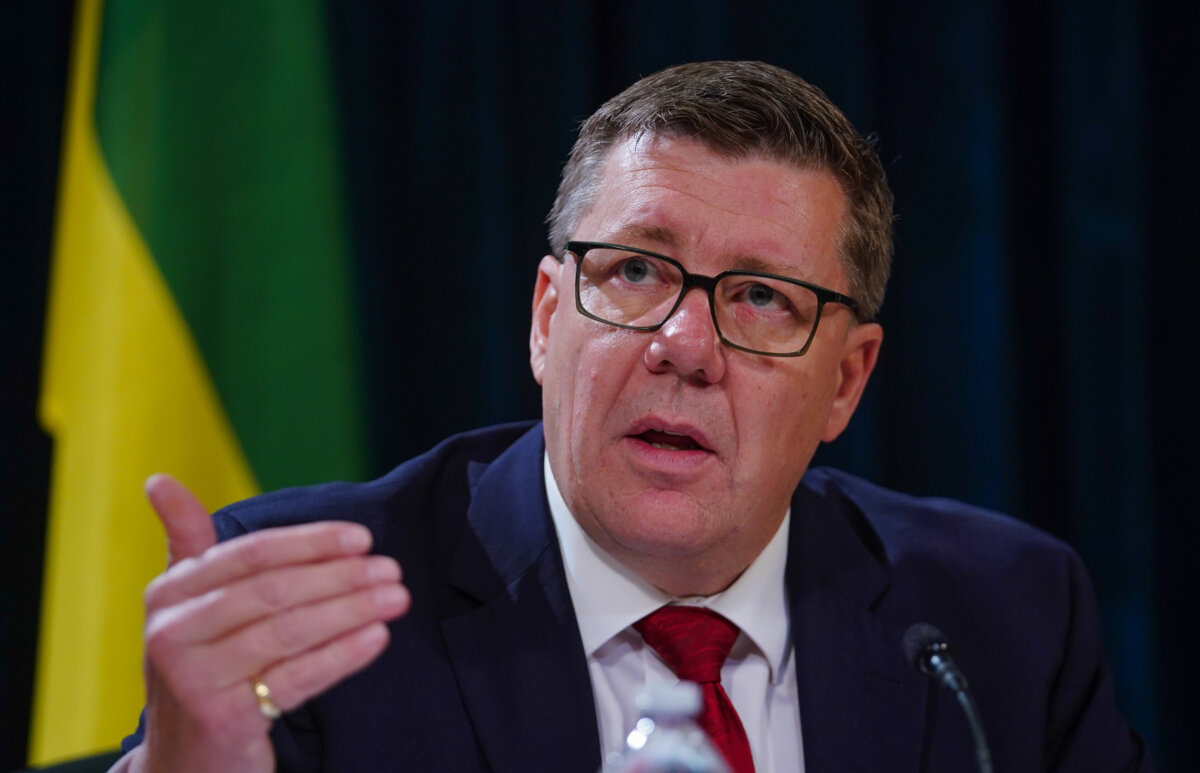

Saskatchewan Premier Scott Moe announced plans on Sept. 29 to expand nuclear power generation in the province, including a goal of at least 2,600 megawatts (MW) of nuclear capacity by 2050.
During a news conference at the University of Saskatchewan in Saskatoon, Moe released a new plan which supplements the Saskatchewan First Energy Security Strategy and Supply Plan released by his government in October 2025.
The new report sets a target of at least 2,600 MW of nuclear generation by 2050 to meet rising electricity demand from industrial expansion, resource development, manufacturing, and population growth.
It calls for four priorities: building electricity capacity for long-term growth, incorporating large nuclear reactors into electricity planning, continuing nuclear development in Estevan, and expanding Saskatchewan’s nuclear capabilities.
The report says SaskPower will begin planning for the potential development of two large nuclear reactors in northwest Saskatchewan, with a goal of bringing the first one online by 2042. The reactors would initially generate more than 2,000 MW.
SaskPower will evaluate potential sites in northwest Saskatchewan while engaging with communities and First Nations, the province says.
Meanwhile, SaskPower has selected the Rafferty site near Estevan for further study of a small modular reactor (SMR) capable of producing at least 600 MW.
The province says nuclear power would provide non-emitting baseload electricity alongside existing sources such as coal, wind, solar, hydro, and natural gas.
Moe highlighted several initiatives supporting the province’s nuclear plans, including a power line being built in northwest Saskatchewan, Western Canada’s first SMR safety licensing and testing centre at the University of Regina, and an agreement between SaskPower and Bruce Power Corporation to access nuclear expertise.
He also pointed to a memorandum of understanding with Alberta and the Northwest Territories aimed at strengthening nuclear cooperation and collaboration on large-scale reactors in Western Canada.
“These are important—and I would say significant—milestones for us to create that affordable, reliable electricity security into the future for residents of this province,” Moe said.
Moe said nuclear development represents “one of the largest energy and economic development opportunities” in Saskatchewan’s history.
He pointed to more than 60 major private-sector projects representing over $100 billion in committed investment and argued that the province will need additional electricity to support that growth.
Moe said 600 MW could power the equivalent of Regina and Saskatoon, while 2,600 MW could power the equivalent of 2.6 million homes.
He also highlighted Saskatchewan’s uranium industry, saying the province is the world’s second-largest uranium-producing jurisdiction and should use its uranium resources to generate power at home.
“Saskatchewan has the uranium. We have the expertise. We have the workforce. We have the partnerships,” Moe said. “And we most certainly have the vision.”
Responding to reporters’ questions, Moe said the government does not yet have a firm cost estimate for the nuclear buildout because construction costs can change substantially and the province remains years away from making the investment.
He said Saskatchewan is examining financing models used in the United Kingdom, Poland, the Czech Republic and the United States. All ownership and financing options remain open, including models involving SaskPower ownership and private-sector participation.
Moe said he has “a high degree of confidence” that Saskatchewan will need at least 2,600 MW—and possibly more—as the province’s mining, data-centre, manufacturing, and agricultural industries expand.
“This is not a 20- or 30-year investment. It’s not a one-generation investment,” he said. “This is an investment that is multi-generational.”
Moe also said the province wants Saskatchewan companies to develop the expertise and capacity to participate in nuclear construction projects around the world.
Jeremy Harrison, the minister responsible for Crown Investments Corporation and SaskPower, said he recently met with Canadian Nuclear Safety Commission Chair Pierre Tremblay to discuss the feasibility of the province’s timeline.
“I am very comfortable, although we are going to push hard, I am very comfortable that what we have put forward, as far as 2042 being a very realistic timeframe for large-scale nuclear,” Harrison said.
 Friends Read Free
Copy
Facebook
Tweet
Friends Read Free
Copy
Facebook
Tweet