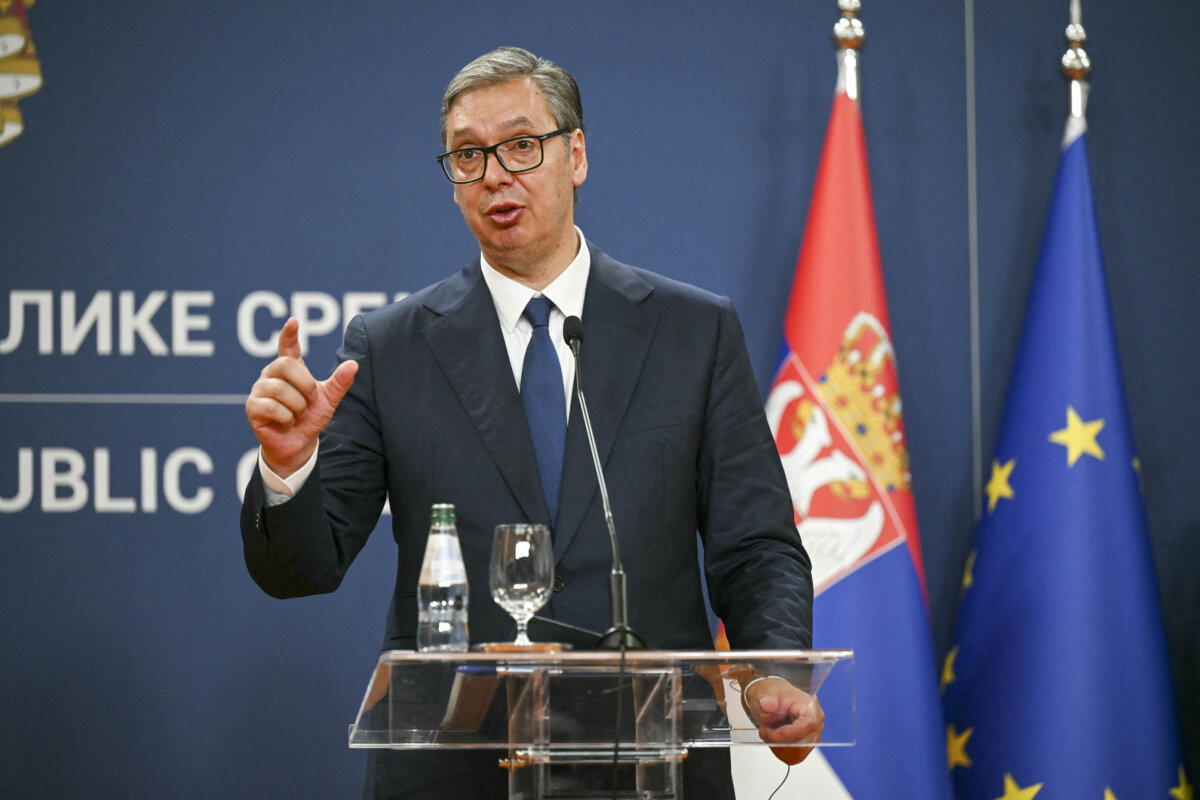

Serbian President Aleksandar Vucic resigned Sunday, seven months before the end of his second and final term, setting up an early presidential election as the country prepares to vote for a new parliament on Oct. 25.
The move would allow Vucic to become prime minister if his Serbian Progressive Party and its allies form the next government.
“This is the last evening for me in this building,” Vucic told supporters gathered outside the presidency in Belgrade. “I have faithfully served you and my fatherland, Serbia.”
Hundreds of Vucic’s supporters showed up in front of the Presidential Palace in Belgrade and cheered him.
Parliament Speaker Ana Brnabic will serve as interim president. Under Serbia’s constitution, a presidential election must be completed within 90 days. Vucic said he expects its first round by the end of December.
Meanwhile, the parliamentary election pits his party and its allies against Students Win, a student-led anti-corruption movement, and European Serbia, an alliance of pro-European opposition parties. The opposition groups have yet to name presidential candidates.
Vucic originally announced his pending resignation in late June after 18 months of anti-government protests. Vucic had been either prime minister or president for 12 years.
On Sept. 14, Vucic said he would seek to become prime minister in the Oct. 25 election in the midst of student-led protests that have gone on for nearly two years.
“This is not at all the end of Vucic,” said Radivoje Grujic, a political analyst based in Warsaw, said in June. “He already has a plan, one that definitely does not mean he’s going to go into political retirement—quite the opposite.”
Vucic faced criticism after tons of concrete and metal from a fallen canopy collapsed at the entrance of a railway station in 2024 in the city of Novi Sad, causing the deaths of 16 people.
The collapse of the canopy led to anti-corruption demonstrations led by students. Vucic and his ruling Serbian Progressive Party denied allegations that corruption led to the tragedy at the railway station.
By December 2024, students protests had led to the suspension of classes at more than 40 university departments. Hundreds demonstrated outside Serbia’s state television headquarters in Belgrade, objecting to its broadcast of Vucic’s claim that Western interests were paying protesters.
Protesters carried mock bags of money to the station and demanded an apology. Vucic said documents related to the renovation would be released, meeting one of the students’ demands. Student activist Irina Sekulic said the protests would continue until authorities arrested people accused of attacking demonstrators.
Reuters contributed to this report.
 Friends Read Free
Copy
Facebook
Tweet
Friends Read Free
Copy
Facebook
Tweet