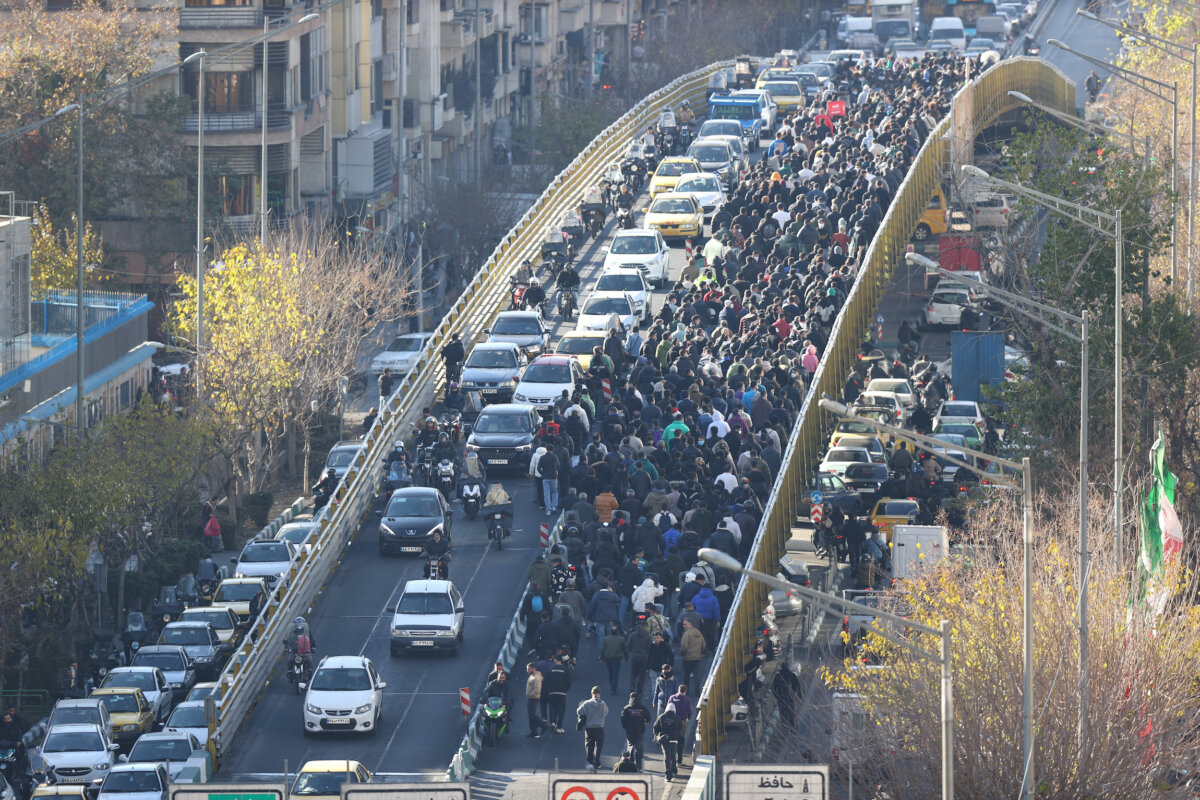
Several people have been killed during demonstrations in Iran over the nation’s ailing economy, according to accounts from Iranian media and rights groups on Jan. 1, with President Donald Trump warning Tehran against using force on protesters.
Rights groups and state-affiliated outlets have reported at least six to seven deaths nationwide since the unrest began earlier this week, although casualty figures could not be independently verified. The Fars news agency reported that three protestors were killed and 17 were injured on Jan. 1 in a police station attack in Iran’s western province of Lorestan.
Iranian state media reported that a local official in western Iran where deaths were reported warned that any illegal gatherings would be met “decisively and without leniency,” raising fears of further bloodshed.
One protester told the media outlet that refrigerators and pockets are empty, and people see themselves becoming poorer every day.
The protests have escalated as the biggest in Iran since 2022, when the death of 22-year-old Mahsa Amini in police custody sparked nationwide unrest.
“The rioters entered the police headquarters around 1800 (local time) on Thursday … they clashed with police forces and set fire to several police cars,” according to Fars.
Responding to the government’s management of a sharp currency slide and rapidly rising prices, shopkeepers began protesting on Dec. 28, 2025. Clashes between protestors and security forces have intensified since then.
Iran’s clerical rulers are dealing with Western sanctions that have devastated an economy already struggling with more than 40 per cent inflation. Also, Israeli and U.S. airstrikes in June 2025 targeting Iran’s nuclear and ballistic missile infrastructure and military leadership have impacted the country.
“Refrigerators are empty. Pockets are empty. Every day, people see themselves becoming poorer,” one protester said.
Fars and rights group Hengaw reported deaths in Lordegan city, which is located in Iran’s Charmahal and Bakhtiari province.
In the western city of Kuhdasht, authorities confirmed one death, and Hengaw reported another death in the central province of Isfahan.
According to the state-operated IRNA news agency, a separate demonstration on Dec. 31, 2025, resulted in the death of a 21-year-old volunteer in the paramilitary Revolutionary Guard’s Basij force.
Iranian news agency Student News Network blamed demonstrators for the Guard member’s death, referencing comments from Saeed Pourali, a deputy governor in Iran’s Lorestan province.
Trump on Jan. 2 warned Iran that if security forces “violently kill peaceful protesters,” the United States would “come to their rescue.” Writing on social media, Trump said the United States was “locked and loaded and ready to go.”
The president’s remarks came months after U.S. forces joined Israeli airstrikes in June 2025 that targeted Iranian nuclear facilities and military leadership, an episode that raised tensions between Tehran and Washington.
Iranian officials swiftly rejected Trump’s warning. Ali Larijani, a former parliament speaker who now serves as secretary of Iran’s Supreme National Security Council, accused the United States and Israel of stoking unrest and meddling in Iran’s internal affairs.
“Trump should know that U.S. interference in this internal matter would mean destabilizing the entire region and destroying America’s interests,” Larijani wrote on X, which is blocked in Iran.
“The American people should know—Trump started this adventurism. They should be mindful of their soldiers’ safety.”
Ali Shamkhani, an adviser to Supreme Leader Ayatollah Ali Khamenei and a former national security chief, issued a similar warning, saying on social media that any “intervening hand” that gets too close to the security of Iran would be “cut off.”
On Jan. 1, Iranian government spokesperson Fatemeh Mohajerani said that authorities would have direct dialogue with representatives of trade unions and merchants.
President Masoud Pezeshkian has also struck a conciliatory tone, acknowledging that government mismanagement played a role in the crisis while conceding his administration has limited tools to halt the currency’s collapse.
“We are to blame. … Do not look for America or anyone else to blame. We must serve properly so that people are satisfied with us. … It is us who have to find a solution to these problems,” Pezeshkian said on Jan. 1, before Trump threatened U.S. action.
Pezeshkian’s government has pursued a program of economic reform, but one of its measures—loosening currency controls—has helped drive a steep slide in the value of the Iranian rial on the unofficial market.
The currency’s fall has intensified inflation, which has hovered above 36 percent since March, in an economy strained by Western sanctions. In December, inflation reached 42.5 percent while the rial lost around half its value against the dollar in 2025.
In recent years, often with tough security measures and widespread arrests, authorities have silenced protests that have arisen over issues including droughts, high prices, women’s rights, and political freedoms.
Reuters contributed to this report.
 Friends Read Free
Copy
Facebook
Tweet
Friends Read Free
Copy
Facebook
Tweet