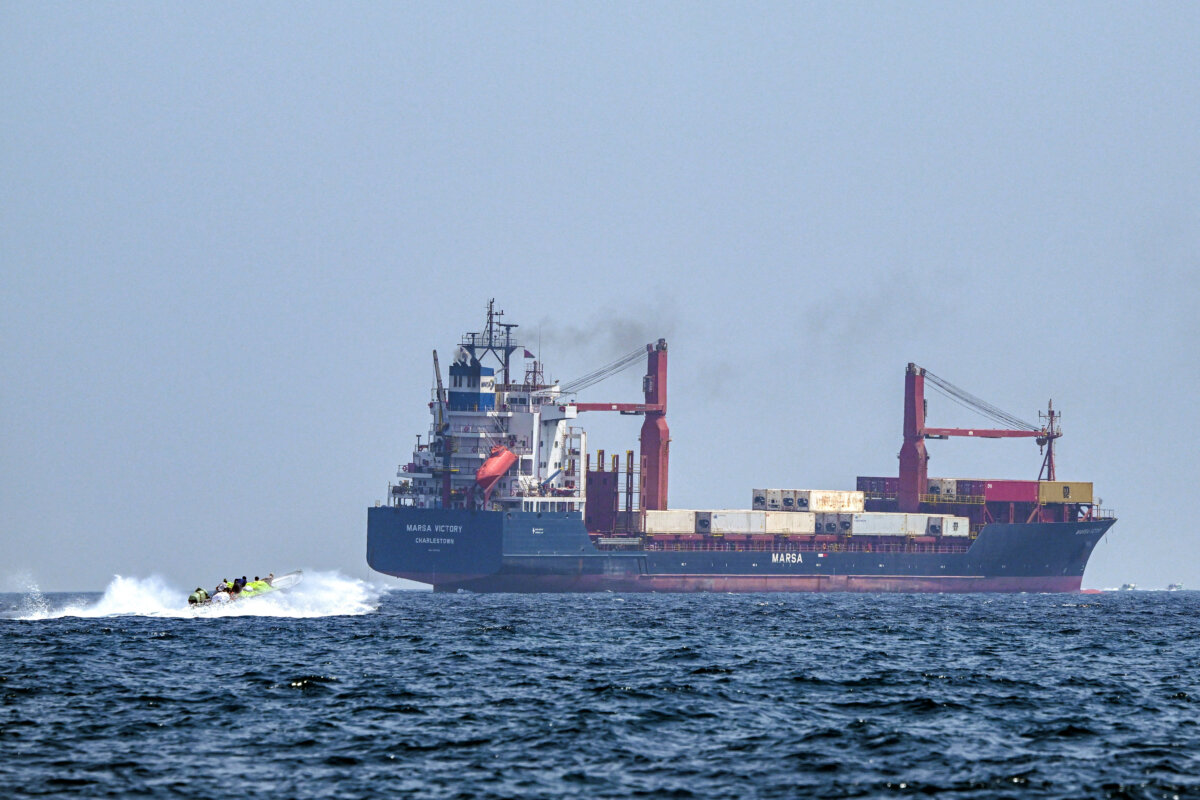

Major shipping companies have announced they are diverting their vessels away from Middle Eastern sea routes amid the ongoing conflict in Iran, with some operators opting to go around the Cape of Good Hope in South Africa.
The U.S. and Israeli militaries launched coordinated strikes on Iran on Feb. 28, with Tehran retaliating against its neighboring Gulf nations.
Maersk, CMA CGM Group, Hapag-Lloyd, and Mediterranean Shipping Company—some of the top shipping operators worldwide— announced changes to their transit routes or have ceased operations temporarily in the region.
In a March 1 statement, Maersk said it was pausing all Suez sailings through the Bab el-Mandeb Strait, a sea route chokepoint between the Horn of Africa and the Middle East, due to the “deteriorating security situation in the Middle East region following the escalating military conflict.”
The company said it was also suspending all vessel crossings in the Strait of Hormuz, located between Oman and Iran.
“All sailings on the ME11 (Middle East-India to Mediterranean) and MECL (Middle East-India to East Coast US) services will be rerouted around the Cape of Good Hope,” Maersk said.
“Once the situation stabilises and the security situation again permits, we will continue to prioritise the Trans-Suez route for ME11 and MECL services.”
Both sea routes are key transit points of the global oil supply. In 2023, the Strait of Hormuz accounted for 20.9 million barrels per day (mbpd) of the global maritime oil trade of 77.5 mbpd, according to approximate data from the Energy Information Administration, while the Bab el-Mandeb strait accounted for 8.6 mbpd of oil trade.
CMA CGM announced on Saturday that it had suspended passage through the Suez Canal, with ships being rerouted via the Cape of Good Hope.
On Monday, the company said a new Emergency Conflict Surcharge will be applied to cargo transits from several regions in the Middle East and North Africa, effective March 2, including Iraq, the United Arab Emirates, Saudi Arabia, Qatar, Sudan, Eritrea, and Egypt.
Hapag-Lloyd said in a Feb. 28 statement that it has suspended all vessel transits via the Strait of Hormuz due to security concerns.
On March 1, the company announced that a War Risk Surcharge rate would be imposed on cargo to and from the Upper Gulf, Arabian Gulf, and Persian Gulf areas, effective March 2.
Mediterranean Shipping Company announced on Monday the suspension of all worldwide cargo bookings to the Middle East, with operations only set to resume once the security situation improves.
Insurance Risks
Multiple ship insurers have also announced they are canceling war risk cover for ships in the conflict-prone Gulf region.
On Monday, insurance company The London P&I Club said that it was terminating war risk coverage to vessels in Iran and Iranian waters, including coastal waters up to 12 nautical miles offshore of the Persian/Arabian Gulf region and adjacent waters.
Insurance company The American Club also announced that it will terminate war risk cover for ships in Iran and Iranian waters, effective March 5.
On Sunday, President Donald Trump suggested the U.S.–Israeli military strikes against Iran could last up to five weeks. Trump previously said the operation’s aim is to eliminate threats from Iran and ensure that the regime can “never have a nuclear weapon.”
Within 24 hours of initiating strikes on Feb. 28, U.S. and Israeli forces struck more than 1,000 targets in Iran, according to U.S. Central Command.
The command said it had struck Iranian ballistic missile sites, but did not reveal the targeted sites or the strikes’ effectiveness.
Meanwhile, in a March 1 joint statement, the United States, Bahrain, Jordan, Kuwait, Qatar, the Kingdom of Saudi Arabia, and the UAE said they “strongly condemn” the Islamic Republic of Iran’s “indiscriminate and reckless missile and drone attacks against sovereign territories” in the Middle East.
Nations targeted by Iran include Bahrain, Iraq, Jordan, Kuwait, Oman, Qatar, Saudi Arabia, and the UAE, according to the statement.
“These unjustified strikes targeted sovereign territory, endangered civilian populations, and damaged civilian infrastructure,” the statement said.
“The Islamic Republic’s actions represent a dangerous escalation that violates the sovereignty of multiple states and threatens regional stability. The targeting of civilians and of countries not engaged in hostilities is reckless and destabilizing behavior.”
 Friends Read Free
Copy
Facebook
Tweet
Friends Read Free
Copy
Facebook
Tweet