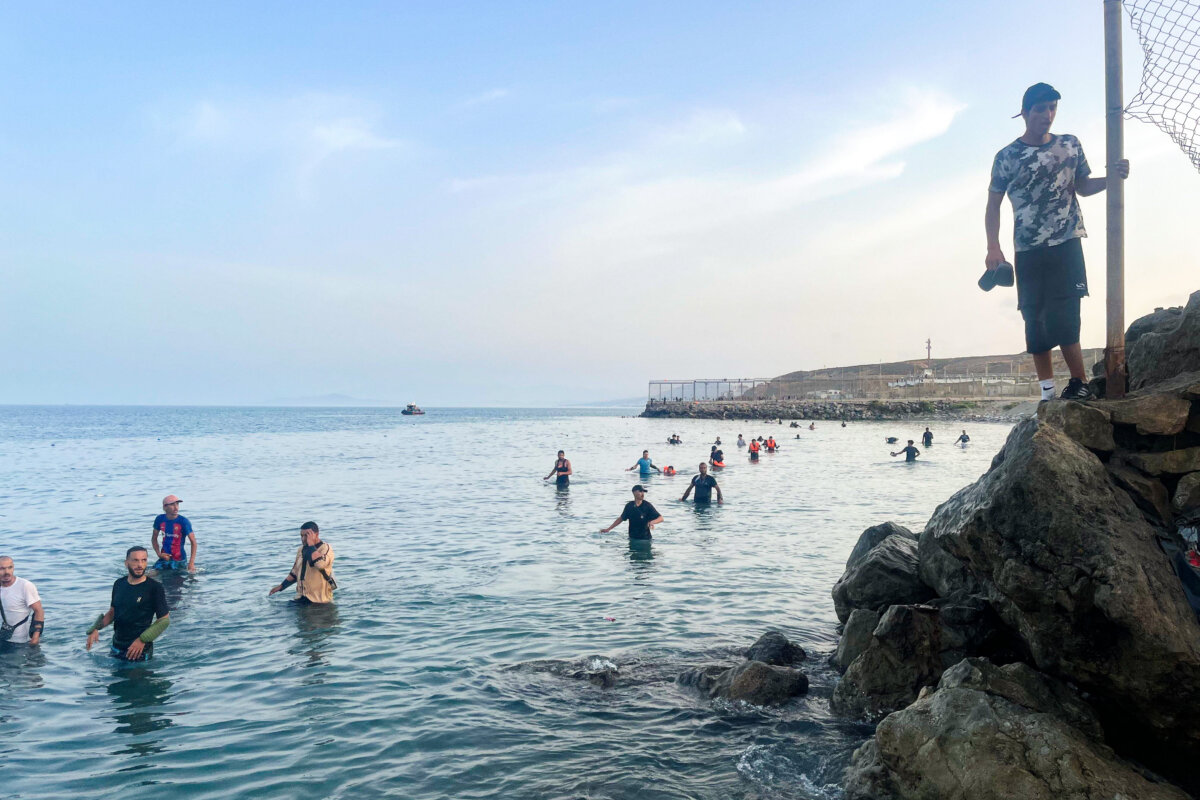

Spain has said the sovereignty of the North African exclaves of Ceuta and Melilla is not up for discussion, after a Moroccan minister repeated Rabat’s claims over the cities.
Moroccan Justice Minister Abdellatif Ouahbi made his remarks on Tuesday to Asharq TV, marking the first time Rabat has publicly voiced the contentious issue since Ceuta’s illegal immigrant crisis at the end of July, during which an estimated 72,000 people crossed into the exclave.
At least 96 people are believed to have died attempting to enter the exclave, with the majority of the border crossers swiftly returning to Morocco.
Morocco raises the issue of the autonomous cities’ status whenever it is in negotiations with Spain, with a long-term goal of achieving a resolution through dialogue, Ouahbi said.
Since becoming an independent country in 1956, Morocco has consistently regarded Ceuta and Melilla as Moroccan territory occupied by Spain, while Madrid has considered the two self-governing cities integral parts of its territory since the 17th and 15th centuries, respectively.
Prior to 1956, Morocco was under Spanish and French protectorate status, though not a colony. France controlled the majority of the territory, including the major cities of Rabat, Fes, and Marrakech, while Spain administered a smaller northern zone along the Mediterranean and Strait of Gibraltar.
Spain: Enclaves ‘Cannot Be Touched’
“Ceuta and Melilla aren’t just Spanish; they’re super-Spanish and cannot be touched,” Spanish Defense Minister Margarita Robles told reporters in Ceuta on Wednesday when asked about Ouahbi’s comments.
“Any attack on Ceuta and Melilla is an attack on Spain as a whole. It must never happen again,” she added, referring to the border crisis.
Spain’s socialist government has largely praised Moroccan authorities for their cooperation in swiftly repatriating the illegal immigrants, and blamed the crisis on people-smuggling mafias.
Spain’s Foreign Ministry said in a statement that Spain’s territorial integrity “has not been, and will never be, discussed with anyone.”
Morocco’s Interior Ministry said on Wednesday it had bolstered security near the borders with Ceuta and Melilla in response to online calls for another mass crossing attempt this coming weekend. The ministry warned it would prosecute organizers as well as participants.
“The ministry calls on everyone to remain vigilant and responsible and not to be drawn into such suspicious and misleading calls, given the risks they may pose to people’s lives,” it said in a statement.
Spanish media outlet El País reported that Juan Jesus Vivas, the mayor-president of Ceuta, told the European Parliament on Aug. 6 that what happened on July 30 and 31 was “not a typical migration crisis.”
“It is an episode through which our integrity has been put in check: That of Ceuta, that of Spain, that of Europe. … Our security is in the hands of a third country, Morocco, which does not recognize our sovereignty,” the veteran leader said in an Aug. 6 online session of the Home Affairs Committee of the European Parliament.
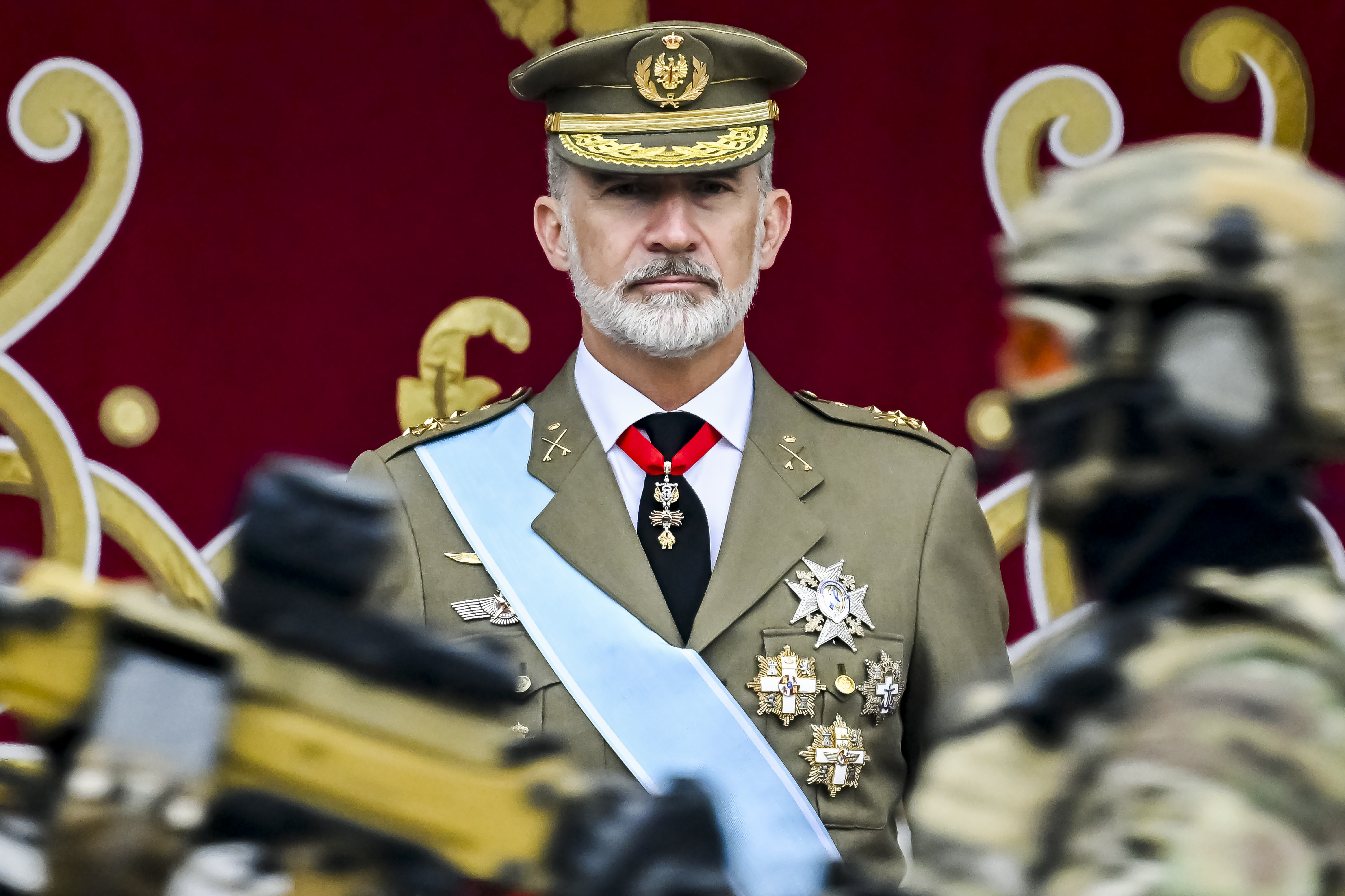 King Felipe VI of Spain attends the National Day Military Parade in Madrid on Oct. 12, 2024. (Carlos Alvarez/Getty Images)
King Felipe to Visit Ceuta
Vivas said that the king of Spain, Felipe VI, has promised to visit the autonomous city, which he has not previously done during his 12-year reign.
The king received Vivas at the palace in Palma last week, and during the visit, he pledged to come to Ceuta. No date has been announced for the royal visit, which will be diplomatically sensitive given Morocco’s claim to the territory.
El País reported that Spanish intelligence services have concluded that Rabat allowed and used the human wave over Ceuta, but did not plan it.
Vivas, who has been in office for 25 uninterrupted years, has criticized his North African neighbors since the mass border crossing, saying that Morocco has shown that it is “not reliable.”
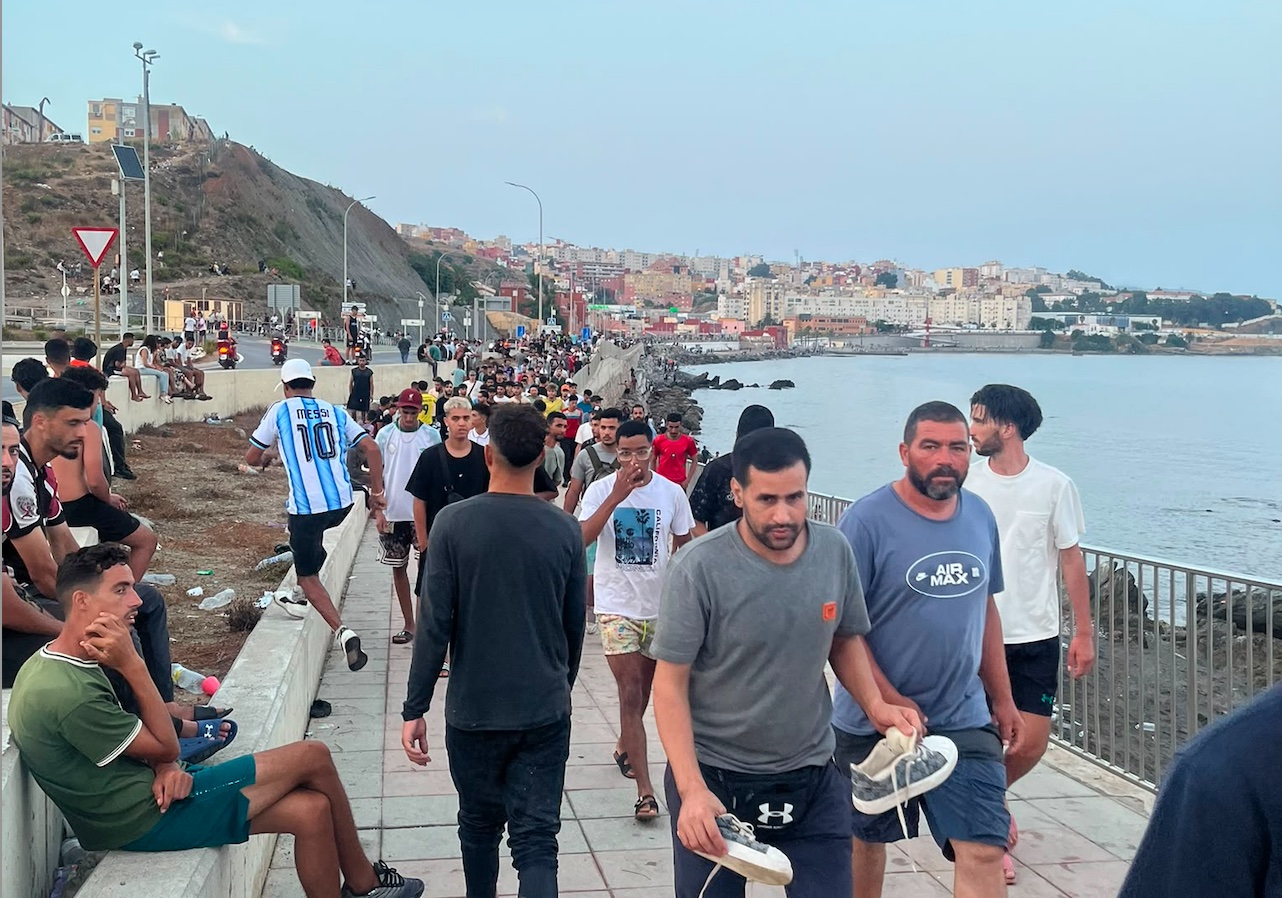 Moroccan migrants gather walk the coastal road near Avenida Martínez Catena in the Spanish territory of Ceuta on July 31, 2026. (Etienne Fauchaire/The Epoch Times)
Spain’s Amnesty Blamed by Morocco
Moroccan officials have defended their authorities and pointed to Spain’s amnesty for half a million illegal immigrants as having provided the draw for migrants from the African continent to try their luck in the Ceuta breach.
Ouahbi said it was very difficult for Morocco to prevent people from leaving his country if they believed they could simply walk or swim over the border and be allowed to stay, Spanish radio broadcaster Cadena SER reported on Thursday.
According to the broadcaster’s translation, the Moroccan minister said, “If Spain announces that it is willing to receive all immigrants, why do we force people to jump over fences and jump into the sea?”
Ouahbi said that some illegal immigrants from sub-Saharan countries detained by the Moroccan authorities question this contradiction.
“Why are you blocking our way if Spain is going to accept us?” the minister said some migrants ask.
Many of the illegal immigrants went back voluntarily after they saw that there was little chance of reaching mainland Europe, or that the tiny exclave of about 84,000 people was not going to accommodate them, according to Spanish authorities.
Those who didn’t immediately turn back willingly were rounded up, placed on trucks, and returned to the border. However, more than 1,300 minors remained in the exclave, as, according to Spanish law, they are entitled to the care of the state and cannot be deported in the same way as adults.
According to Cadena SER, the minister pointed to complaints of rape and assault against minors who crossed into Ceuta.
“That’s why we say to Spain: ‘give us back the minors,'” he said.
Spanish Youth Minister Sira Rego said last week that Madrid would consider Morocco’s offer to repatriate the children on a case-by-case basis, and that family reunification would be facilitated whenever possible.
Reuters contributed to this report.
 Friends Read Free
Copy
Facebook
Tweet
Friends Read Free
Copy
Facebook
Tweet