
Americans currently visiting Nepal were advised on Sept. 9 to shelter in place until further notice, due to ongoing destructive protests in the nation’s capital.
“Due to escalating political unrest and violent demonstrations, all U.S. citizens are strongly advised to shelter in place until further notice,” the U.S. Embassy in Kathmandu announced. “Avoid all travel unless absolutely necessary in an emergency.”
The embassy also shared reports that flights out of Tribhuvan International Airport in Kathmandu and Pokhara International Airport in Pokhara have been suspended indefinitely.
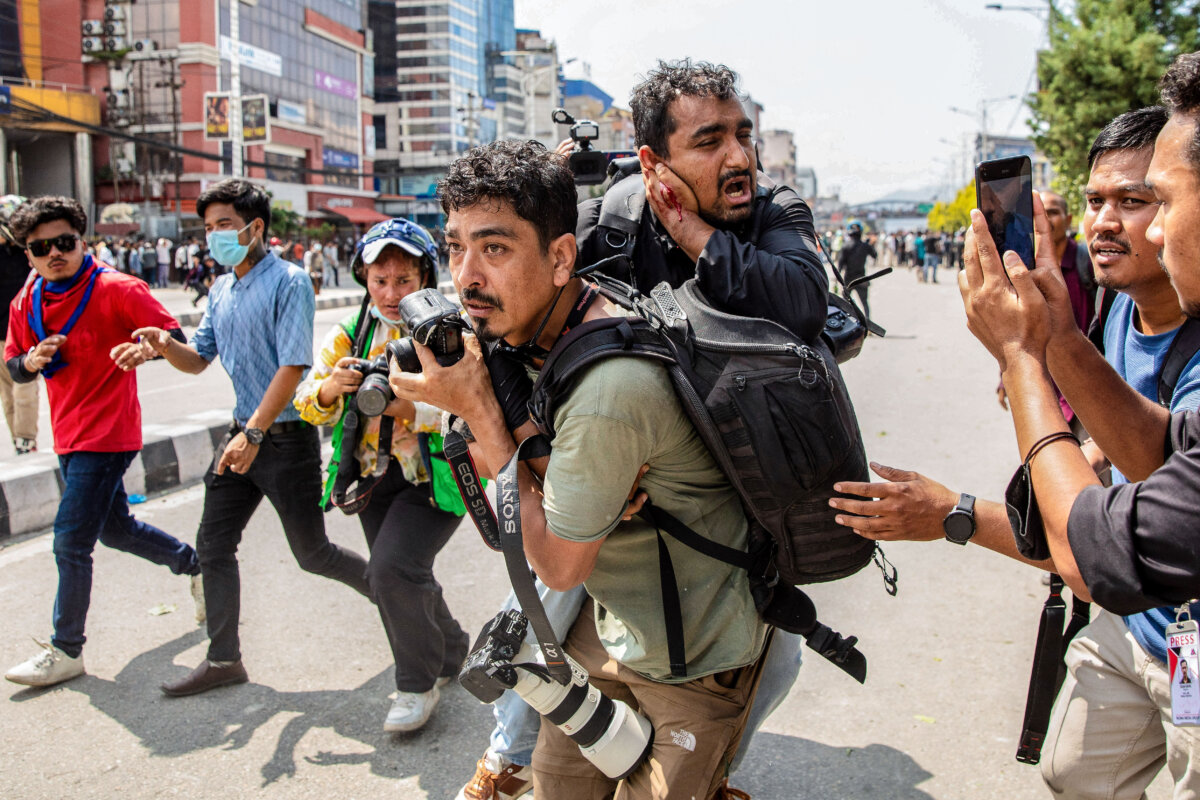
Sept. 9 marked the second day of violent protests, sparked by the Nepalese parliament’s decision to enforce stringent regulations on social media in the country to curb the spread of what it calls misinformation, which resulted in several platforms, including Facebook, being banned outright.
Tens of thousands of people—mostly of the Generation Z population—flooded the streets on Sept. 8 and surrounded the parliament building.
“Stop the ban on social media. Stop corruption, not social media,” the crowds chanted, waving national flags.
Police opened fire. At least 19 people were reported to have been killed, and several more were injured.
The protests continued the following day. But this time, the purpose shifted to revolting against the apparent corruption of the current government’s ruling class amid a 2024 youth unemployment rate of 20 percent, according to the World Bank. The government estimated that more than 2,000 young people were leaving the country every day to seek better opportunities in the Middle East or Southeast Asia.
“I am here to protest about the massive corruption in our country,” Bishnu Thapa Chetri, a student, told The Associated Press. “The country has gotten so bad that for us youth, there is no grounds for us to stay.”
The protests did not stay peaceful. People started attacking buildings and physically assaulting lawmakers and ministers. The private homes of Nepalese Prime Minister Khadga Prasad Oli, Nepalese President Ram Chandra Poudel, and the leader of the Communist Party of Nepal (Maoist) were set on fire. Military helicopters were flown in to evacuate politicians to safety.
Oli wrote a letter of resignation to the president, who accepted it and is in the process of looking for a “new leader.”
Nepalese army chief Ashok Raj Sigdel urged protesters in a video message to stop their demonstration to prevent further loss of life and property. But Nepalese security forces had yet to be deployed in response to the protests.
The Associated Press contributed to this report.
 Friends Read Free
Copy
Facebook
Tweet
Friends Read Free
Copy
Facebook
Tweet