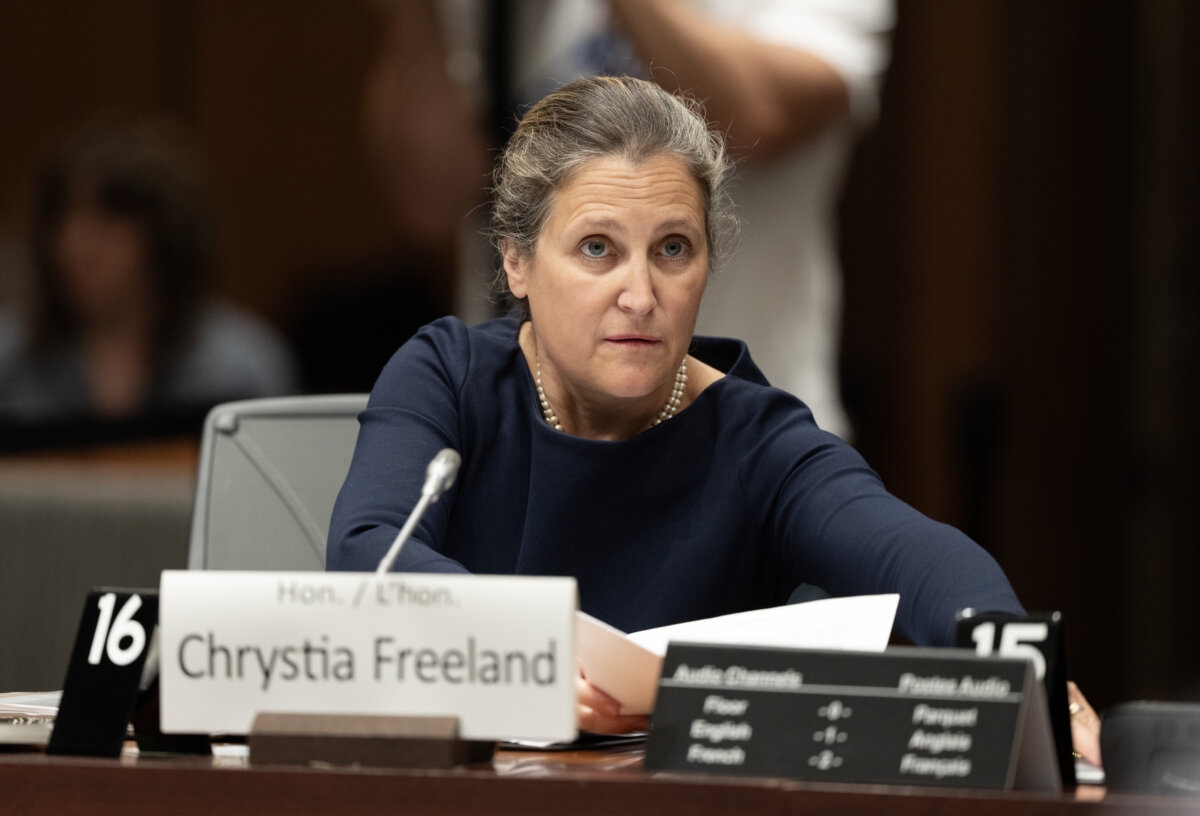


Federal ministers told MPs they are “dismayed” and “disappointed” by BC Ferries’ decision to purchase vessels from Chinese shipyards, but they won’t ask the Canada Infrastructure Bank (CIB) to cancel the $1 billion loan it provided the corporation for the purchase.
Infrastructure Minister Gregor Robertson, who oversees the CIB, and Transport Minister Chrystia Freeland made the comments on Aug. 1 as they testified before the House of Commons transport committee, which is reviewing the issue.
In June, BC Ferries announced it had hired state-owned China Merchants Industry Weihai Shipyards to build four vessels. The announcement came amid concerns with Chinese interference in Canada, as well as the United States imposing 50 percent tariffs on steel and aluminum, which has prompted Ottawa to prioritize “buy Canadian.”
No Canadian shipyard participated in the procurement process, with B.C. shipyard Seaspan saying it didn’t bid on the contract due to the difficulty of competing with countries that have lower industry standards.
Robertson told the committee that Ottawa had no role in approving the $1 billion CIB loan for purchase of the vessels, saying the infrastructure bank operates at arm’s length from the federal government.
“I cannot and will not interfere in the business of the infrastructure bank,” he said.
Robertson said he’s “disappointed” by BC Ferries’ decision to hire a Chinese state-run shipyard, but argued the new ships will benefit Canadian workers through “hundreds of millions of dollars in Canadian based maintenance [and] service support over the life of these vessels.”
“BC Ferries are essential to the B.C. economy, which is a critical piece of the Canadian economy,” Robertson added.
Robertson, who became housing minister on May 13, said he only became aware of the CIB loan to BC Ferries on June 11 once it was too late to reverse-course on the deal signed March 28. He added that the “lion’s share” of the 102 projects the CIB has provided funds for support Canadian infrastructure, businesses, and workers.
Robertson said his policy directions going forward would focus on a “buy Canada” approach.
Tory MP Leslyn Lewis, who serves as her party’s infrastructure critic, expressed disbelief that it took Robertson one month to learn about the CIB loan. Lewis subsequently put forward a notice of motion to abolish the CIB, saying its loan to BC Ferries violates section 6 of its founding act, which pledges to invest and attract investment in the Canadian public interest and with an aim to strengthen the sustainability of Canada’s infrastructure.
Freeland Testimony
Freeland testified at the committee before Robertson and said that Transport Canada has provided $38 million in annual support to B.C. for ferry operations. She said she received assurances that this money would not be used in the procurement of Chinese ships.
Opposition MPs pressed Freeland on whether she supported cancelling the CIB loan but she did not answer the questions.
Freeland had written a letter to her provincial counterpart in B.C. in June, expressing “great consternation” with the decision to buy Chinese ships and requesting assurances that BC Ferries conducted a “robust risk assessment” of the deal.
Conservative MP Dan Albas asked Freeland if Ottawa was “standing by” the loan decision, and whether she favoured cancelling the loan. Freeland responded that there had been “widespread disappointment across Canada with this procurement,” which was why she was ensuring procurement would favour Canadian manufacturers.
“You have an opportunity to say no to this loan,” Albas responded. “Why aren’t you saying, ‘No, I won’t support this loan, it’s contrary to what the government’s intentions are and what Canadians are asking for.’”
Freeland reiterated that she was disappointed by the decision, and that she was doing “everything in my power” to ensure Canadian workers, steel, and aluminum are prioritized.
“I’m going to stay in my lane and answer the questions about areas I have responsibility,” Freeland said.
Regarding her areas of responsibility, Freeland said she has asked all organizations under Transport Canada, including ports, to use Canadian steel and aluminum in their purchases wherever possible, as well as prioritizing purchases from countries Canada has reciprocal trade agreements with.
Freeland said she is convening a meeting with the provinces and territories, ferry owners, shipyards, and steel and aluminum industry representatives to discuss “the challenges related to the procurement of ferries in Canada.”
CIB CEO Ehren Cory spoke Aug. 1 before the committee, saying that CIB’s loan to BC Ferries benefits Canadians regardless of where the ferries are being built.
“The idea of each loan is to try and deliver maximum benefits to Canadians, and it’s up to each of our project proponents, from critical mining companies to ferry companies to broadband companies, to figure out their global supply chains in accordance with Canadian law,” Cory said.
He added that when discussions began in September of last year with BC Ferries about a loan, where the vessels would be constructed was not yet known and “wasn’t part of the decision,” as the focus was on benefiting the approximately 23 million customers who use BC Ferries annually.
Asked by Liberal MP Stéphane Lauzon about whether mandating Canadian labor and materials in projects comes down to political will, Cory said “yes,” adding that if the government mandated BC Ferries to source vessels from Canada, the CIB would support that indirectly—possibly by increasing its loan. However, he noted that repaying a larger loan could mean higher fares for ferry riders.
“The CIB will respond to any, you know, any broader direction of government, they’re our shareholder,” Cory said.
The committee passed a motion in a 5–4 vote for all documents relating to the BC Ferries procurement and loan to be submitted in the next two months.
BC Ferries CEO Says Options Limited
The head of BC Ferries also appeared before the committee on Aug. 1 and explained the current strains on the system, the procurement process, and the impact cancellation of the order would have.
BC Ferries CEO Nicolas Jimenez said that the company ran at 92 percent capacity in 2024. He said travel demand is expected to rise by 15 percent, and that even with four new vessels demand will outpace capacity.
“Last summer, our major route sailings ran at an average of 92 percent capacity, and we left a quarter of a million people behind because we were full,” he said.
Jimenez said that while BC Ferries adjusted its procurement process qualifications specifically to allow Canadian shipyards to qualify, none chose to formally submit a proposal. He said the six compliant bids that the company received were from foreign countries.
Jimenez said while one Quebec shipyard “showed interest,” it ultimately declined to submit a proposal. He said Canadian shipyards are at maximum capacity because of their commitment to the federal National Shipbuilding Strategy, and the company “didn’t have the luxury to wait for those yards and their order books to become open and available.”
“We chose the proposal that offered the best combination of value, quality, delivery, timelines and protections for our customers throughout the build,” Jimenez said, adding that a Canadian team will be on site in China to ensure the ships meet expected standards.
Jimenez said if the procurement process for the new ships or the CIB loan were to be cancelled, it would have a “huge impact” on local communities. He said BC Ferries does not have any reserve vessels, “so every time a ship goes down, the system suffers, and this is particularly acute … on our busiest routes.”
 Friends Read Free
Copy
Facebook
Tweet
Friends Read Free
Copy
Facebook
Tweet