

U.S. President Donald Trump said on April 21 that the United States was considering a currency swap with the United Arab Emirates to help the Gulf state financially.
When asked on CNBC’s “Squawk Box” whether a currency swap between Washington and Abu Dhabi was being considered, Trump said “it is,” describing the Middle Eastern state as a “good country” that had been a “good ally” of the United States.
“They were hit the hardest of the group, actually. And they’re really led by incredible people,” he said.
Trump said he was surprised the UAE might need financial aid, since they are “really rich,” and added that the Emiratis were “very good” for the United States.
“So, if I could help them, I would. I mean, we’re helping them much more with what we’re doing with the war because, you know, the bully of the Middle East was Iran,” he said.
The UAE is home to the Al Dhafra Air Base, which is shared by the U.S. and Emirati air forces, and serves as a critical hub for American military operations in the region.
Emirati Ambassador to the United States Yousef Al Otaiba said in a statement on X that he appreciated Trump’s recognition of his country as an important trade and economic partner, adding that it “reflects the depth of a relationship built on mutual interest, mutual investment & long-term strategic confidence.”
However, he added that “any suggestion that the UAE requires external financial backing misreads the facts,” calling his nation “one of the world’s most financially resilient economies.”
The Middle Eastern monarchy has been pounded by repeated attacks from Iranian drones and missiles since the outbreak of the war.
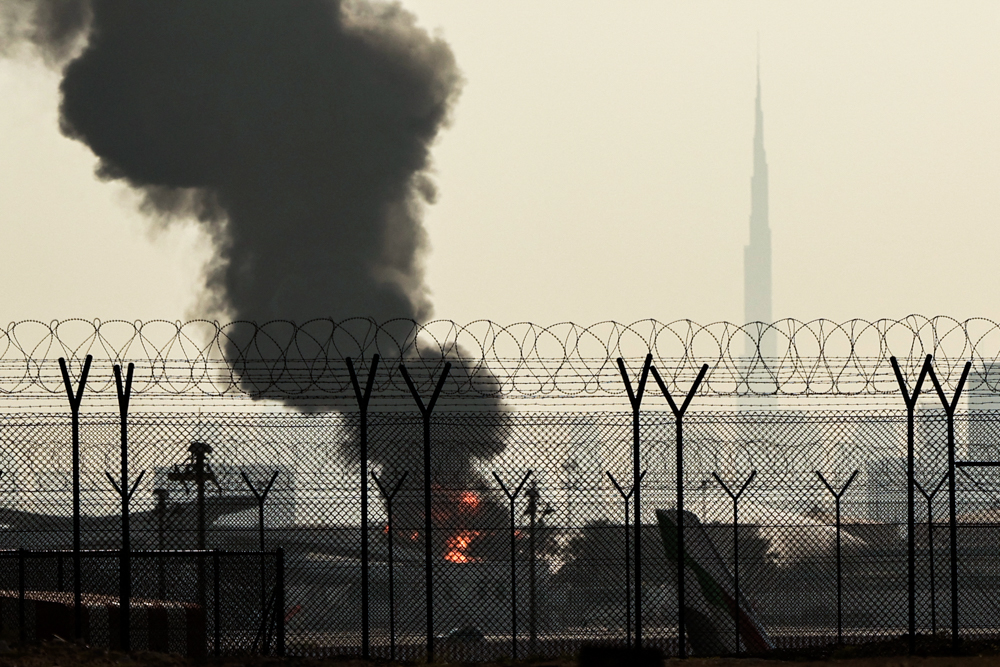
Last week, Emirati Minister of State for International Cooperation Reem Al Hashimy told ABC News’s “This Week With George Stephanopoulos” that over the previous 40 days, the country had been attacked by a “little over 2,800” missiles and drones, adding that “over 90 percent of all of their targets” were civilian infrastructure, such as hotels and airports.
Al Hashimy said she was concerned about the prospect that Iran would retain the power to attack the UAE, even in the event of a peace deal. She said that the Islamic Republic wanted to “break what it was that made the UAE special, which is this incredible model of prosperity and tolerance.”
When asked about the prospects of such a deal, she said Abu Dhabi does want peace in the region, “but it can’t be a bad peace.”
“It can’t be a peace where it doesn’t address the root causes, which is Iran dealing with proxies like Hezbollah and Hamas and the Houthis having a nefarious missile and drone program, a nuclear enrichment program, being able to weaponize the straits,” she said.
She also described Iran’s ability to control vital shipping lanes such as the Strait of Hormuz as “a really serious tool” that can “hurt cities from Des Moines to Delhi in spiking up fuel prices and spiking up food prices.”
Reuters contributed to this report.
 Friends Read Free
Copy
Facebook
Tweet
Friends Read Free
Copy
Facebook
Tweet