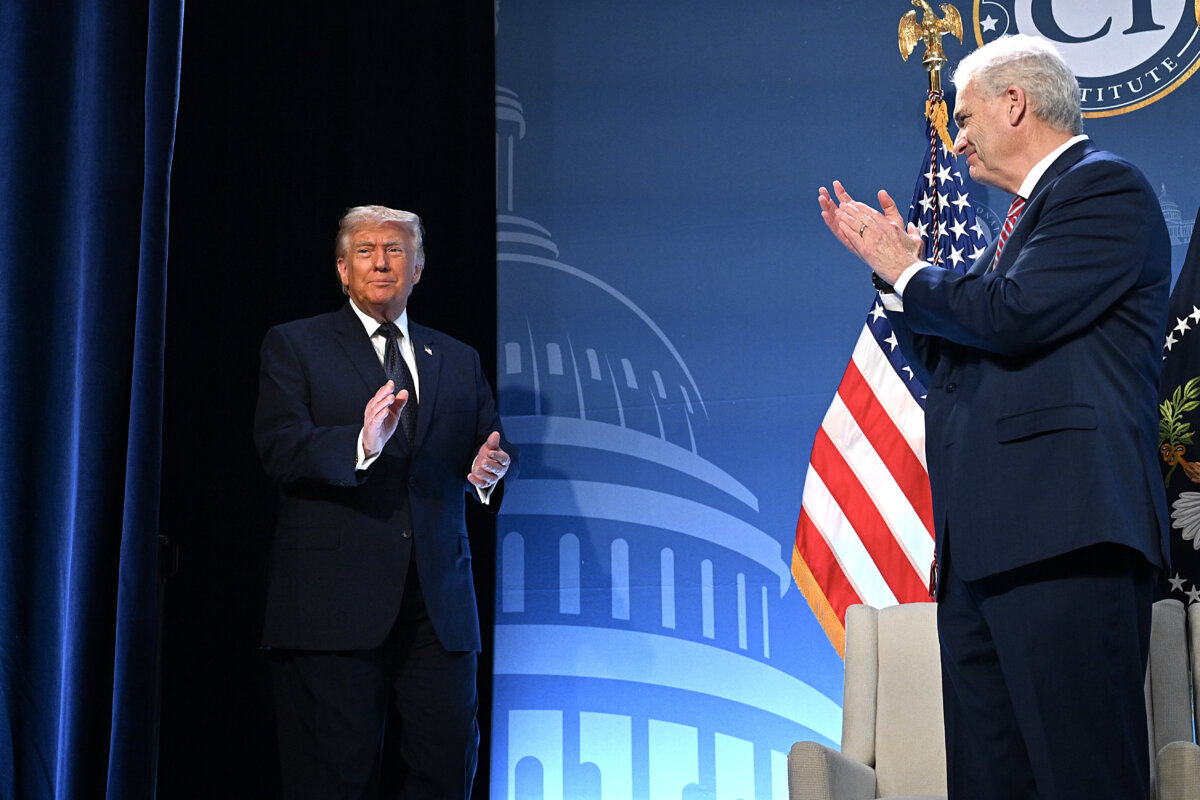

The war in Iran could be over soon after U.S. and Israeli military operations have wiped out Iranian ships and most of the regime’s missile and drone capabilities, President Donald Trump told reporters on March 9.
“We’re winning very decisively. We’re way ahead of schedule,” Trump told reporters at his National Doral golf club in Miami before heading back to Washington. “It’s going to be ended soon.”
“And if it starts up again, they’ll be hit even harder,” he said.
Trump said he believes Iran would have taken over the Middle East if the United States and Israel hadn’t struck when they did.
“We stopped it with good timing, and we’re very proud to be involved in this,” Trump said.
The president said the conflict would take at least another week to conclude. He didn’t provide a definitive timeline of when he expects military operations to cease in the region.
Trump was optimistic about global oil and gas supplies, despite the ongoing conflict. Military operations have put an end to terror attacks launched at hundreds of commercial vessels traveling through the Strait of Hormuz, he said.
The Trump administration created a $20 billion federal reinsurance program for commercial oil and gas vessels last week, in a bid to restore tanker traffic in the Strait of Hormuz and stabilize global energy markets.
“We’re putting an end to all of this threat once and for all, and the result will be lower oil prices, oil and gas prices, for American families,” Trump said.
“We’ve brought it very low. This was just an excursion into something that had to be done. We’re getting very close to finishing that, too,” he said.
The United States also waived some oil-related sanctions temporarily, and the president floated the idea of permanently removing the sanctions.
“We’re in a very good position, but very unfair to other parts of the world,” Trump said. “We’re doing this for the other parts of the world, including countries like China.” He expects to meet with Chinese leader Xi Jinping “in a short period of time,” he said.
News of a possible end to the fighting in the Middle East sent oil prices plunging, after they smashed the $100 mark earlier in the day for the first time in nearly four years.
The price of West Texas Intermediate (WTI) settled at $87.75 a barrel by the end of the day, and Brent Crude landed at $91.35 a barrel.
The U.S. president also told reporters he hoped Iran’s new leaders would not continue seeking ways to build a nuclear weapon. U.S. military operations have obliterated key military sites in the past, but the country’s leaders have rebuilt them in other areas.
After U.S. strikes on three Iranian nuclear facilities in June 2025, “the regime was trying to reconstitute its nuclear weapons,” Trump said.
“They were starting to work at a different site … protected by granite,” rapidly building conventional ballistic missiles, he said.
Trump warned Iran’s incoming leadership that if it took similar actions to try to rebuild a nuclear program, “they’ll get hit at a much, much harder level.”
“They will never be able to recover if they want to play that game,” Trump said.
Trump expressed disappointment at Iran’s pick of Mojtaba Khamenei to succeed his father as Iran’s supreme leader. The president told reporters it would lead to “more of the same.”
Trump said he would like a candidate inside Iran who was “internal and eternal.”
Meanwhile, Iran’s capital was rocked by multiple heavy explosions March 9. Strikes around midnight were the heaviest since the beginning of the war.
Meanwhile, the U.S. State Department on Monday ordered the departure of nonessential staff and families from Saudi Arabia and the U.S. consulate in Adana, Turkey. Ten U.S. embassies and consulates in the region have reduced staffing, although only two have fully suspended operations.
 Friends Read Free
Copy
Facebook
Tweet
Friends Read Free
Copy
Facebook
Tweet