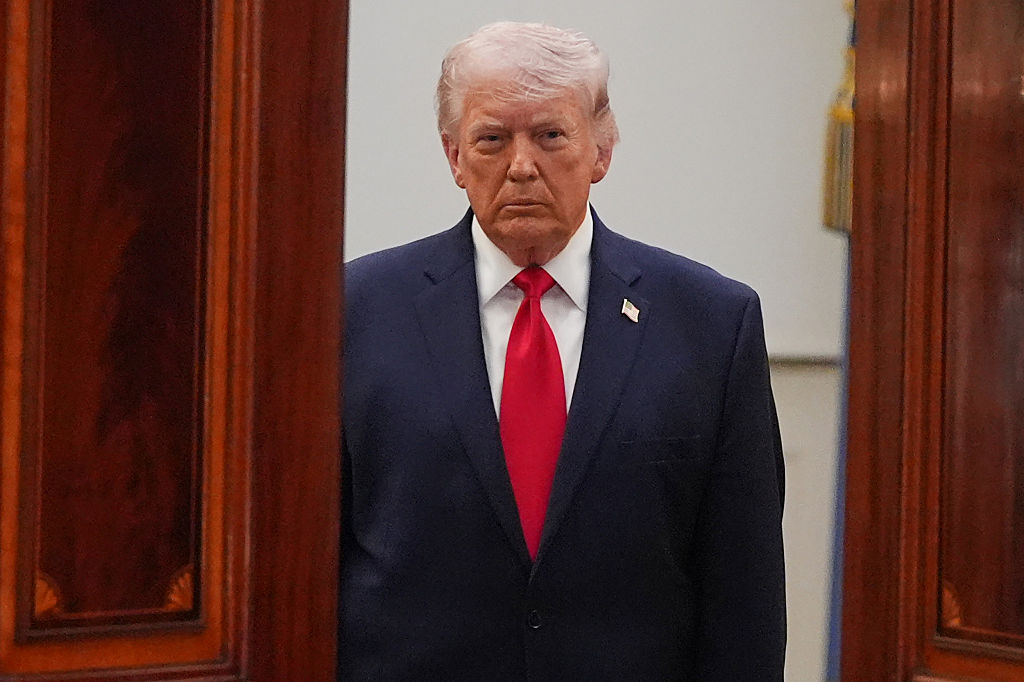

President Donald Trump warned on April 13 that the United States could destroy any Iranian vessels approaching its newly announced blockade of the Strait of Hormuz.
“Warning: If any of these ships come anywhere close to our blockade, they will be immediately eliminated, using the same system of kill that we use against the drug dealers on boats at Sea,” Trump said in a post to TruthSocial. He was alluding to operations used against drug trafficking vessels in the Caribbean and Pacific.
Trump said Iran’s navy had been largely destroyed, with 158 ships “completely obliterated.” He added that smaller “fast attack ships” had not been targeted previously because they were not considered a significant threat.
The blockade was announced on Sunday and went into effect on Monday, following the collapse of negotiations between the United States and Iran in Islamabad.
U.S. Central Command later clarified that ships traveling between non-Iranian ports would still be allowed to pass through the strait, allowing continued traffic through one of the world’s most important shipping routes as long as Iranian ports are avoided.
In a post on Truth Social, Trump said 34 vessels passed through the Strait of Hormuz on Sunday.
Although traffic had slowed prior to the blockade, maritime tracking data showed that more than 40 commercial vessels had passed through the strait since a two-week ceasefire was announced April 7. The strait handled about 20 percent of global oil shipments before the war.
The blockade affected global energy markets with oil prices rising sharply following the announcement. U.S. crude increased 8 percent to $104.24 per barrel, and Brent crude rose 7 percent to $102.29. Before the conflict began in late February, Brent crude was priced at around $70 per barrel.
Iran’s Revolutionary Guard responded by asserting that the strait remains under its “full control” and open to civilian shipping, while warning that military vessels would face a “forceful response,” according to Iranian media reports.
During the weekend’s 21-hour negotiations in Pakistan, the U.S. military said two destroyers passed through the strait ahead of planned mine-clearing operations—something it described as the first such movement since the conflict began. Iran disputed that account.
The talks, which ended early Sunday, failed to produce an agreement, and neither side has outlined what will happen after the current ceasefire expires on April 22.
Vice President JD Vance, who led the U.S. delegation, emphasized that Washington is seeking a firm commitment from Iran not to pursue nuclear weapons.
Iranian negotiators were unwilling to accept several key U.S. demands. These included permanently abandoning nuclear weapon development, ending uranium enrichment, dismantling major facilities, surrendering highly enriched uranium, reopening the Strait of Hormuz fully, and halting support for groups such as Hamas, Hezbollah, and Houthi forces.
The Associated Press contributed to this report.
 Friends Read Free
Copy
Facebook
Tweet
Friends Read Free
Copy
Facebook
Tweet