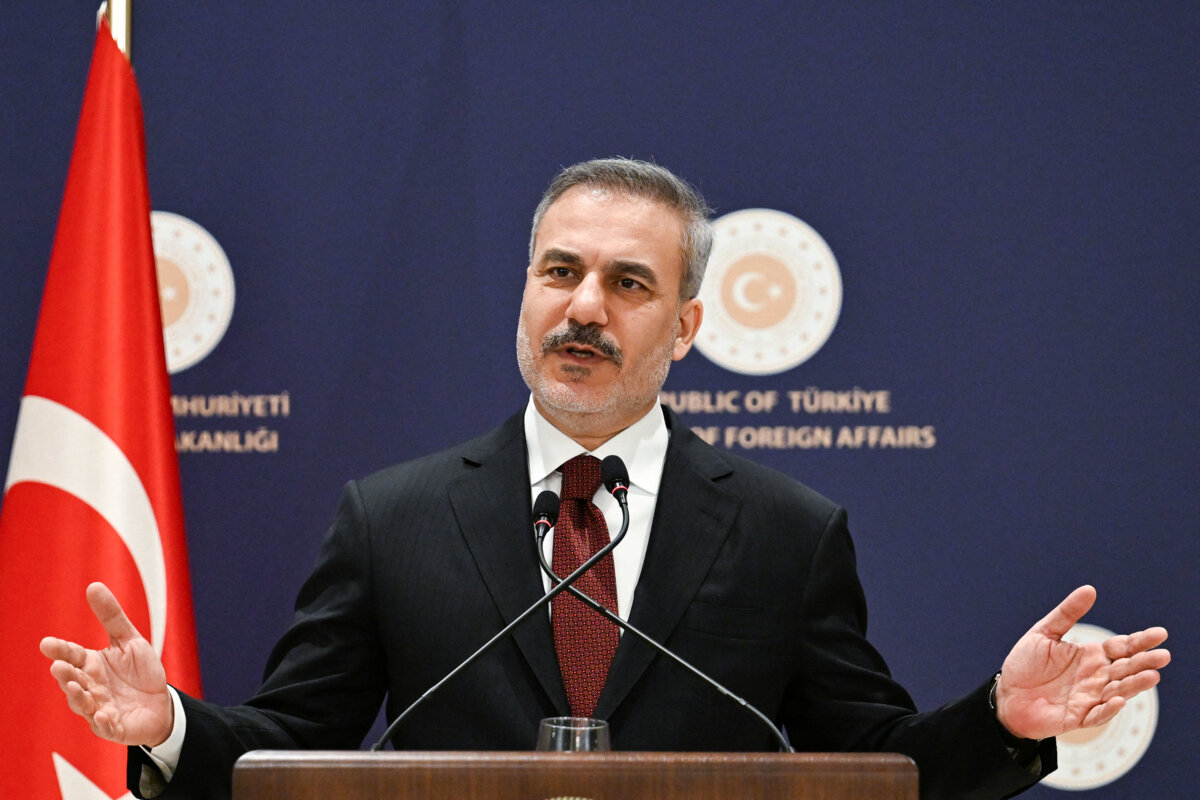

Turkish Foreign Minister Hakan Fidan said Ankara is prepared to provide technical military assistance to Saudi Arabia if needed under the Mecca Defense Alliance, as Houthi attacks on the kingdom continue.
Saudi Arabia, Turkey, and Pakistan signed a defense agreement in August under which an attack on one would be treated as an attack on all three.
The alliance brings together Saudi Arabia, which has the Gulf’s largest military; Turkey, which has NATO’s second-largest army after the United States; and Pakistan, the world’s only nuclear-armed Muslim nation.
Speaking in an interview with Turkish broadcaster NTV on Sept. 19, Fidan said Turkey and its alliance partners would honor the Makkah (Mecca) Joint Defence Agreement.
When asked whether recent Houthi attacks on Saudi Arabia could trigger the trilateral defense agreement, Fidan said: “As members of the Mecca Alliance, we are closely following the situation. … Military needs may be particularly related to certain technical issues. We will not have any difficulty in meeting these needs.”
Fidan said the Mecca Alliance is open to other regional countries as members move to institutionalize the alliance.
Following an intercepted drone attack on the Islamic holy city of Mecca last week, Pakistani Prime Minister Shehbaz Sharif condemned the attempt to target the sacred site but did not mention the Houthis by name.
Fidan rejected suggestions that the Mecca Alliance existed only on paper. Comparing it to NATO, he said that collective defense agreements should not be judged solely by whether they have been activated.
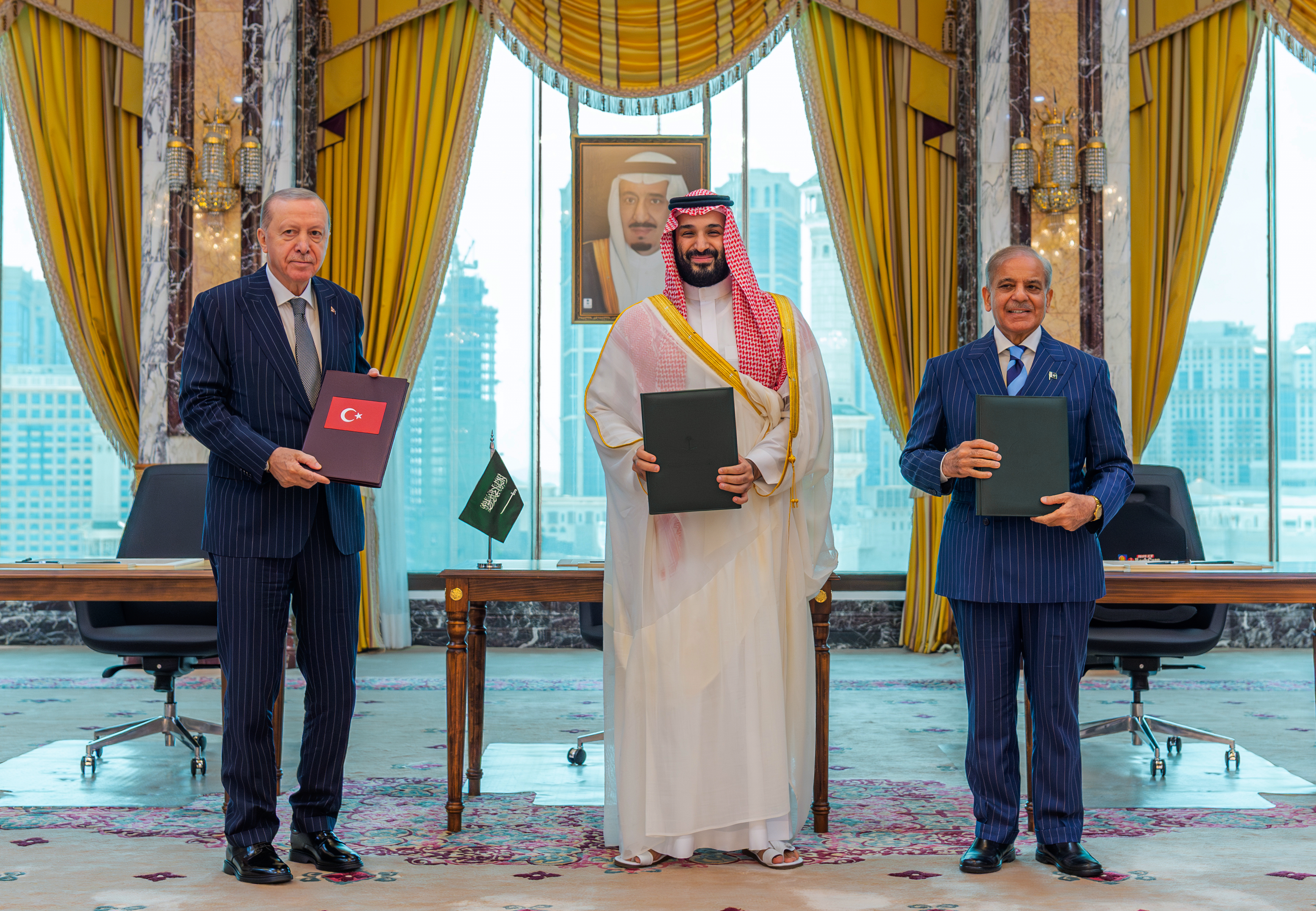 Turkish President Recep Tayyip Erdogan (L), Saudi Crown Prince Mohammed bin Salman (C), and Pakistani Prime Minister Shehbaz Sharif (R) in Mecca, Saudi Arabia, on Aug. 7, 2026. (Saudi Press Agency/AP)
Saudi military spokesman Maj. Gen. Turki Al-Malki said on Sept. 19 the Saudi forces intercepted a ballistic missile targeting Riyadh and thwarted attacks on the four cities of Baish, Taif, Farasan, and Yanbu.
The Houthis, meanwhile, said Saudi warplanes carried out dozens of airstrikes across Yemen.
Houthi military spokesperson Brig. Gen. Yahya Saree said in a Sept. 20 statement that Saudi aircraft conducted 28 airstrikes during the previous 24 hours against the governorates of Taiz, Al-Jawf, and Marib, bringing the total number of airstrikes since what he described as the latest Saudi escalation to 760.
Security Concerns
The Saudi–Houthi fighting has heightened concerns over the security of energy infrastructure and shipping through the Bab el-Mandeb Strait, a key maritime chokepoint linking the Red Sea with the Gulf of Aden.
The attacks prompted Saudi Arabia to shut down its East–West Pipeline as a precaution on Sept. 11. U.S. Energy Secretary Chris Wright said he expected oil flows through the pipeline to resume shortly, although some industry analysts said the disruption could last for weeks.
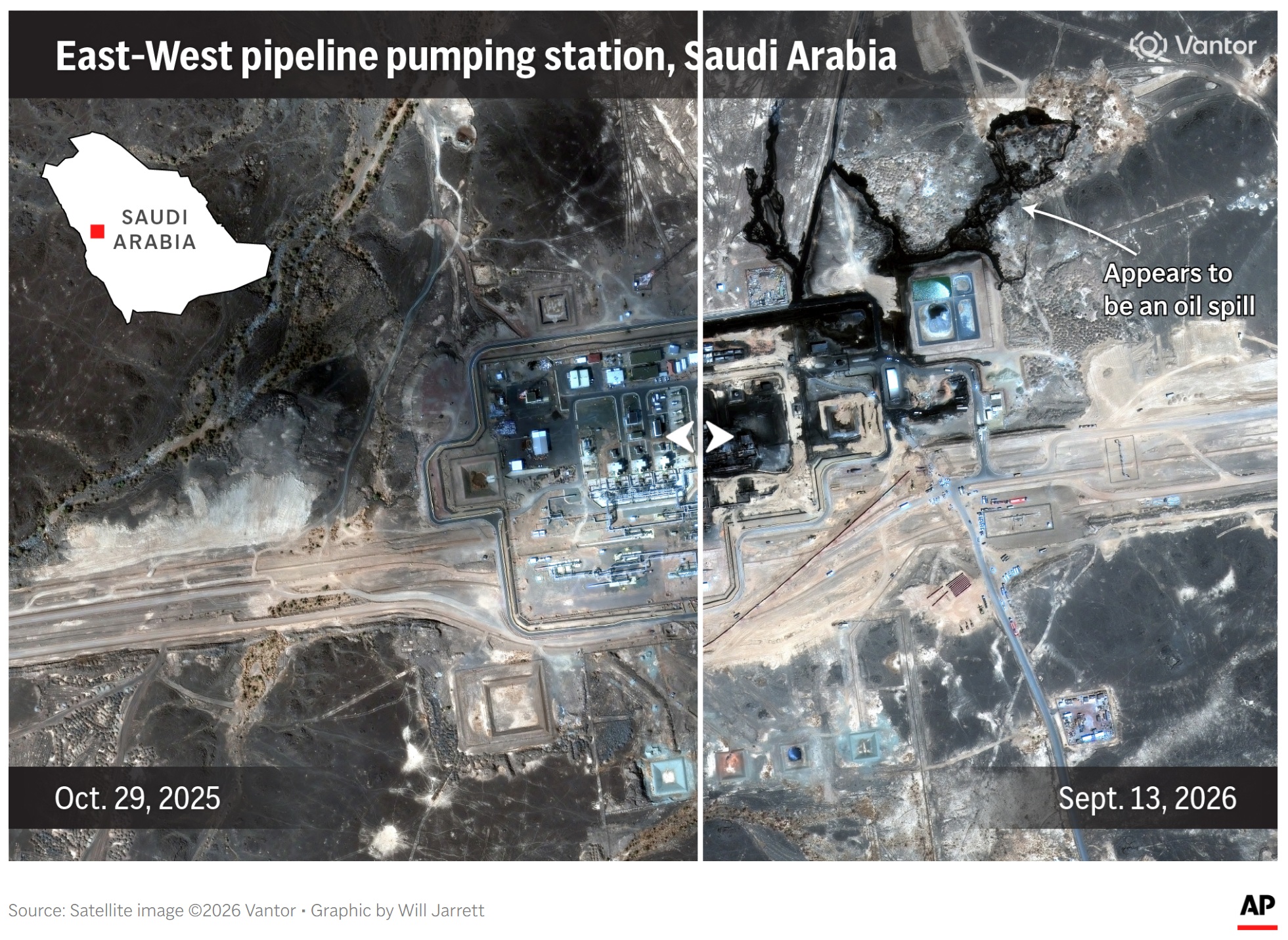 A slider showing damage to a pumping station on the East-West pipeline in Saudi Arabia. (AP Digital Embed)
Mohamed al-Bukhaiti, a member of the Houthis’ political bureau, said the group would not target U.S. or other foreign vessels transiting Bab el-Mandeb, with the exception of what he described as the “Saudi enemy.”
He said that Yemen was prepared to fight on multiple fronts should other countries become involved alongside Saudi Arabia.
His comments came after Saudi Arabia and Egypt pledged closer political and security coordination last week. Separated by the Red Sea, the two countries share strategic interests in securing key maritime trade routes linking the Mediterranean, Red Sea, and Gulf region, which are vital to both economies.
Speaking about the United States, Al-Bukhaiti said Washington had contacted the Houthis following their advance along Yemen’s western coast earlier this month. Separately, U.S. President Donald Trump said his administration had held discussions with the group and that the Houthis “don’t want to fight with us.”
The Associated Press contributed to this report.
 Friends Read Free
Copy
Facebook
Tweet
Friends Read Free
Copy
Facebook
Tweet