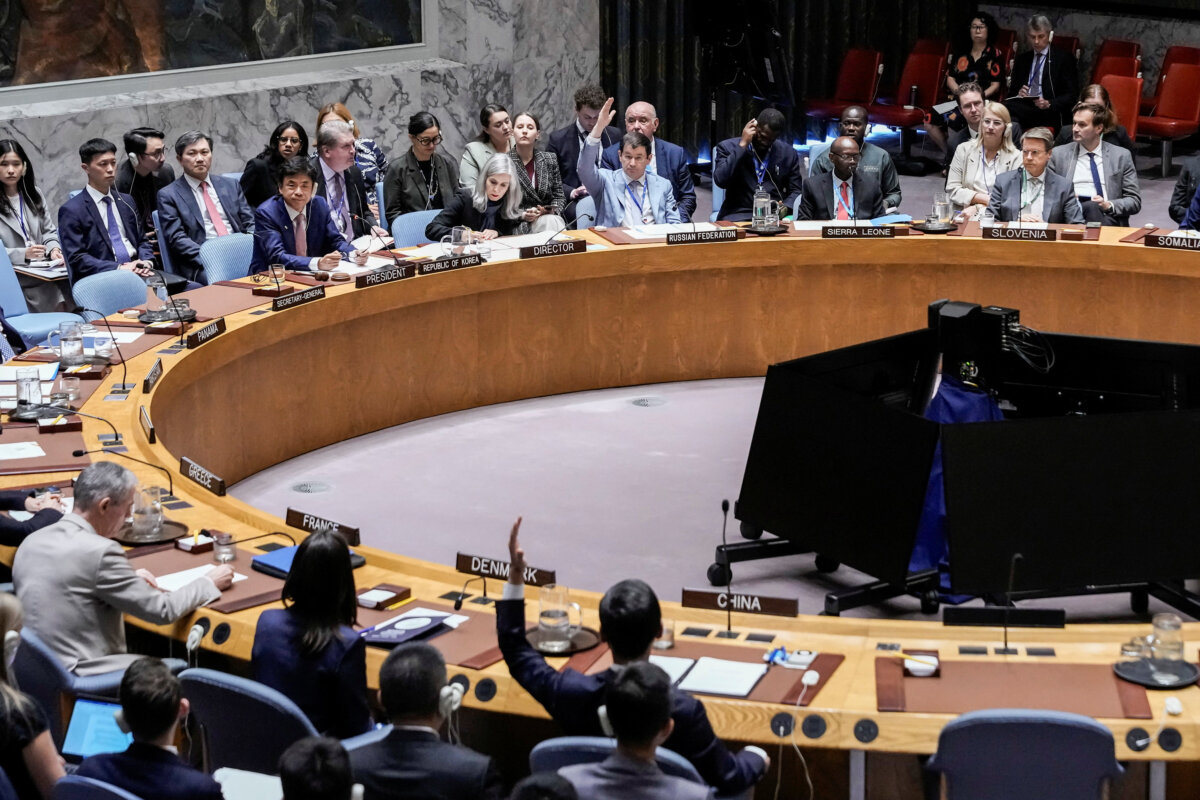

The United Nations on Sept. 27 reinstated an arms embargo and other sanctions on Iran after its nuclear program triggered a process in which European powers warned Tehran it would receive a harsh response.
The return of sanctions on Iran was initiated by Britain, France, and Germany at the U.N. Security Council, following accusations that the Middle East nation violated a 2015 agreement intended to prevent it from building a nuclear warhead. Tehran has denied pursuing nuclear bombs.
The decade-long nuclear agreement was brokered by the five permanent members of the Security Council—Britain, France, Russia, China, and the United States—plus Germany.
The U.N., at 8 p.m. ET on Sept. 27, reinstated the sanctions, which were first adopted by the Security Council between 2006 and 2010. During the annual meeting of world leaders at the U.N. last week, attempts to postpone the reinstatement of sanctions on Iran failed.
“We urge Iran and all states to abide fully by these resolutions,” the foreign ministers of France, Britain, and Germany wrote in a joint statement after the deadline passed.
Kaja Kallas, the European Union foreign policy chief, said in a statement on Sept. 28 that the U.N. would “proceed to implement the re-imposition of all previously lifted U.N. and EU nuclear-related sanctions without delay.”
Israel commended the reinstatement of sanctions on Tehran as a “major development in response to Iran’s ongoing violations, especially on its military nuclear program.”
“The goal is clear: prevent a nuclear-armed Iran. The world must use every tool to achieve this goal,” the Israeli Foreign Ministry said in a post on X.
Iran has vowed a harsh response to the reimposition of sanctions. The nation said on Sept. 27 that it would recall its ambassadors to Britain, France, and Germany for consultations.
However, on Sept. 26, Iranian President Masoud Pezeshkian said Tehran had no plans to leave the Nuclear Non-Proliferation Treaty.
Russia criticized the reinstatement of U.N. sanctions on Iran.
“It is unlawful, and it cannot be implemented,” Russian Foreign Minister Sergei Lavrov told reporters at the U.N. earlier on Sept. 27.
Lavrov added that he wrote to U.N. Secretary-General Antonio Guterres, warning that a return to U.N. sanctions on Tehran would be a “major mistake.”
Iran was offered a delay in the reinstatement of sanctions of up to six months by the European powers, to allow enough time to negotiate a long-term agreement on the condition that Iran open its doors again to U.N. nuclear inspectors, acknowledge worries about its stockpile of enriched uranium, and resume talks with the United States.
“Our countries will continue to pursue diplomatic routes and negotiations. The reimposition of U.N. sanctions is not the end of diplomacy,” the foreign ministers of Britain, France, and Germany said, calling for Iran to “return to compliance.”
U.S. Secretary of State Marco Rubio said that U.S. President Donald Trump has reiterated that diplomacy remains an option for Tehran, and an agreement would be the best outcome for the Iranian people and the rest of the world.
“For that to happen, Iran must accept direct talks, held in good faith, without stalling or obfuscation,” Rubio said in a statement.
He added that until there was a new deal, countries needed to reimpose sanctions “immediately in order to pressure Iran’s leaders.”
The Iranian economy is already straining from the heavy sanctions the United States reimposed since 2018, following Trump’s exit from the Joint Comprehensive Plan of Action, a nonproliferation agreement intended to limit Iran’s use of nuclear technology.
Reuters contributed to this report.
 Friends Read Free
Copy
Facebook
Tweet
Friends Read Free
Copy
Facebook
Tweet