
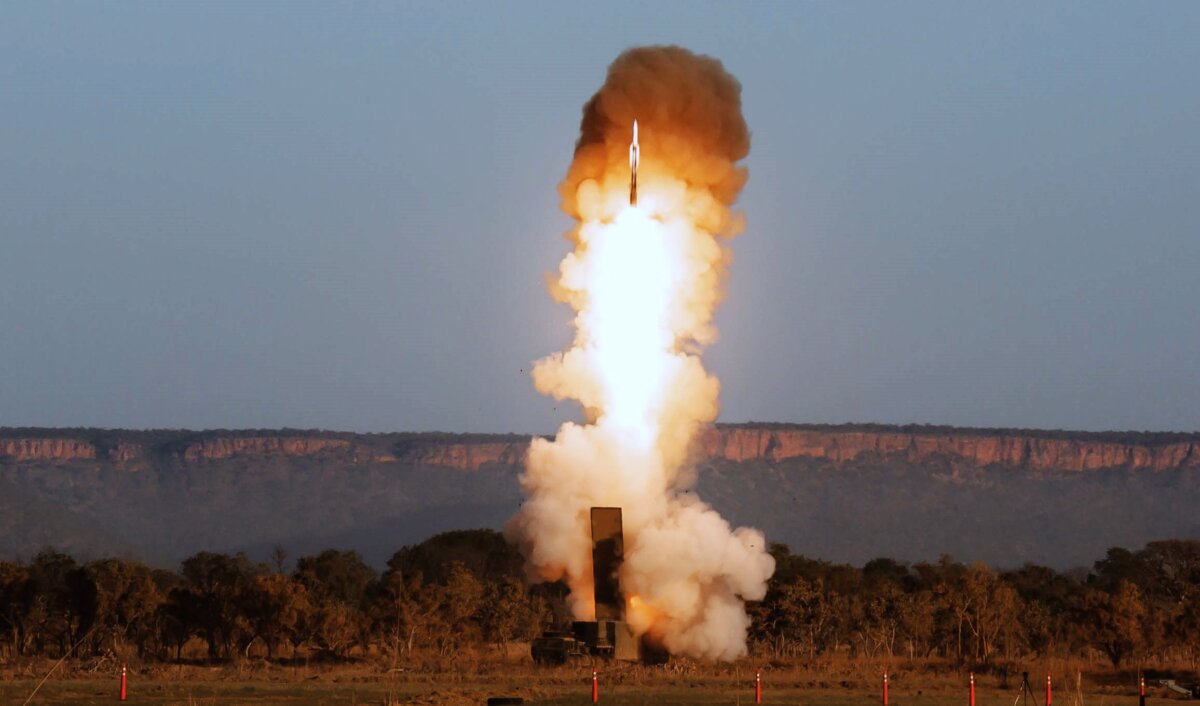

The U.S. Army has deployed its midrange Typhon missile system to Japan for the first time, as the Chinese Communist Party (CCP) continued to flex its military muscle.
The Typhon system was unveiled on Sept. 15 at Marine Corps Air Station Iwakuni, near the southwestern tip of Japan’s main island. It arrived at the base as part of this year’s Resolute Dragon exercise, running until Sept. 25 and involving about 14,000 Japanese troops and 5,200 U.S. personnel.
Typhon is a truck-mounted weapon designed to bridge the gap between the Army’s precision strike missiles and long-range hypersonic systems. It can fire both Tomahawk cruise missiles and SM-6 multi-purpose missiles.
The Tomahawk can strike targets on land or at sea precisely from 1,000 miles away. Japan has ordered Tomahawks and is simultaneously producing its own long-range missiles in its latest round of military buildup.
The SM-6, typically used as an air-defense missile, has been adapted for Typhon to strike targets at sea or ashore, effectively giving it short-range ballistic missile functionality.
“Employing multiple systems and different types of munitions, it is able to create dilemmas for the enemy,” U.S. Army Col. Wade Germann, commander of the 3rd Multi-Domain Task Force that operates the Typhon, said during a televised event at the Iwakuni base.
Another important feature of the system is its ability to be rapidly deployed to forward areas during crises. Typhon launchers can be transported aboard the U.S. Air Force’s C-17 heavy airlifters, which are known for operating short or rough runways, meaning they can be flown into more rugged and austere locations.
“Operating with a crew, it is able to be deployed remotely and through seacraft and aircraft,” Germann said.
Typhon has become an increasingly visible element of U.S. military activity in the Indo-Pacific. In July, the Army deployed a launcher to Australia, where it successfully sank a maritime target with an SM-6, in the system’s first live use outside the continental United States. It was also sent to the Philippines at Manila’s request amid heightened tensions with China in the South China Sea.
The system at Iwakuni will depart Japan after Resolute Dragon, although Germann declined to say where it would be sent next.
In response to the temporary presence of Typhon in Japan, Chinese officials on Sept. 16 accused Washington and Tokyo of inciting military conflict in the region.
Typhon’s deployment came just days after Japan’s Defense Ministry reported spotting China’s newest aircraft carrier, Fujian, in the East China Sea, north of the Senkaku Islands—a group of tiny, uninhabited islets and rocks claimed by Japan, China, and Taiwan.
The deployment also came after a massive military parade in the heart of Beijing commemorating the 80th anniversary of Japan’s defeat in World War II. On Sept. 3, thousands of troops and advanced weapons paraded through Tiananmen Square, in what was seen as an effort to stoke nationalist sentiment amid economic strains and rising tensions with the United States and its allies.
Beyond the parade, the CCP has announced a series of commemorations for 2025, including events marking the Mukden Incident of Sept. 18, 1931, when Japan invaded Manchuria, and the Nanjing Massacre of December 1937.
Largely sidelined from these commemorations are the Nationalists led by Chiang Kai-shek who bore the brunt of the fighting against Japan but were forced out of the mainland to Taiwan in 1949 after their exhausted forces lost to the communists during the ensuing civil war.
Despite its limited engagement in the war against Japan, the CCP has long claimed credit for holding back the Japanese Empire’s military expansion in East Asia.
Also notably absent from Beijing’s celebration was acknowledgment of the United States’ decisive contribution to Japan’s ultimate surrender, an omission President Donald Trump took issue with on Truth Social.
“Many Americans died in China’s quest for Victory and Glory,” he wrote on Sept. 3. “I hope that they are rightfully Honored and Remembered for their Bravery and Sacrifice!”
 Friends Read Free
Copy
Facebook
Tweet
Friends Read Free
Copy
Facebook
Tweet



























