
The U.S. military said on March 17 that it had carried out strikes on hardened Iranian missile sites near the Strait of Hormuz using multiple 5,000-pound deep penetrator munitions.
The U.S. Central Command (CENTCOM) said in a post on X that the strikes struck Iranian anti-ship cruise missiles stationed along Iran’s coastline that “posed a risk to international shipping in the strait.”
The military used 5,000-pound bunker busters in the operation, weapons built to “overcome hardened, deeply buried target challenges” and capable of being deployed from fighter and bomber aircraft.
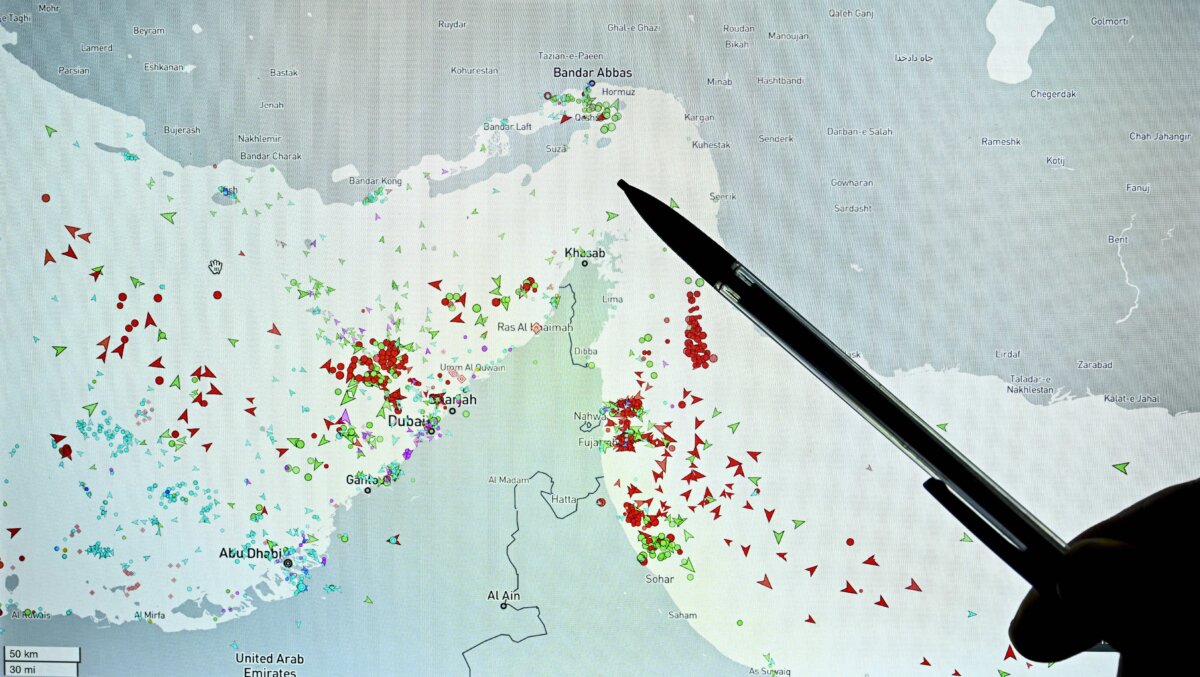
The Strait of Hormuz is one of the world’s most critical energy chokepoints; about 20 percent of global oil supplies pass through the waterway.
Shipping through the Strait of Hormuz has been disrupted since the United States and Israel began military operations against Iran at the end of February and Tehran retaliated by firing missiles and drones at Israel and U.S. military assets and targets across Gulf nations.
U.S. President Donald Trump earlier called on other countries that rely heavily on the Strait of Hormuz to join the United States in patrolling the shipping route.
Trump had named China, France, Japan, South Korea, and the UK as nations he hoped would deploy ships while U.S. forces kept targeting what remained of Iran’s naval capabilities.
However, the president said on March 17 that most NATO countries have expressed they are unwilling to join efforts to secure the waterway “despite the fact that almost every country strongly agreed with what [the United States is] doing.”
Iranian Foreign Minister Abbas Araghchi said on March 16 that the Strait of Hormuz is closed to the United States, Israel, and their allies but open to other countries.
Aragchi told CBS on March 15 that Iranian forces have allowed “a group of vessels” from different countries to pass the waterway but declined to name the countries.
A recent analysis by Lloyd’s List Intelligence, which has published journals on maritime news since 1734, found that Iran’s attacks on ships show no clear pattern.
“Attacks on ships in and around the Strait of Hormuz appear to be random and calibrated towards disruption rather than targeting specific profiles and national affiliation,” the analysis said.
Lloyd’s List said it reviewed the ownership, management, and trading history of each of the 16 vessels that had been hit in the Persian Gulf, the Strait of Hormuz, and the Gulf of Oman since the start of the Iran war on Feb. 28.
“Those 16 vessels that were hit during the conflict had 12 different flags, one of them has the U.S. flag, three Marshall Islands and two of them are Malta-flagged,” the analysis said.
 Friends Read Free
Copy
Facebook
Tweet
Friends Read Free
Copy
Facebook
Tweet