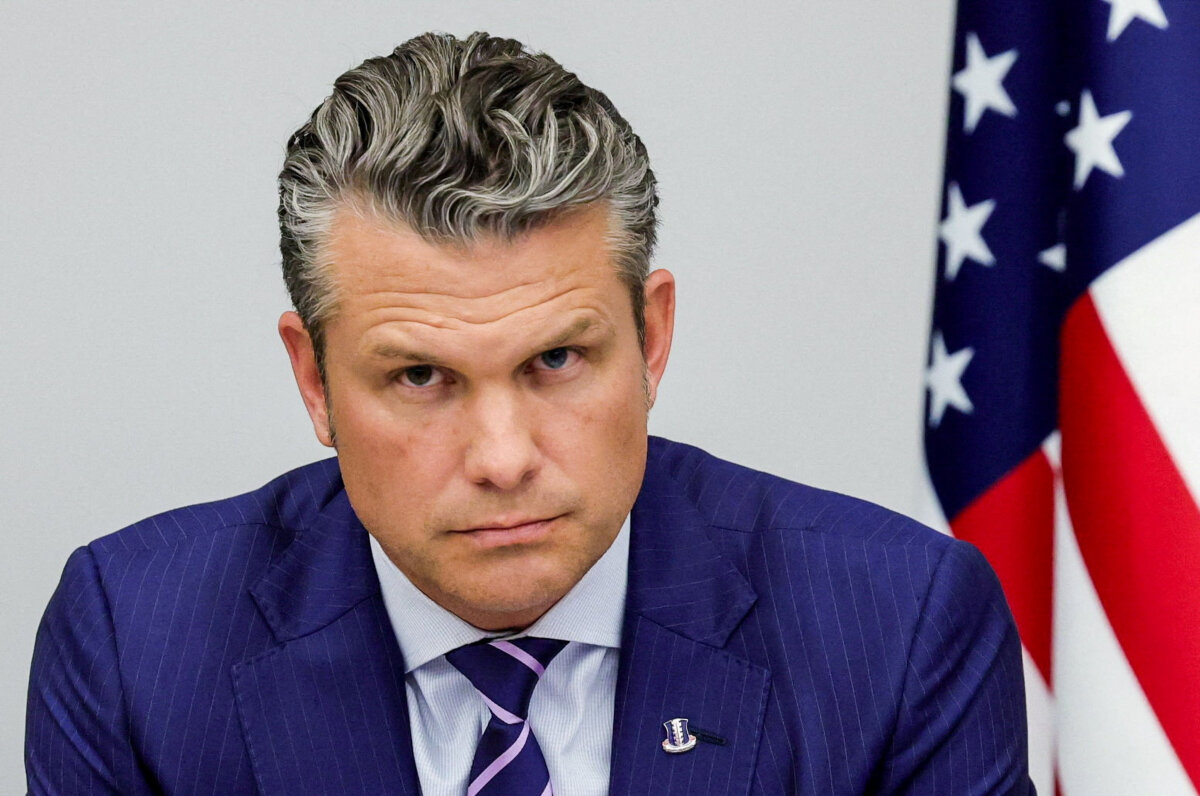

U.S. Secretary of War Pete Hegseth said on Oct. 29 during a meeting with his Japanese counterpart, Shinjiro Koizumi, that the U.S.–Japan alliance is critical to deterring “Chinese military aggression.”
The two defense ministers held talks in Tokyo just a day after U.S. President Donald Trump met with Japanese Prime Minister Sanae Takaichi and both countries signed an agreement to implement a “New Golden Age” for the U.S.–Japan alliance and secure rare-earth metals and critical minerals.
At a joint news conference, Hegseth said they discussed the regional security landscape and that he agreed with Koizumi’s view that the security situation around Japan and in the region remains severe.
“The threats we face are real and they are urgent,” the Pentagon chief said. “China’s unprecedented military buildup and its aggressive military actions in the region speak for themselves.”
Hegseth welcomed Japan’s commitment to increase defense spending, saying that it is “an important step forward, and one that we hope will be implemented, and believe will be as soon as possible.”
“Make no mistake about it, our alliance is critical to deterring Chinese military aggression,” he said. “To respond to regional contingencies and keeping our country safe, shoulder to shoulder with Japan, we look forward to continuing to strengthen our alliance.”
Speaking through an interpreter, Koizumi described his hour-long meeting with Hegseth as “fruitful,” noting that they “candidly discussed” the details of a blueprint outlining the future direction of the U.S.–Japan alliance.
The two countries agreed to advance initiatives on missile coproduction and the manufacturing and sustainment of U.S. military vessels and aircraft, according to Koizumi.
Takaichi, who assumed office on Oct. 21, previously said in a policy speech that the government plans to increase Japan’s defense spending to 2 percent of gross domestic product by March 2026, from about 1.8 percent at present.
The newly elected prime minister is widely regarded as having a hardline stance against the Chinese communist regime. In an Oct. 1 report for the Hudson Institute on the future of Japan’s foreign policy, Takaichi said there is a need to strengthen the security cooperation between Japan and the United States to counter threats.
Takaichi stated that the growing military activities by China, North Korea, and Russia have created an “increasingly severe and complex” security environment for Japan in recent years.
On the issue of China’s military threat against Taiwan, a self-governed island that Beijing claims as part of its territory, Takaichi said that peace and stability in the Taiwan Strait are “of the utmost importance” to Japan and the international community. She referred to Taiwan as an “extremely important partner” of Japan.
Reuters contributed to this report.
 Friends Read Free
Copy
Facebook
Tweet
Friends Read Free
Copy
Facebook
Tweet