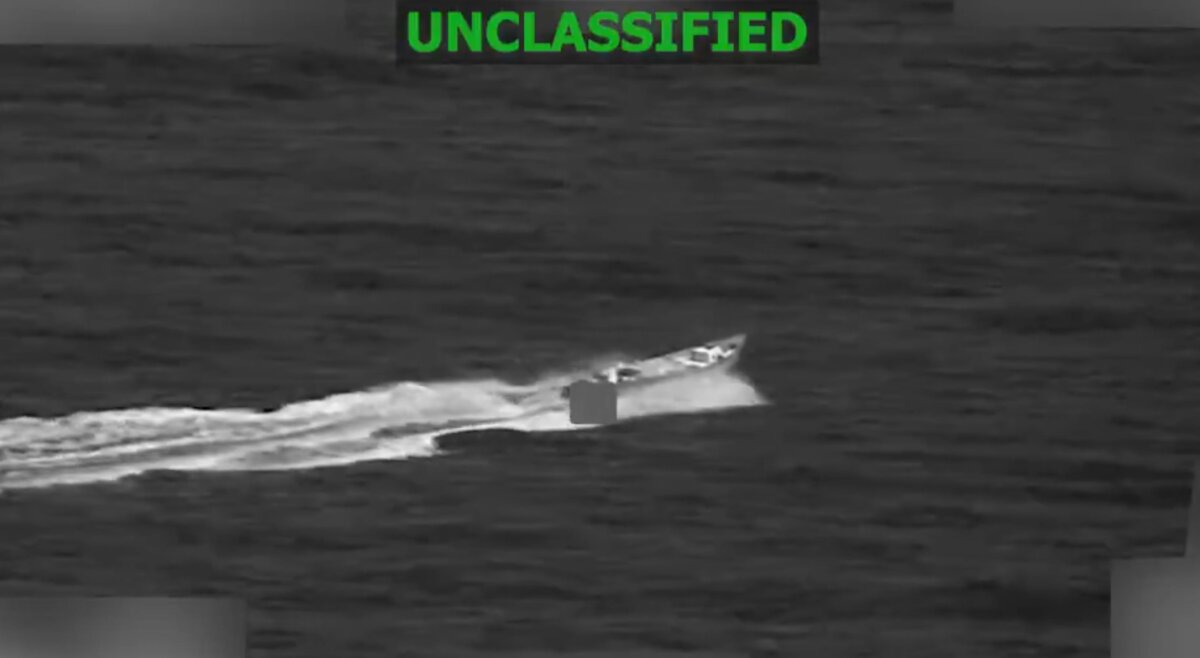

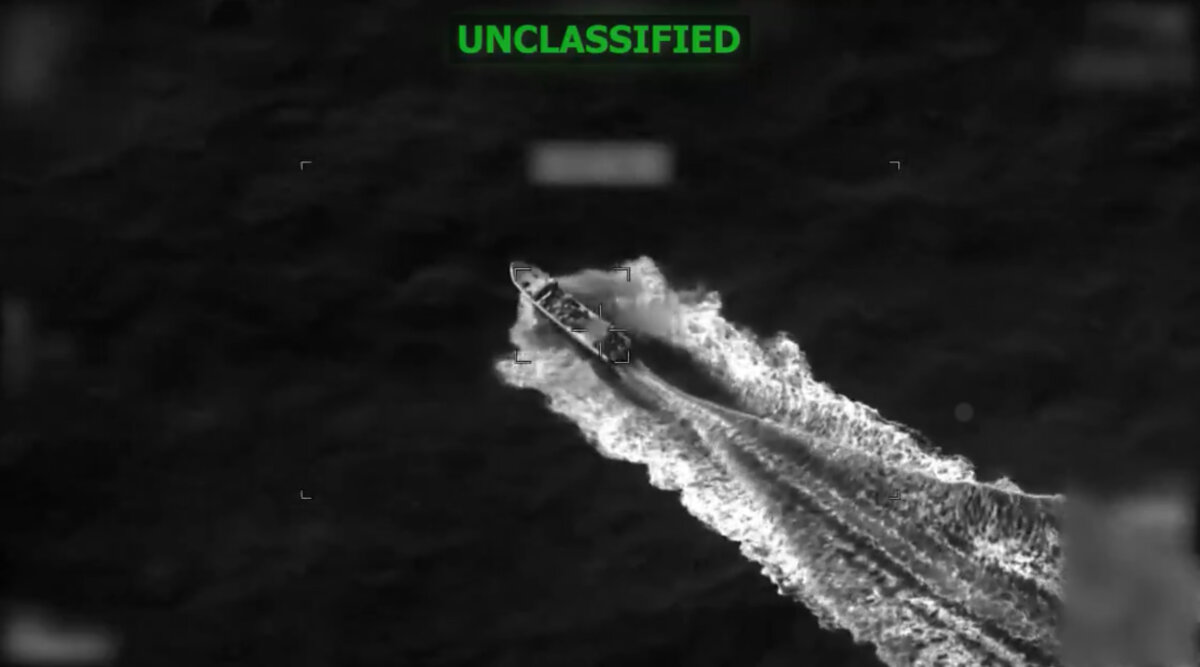
The U.S. military said on May 26 it launched a strike on a drug trafficking vessel in the eastern Pacific Ocean, killing one man and leaving two survivors.
U.S. Southern Command posted a video on social media showing the boat speeding through the water before suddenly exploding in a fireball.
In the post on X, Southern Command said the vessel was being operated by “Designated Terrorist Organizations.”
“Intelligence confirmed the vessel was transiting along known narco-trafficking routes in the Eastern Pacific and was engaged in narco-trafficking operations,” Southern Command said. “One male narco-terrorist was killed during this action, and there were two survivors.”
Southern Command said it immediately notified the U.S. Coast Guard to activate a search-and-rescue operation for the survivors.
No members of the U.S. military were harmed in the incident, Southern Command said.
On Jan. 20, 2025, President Donald Trump signed an executive order designating several Latin American narcotics cartels as terrorist organizations.
The following month, Mexico’s Cártel de Sinaloa and Cártel de Jalisco Nueva Generación (CJNG), Venezuela’s Tren de Aragua (TdA), and Mara Salvatrucha (MS-13) from El Salvador were formally designated as foreign terrorist organizations by the U.S. State Department.
In early September 2025, the U.S. military targeted a number of boats in the eastern Pacific and the Caribbean Sea—which it alleges are being operated by drug traffickers—killing at least 194 people.
Boat Strikes Review ‘Self-Initiated’
Last week, the Pentagon inspector general said it would evaluate whether the U.S. military had followed an established targeting framework during the boat strikes.
The six-phase Joint Targeting Cycle includes a military commander’s intent, target development, analysis, decision, execution, and assessment.
The Pentagon inspector general’s office said the review was “self-initiated.”
It will not probe the legality of the strikes, which have drawn controversy in Congress.
Some Democrats have asserted that the U.S. military strikes are not effective, and some have argued that the strikes are illegal because they were initiated without congressional approval.
In March, Rep. Jamie Raskin (D-Md.) said in the House that the Caribbean and Pacific strikes “also fundamentally weaken [the United States’] ability to bring cases against drug kingpins” because those in lower-level operations who are killed in the strikes cannot testify against drug lords.
On March 17 and 19, Gen. Francis L. Donovan, the commander of Southern Command who authorized the April 9 strike, testified to the Senate’s Armed Services Committee.
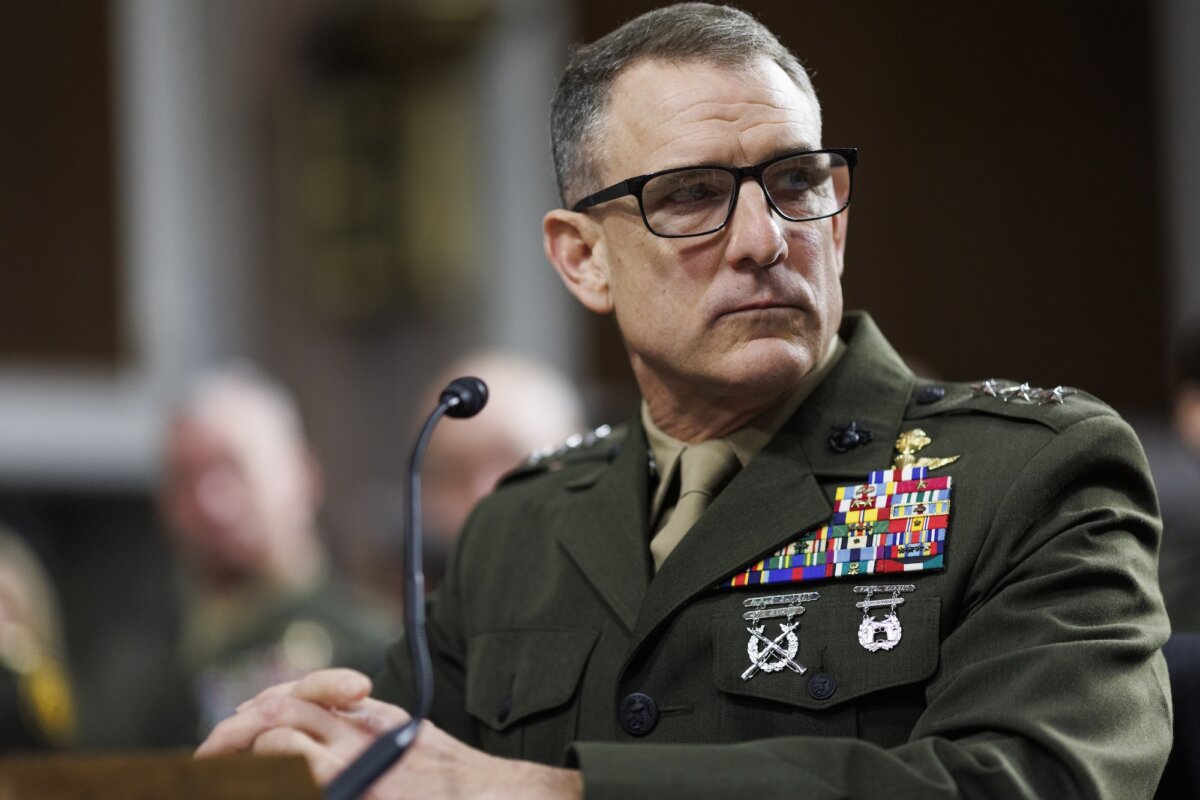
He said that he believed that military strikes on drug boats may not be a long-term solution to the problem.
“We’ve seen changes in the narco-traffickers’ patterns,” he told the Senate. “Looking forward, senator, the boat strikes aren’t the answer.”
On March 31, Washington-based nonprofit Human Rights Watch said the boat strikes amounted to extrajudicial executions.
“When unlawful force is repeated over time, it risks becoming normalized,” Human Rights Watch’s Washington director, Sarah Yager, said. “That’s dangerous because it opens the door to using lethal force whenever and wherever a government wishes and without constraints.”
In February 2025, Ioan Grillo, a Mexico-based journalist and author of several books, including “El Narco, The Bloody Rise of Mexican Drug Cartels,” told The Epoch Times that designating the cartels as terrorist organizations would provide the U.S. government with far more power.
“As for the legal implications, it redefines the battle and could be used in justification of other things such as military actions, as were used against al-Qaeda in Pakistan,” he said.
The Associated Press contributed to this report.
 Friends Read Free
Copy
Facebook
Tweet
Friends Read Free
Copy
Facebook
Tweet