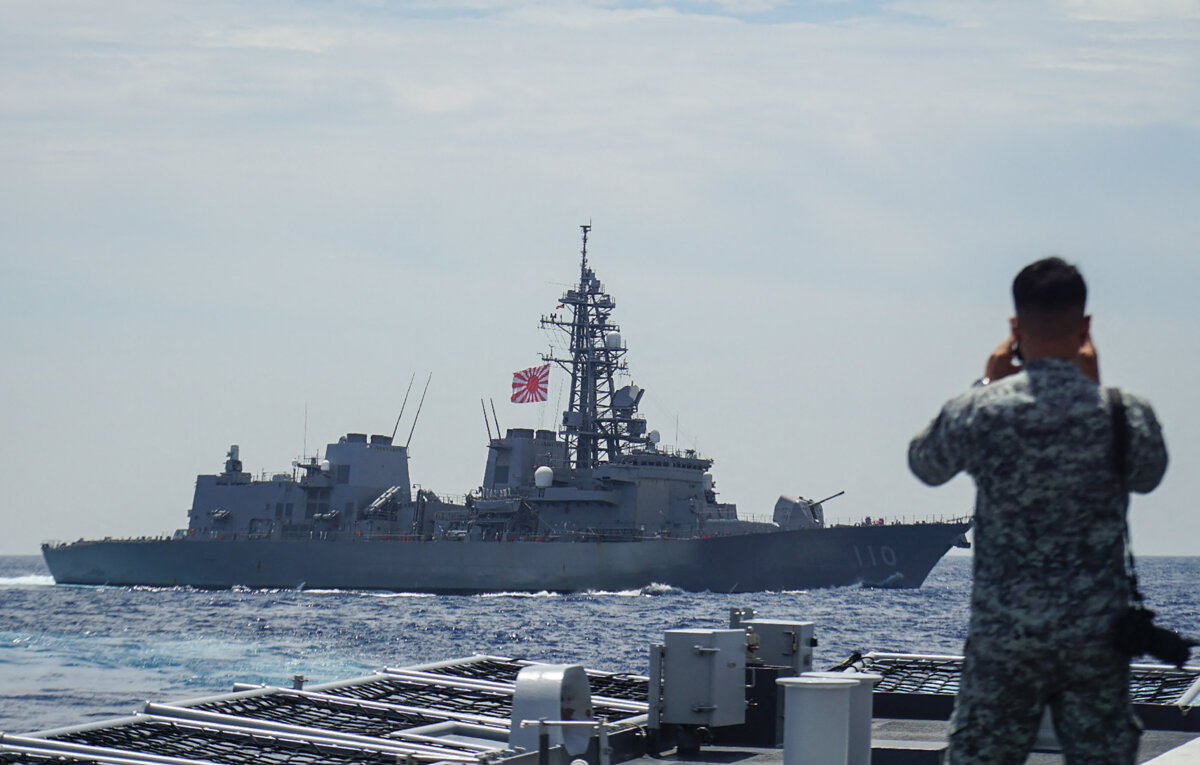

The navies of the United States, Japan, and the Philippines held joint exercises in the South China Sea this week to demonstrate the allies’ commitment to an open Indo-Pacific, the U.S. Indo-Pacific Command (USINDOPACOM) said on Feb. 26.
USINDOPACOM said in a statement that the United States and its two allies conducted a multilateral maritime cooperative activity (MMCA) within the Philippines’ exclusive economic zone between Feb. 20 and 26, focusing on key maritime skills, including communication drills and replenishment-at-sea.
“This activity demonstrated a collective commitment to strengthening regional and international cooperation in support of a free and open Indo-Pacific,” the statement said.
U.S. Navy Capt. Dave Huljack, commodore of Destroyer Squadron 15, said that the MMCA with the Philippine Navy and the Japan Maritime Self-Defense Force “is a testament to the strength and resilience of our bond.”
“For decades, our nations have stood shoulder-to-shoulder, and through activities like these, we continue to build upon that legacy, ensuring we are ready to face any challenge to regional security together,” Huljack said.
“The professionalism and dedication of our Sailors is a direct reflection of that friendship and our shared commitment to a free and prosperous Indo-Pacific.”
USINDOPACOM, which is responsible for defending and promoting U.S. interests in the Asia-Pacific region, said this was the second MMCA of this year, following similar drills with Australia and the Philippines earlier this month.
The Armed Forces of the Philippines (AFP) said in a Feb. 27 statement that this second MMCA of the year “underscores the sustained commitment of partner forces to enhance interoperability, reinforce maritime security, and improve Maritime Domain Awareness in the region.”
The AFP said that among the assets the Philippines deployed during the exercises were the BRP Antonio Luna frigate, helicopters, and fighter jets. Japan contributed a P-3 Orion maritime patrol aircraft, and the United States deployed the USS Dewey and a P-8A Poseidon plane.
“The integration of these platforms showcased the three nations’ ability to operate seamlessly together in complex maritime environments, highlighting the growing depth of maritime cooperation,” AFP said.
Tensions With China
Since 2023, the Philippines has worked with several countries to assert its rights and maritime entitlements in the West Philippine Sea, which Manila calls the parts of the South China Sea within the Philippines’ exclusive economic zone.
China claims most of the resource-rich waterway, rejecting a 2016 international arbitration ruling that has voided Beijing’s claims to the area.
On Jan. 15, the Philippines and Japan signed a new defense pact that allows their forces to exchange supplies and services to aid joint exercises and training.
The agreement was signed in Manila by Japanese Foreign Minister Toshimitsu Motegi and Philippine Foreign Secretary Maria Theresa “Tess” Lazaro.
The Japanese Ministry of Foreign Affairs said in a statement released after the meeting that the two ministers “shared serious concerns over the continuation and the intensification of the unilateral attempts to change the status quo by force or coercion in the East China Sea and the South China Sea and concurred to continue closely working together.”
“Moreover, in the face of the current severe international situations, the two Ministers confirmed the strategic importance of deepening Japan–US–Philippines trilateral cooperation and the US engagement in the Indo-Pacific region, in addition to the bilateral efforts, and concurred on promoting concrete cooperation, including in the area of maritime security,” the statement said.
While the Japanese ministry did not name China specifically in its statement, the remarks about the East and South China seas appear to be a rebuke of Beijing’s increased aggression in the region, affecting both Japan and the Philippines.
Reuters contributed to this report.
 Friends Read Free
Copy
Facebook
Tweet
Friends Read Free
Copy
Facebook
Tweet