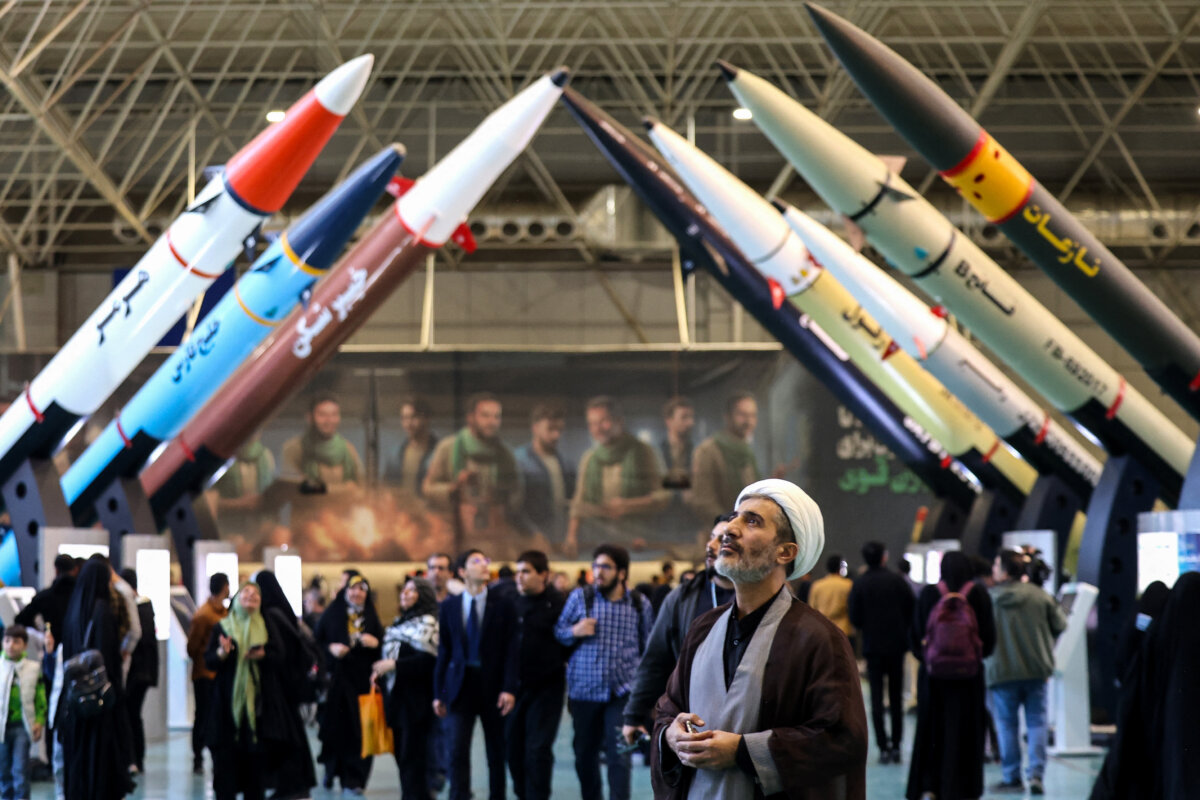

The U.S. Treasury Department levied sanctions on Feb. 25 against 30 different individuals and entities linked to Iran’s arms and fossil fuel industries.
“Iran exploits financial systems to sell illicit oil, launder the proceeds, procure components for its nuclear and conventional weapons programs, and support its terrorist proxies,” Treasury Secretary Scott Bessent said in a Wednesday statement.
The Treasury Department said these latest sanctions are intended to curb individuals and entities helping Iran produce ballistic missiles and other advanced conventional weapons, as well as to stifle a so-called “shadow fleet” of vessels transporting Iranian oil.
They come at a moment of heightened tensions, as President Donald Trump has threatened U.S. military strikes if Iranian leaders don’t submit to new security constraints. U.S. and Iranian delegations are due to meet in Geneva on Feb. 26 for a round of negotiations.
“Under President Trump’s strong leadership, Treasury will continue to put maximum pressure on Iran to target the regime’s weapons capabilities and support for terrorism, which it has prioritized over the lives of the Iranian people,” Bessent said.
Among the sanctioned business entities were a trio of Turkish companies accused of working as financial intermediaries for the Iranian drone-maker known as the Oje Parvaz Mado Nafar Company, which produces the Shahed-131 and Shahed-136 explosive one-way attack drones. These newly sanctioned Turkish companies are Utus Gumrukleme Gida Tekstil Ithalat Ihracat Dis Ticaret ve Sanayi Limited Sirketi, Arya Global Gida Sanayi ve Ticaret Limited Sirketi, and Altis Tekstil Makina Ticaret Limited Sirketi.
New sanctions also targeted the Iran-based Adak Pargas Pars Trading Company and the United Arab Emirates-based Mostafa Roknifard Prime Choice General Trading LLC. Both companies are accused of selling Iran chemical precursors used to make ammonium perchlorate, which can be found in solid-propellant rocket motors like those used on ballistic missiles.
During his State of the Union address on Feb. 24, Trump said Iran has developed missiles that could threaten Europe, “and they’re working to build missiles that will soon reach the United States of America.”
In his prime-time address, the president said he is still waiting for Tehran to commit to not pursuing nuclear weapons.
“They want to make a deal, but we haven’t heard those secret words, ‘We will never have a nuclear weapon,'” Trump said.
As far back as 2003, Iranian Supreme Leader Ayatollah Ali Khamenei has issued religious decrees against pursuing nuclear weapons. Nevertheless, successive U.S. administrations have raised concerns about Iran’s continuing nuclear enrichment and potential to rush to weapons-grade fissile material.
Additional sanctions on Wednesday targeted employees of Qods Aviation Industry Company, an Iranian drone manufacturer that produced the Mohajer-6 armed strike drone.
The newly sanctioned Qods Aviation Industry employees are Mohammad Abedini, Mehdi Zand, Mehrdad Jafari, and Ebrahim Shariatzadeh. The four are accused of helping provide technical support for Russian and Venezuelan users of the Mohajer drones.
Sanctions also targeted 11 international companies.
The sanctioned entities included the Panama-based Poros Maritime Ventures S.A., Ithaki Maritime and Trading S.A., and Paros Maritime S.A.; the Marshall Islands-based Ocean Kudos Shipping Co Ltd, Wansa Gas Shipping Co., Goldwave Maritime Services Inc, and NYR Shipping Co.; the British Virgin Islands-based Mistral Fleet Co Ltd; the Iran-based Behengam Tadbir Qeshm Shipping and Maritime Services Company; and the Liberia-based Kaito Navigation SA and Vast Marine Inc.
Further sanctions targeted 12 tanker vessels registered to these international business entities. Those included HOOT, OCEAN KOI, NORTH STAR, FELICITA, ATEELA 1 and ATEELA 2, NIBA, LUMA, REMIZ, DANUTA I, ALAA, and GAS FATE.
The sanctioned vessels were flagged in Panama, Barbados, Comoros, Palau, Vanuatu, and Iran.
 Friends Read Free
Copy
Facebook
Tweet
Friends Read Free
Copy
Facebook
Tweet