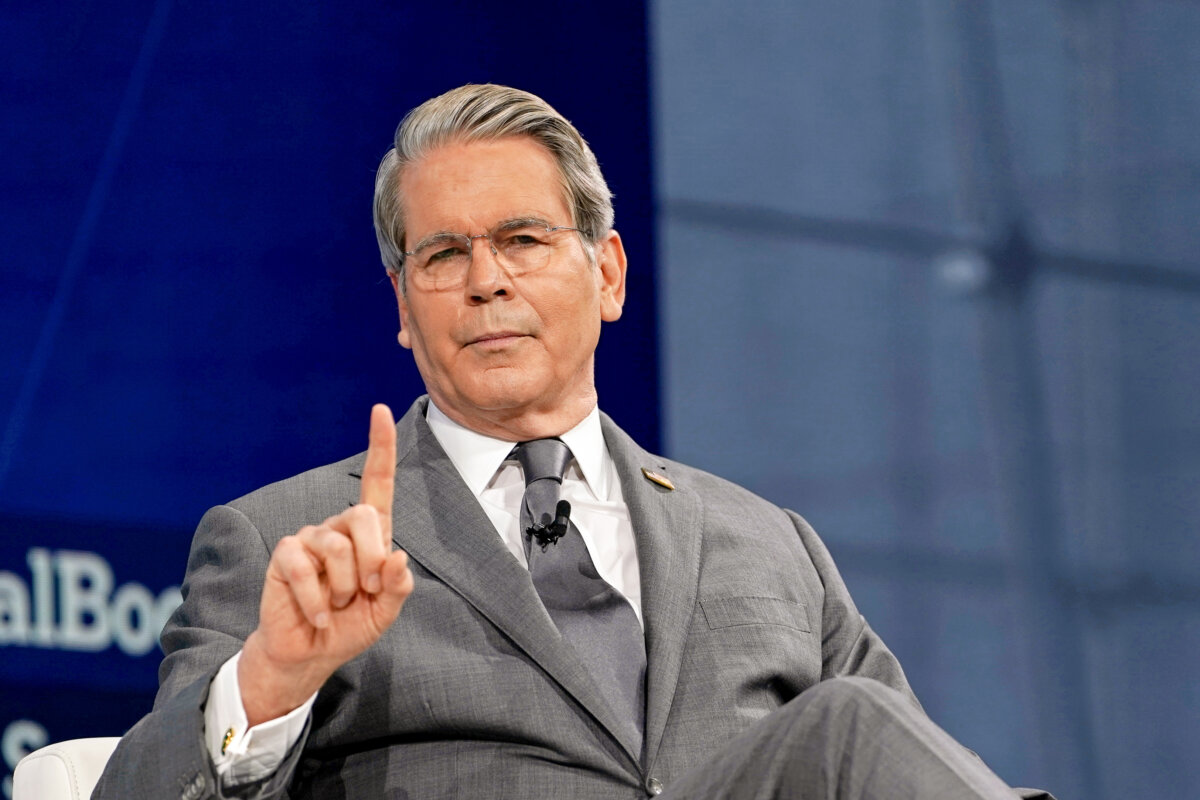

U.S. Treasury Secretary Scott Bessent criticized Canada for opening the door to Chinese electric vehicles, saying it would lead to “cheap goods” entering the United States as well.
Bessent said Prime Minister Mark Carney’s decision to drop industry-specific tariffs on electric vehicles (EVs) from China after meeting with Chinese leader Xi Jinping earlier this month did not bode well for renegotiation of the United States-Mexico-Canada Agreement (USMCA), set to begin on July 1.
“We can’t let Canada become an opening [for] the Chinese to pour their cheap goods into the U.S.,” Bessent told ABC News during a Jan. 25 interview.
“I’m not sure what Prime Minister Carney is doing here, other than trying to virtue-signal to his global friends at Davos,” he added, referring to Carney’s speech at the World Economic Forum in Davos, Switzerland, on Jan. 20. “I don’t think he’s doing the best job for the Canadian people.”
Canada had aligned with the United States in August 2024 by announcing a 100 percent tariff on Chinese-made EVs. Then-Prime Minister Justin Trudeau said it would address China’s “unfair advantage” in the EV sector.
The measure, which was officially enacted in October 2024, mirrored U.S. actions aimed at protecting the North American auto industry from highly subsidized, lower-priced Chinese competition that has been accused of using non-market practices to flood global markets.
Ottawa’s new deal with Beijing lowers Canada’s existing 100 percent tariff on Chinese electric vehicles to 6.1 percent for the first 49,000 units.
Carney announced on Jan. 16 that in exchange, China is expected to reduce canola seed duties from approximately 85 percent to 15 percent from March 1 until at least the end of the year. He also said Canadian canola meal, lobsters, crabs, and peas will be exempt from Chinese “anti-discrimination” tariffs starting in March and continuing until at least the end of the year.
Bessent described the deal as an “about-face” by Carney after Ottawa followed the White House last year in imposing tariffs on Chinese steel.
Canada placed a 25 percent surtax on specific steel goods containing Chinese-melted steel last July and 25 percent tariffs on various steel derivative products last December in a bid to protect domestic industries from unfair competition.
Bessent said North America needs to be protected not only from China’s steel, but also from Chinese EVs.
He added that the Canada-China EV deal is not good news for the United States because many of the goods used for auto manufacturing “can cross across the border during the manufacturing process six times.”
The Epoch Times contacted the Prime Minister’s Office for comment but did not immediately hear back.
In his Jan. 16 statement announcing the EV deal, Carney said it was a bid to forge “a new strategic partnership that builds on the best of our past, reflects the world as it is today, and benefits the people of both our nations.”
Ottawa also said the cap on the number of EV units allowed into Canada without 100 percent tariffs will protect the domestic industry. Canada’s auto industry counters that the number still represents 30 percent of the Canadian market, posing a risk to the sector.
EV Deal Reaction
Trump had initially dismissed Carney’s China agreement when speaking to reporters on Jan. 16, saying “It’s a good thing for him to sign a trade deal. If he can get a deal with China, he should do that.”
Shortly thereafter, Trump’s cabinet expressed concerned about the agreement, and Transport Secretary Sean Duffy said in a recent social media post that Canada “will live to regret the day they let the Chinese Communist Party flood the market with their EVs.”
Trump later joined his cabinet in criticizing the deal. In a Jan. 24 Truth Social post, he said Canadian goods exported stateside would incur 100 percent tariffs if Canada “makes a deal with China.”
Bessent clarified the president’s remarks during his interview, saying there’s a “possibility” of 100 percent tariffs if Canada inks a free-trade deal with China.
Carney told reporters during a Jan. 25 press scrum that Canada has commitments under the USMCA “not to pursue free-trade agreements with non-market economies without prior notification.”
“We have no intention of doing that with China or any other non-market economy,” Carney said. “What we’ve done with China is to rectify some issues that developed in the last couple of years.”
Canada-U.S. Trade Minister Dominic LeBlanc said in a Jan. 24 statement that the recent agreement with China was intended to resolve “several important tariff issues” but was not meant to open a door to a free-trade agreement.
Meanwhile, Ontario Premier Doug Ford has voiced concerns about how Ottawa’s deal will impact the auto sector in his province and shared his take on social media after Carney announced the EV deal.
“The federal government is inviting a flood of cheap made-in-China electric vehicles without any real guarantee of equal or immediate investments in Canada’s economy, auto sector or supply chain,” Ford wrote on Jan. 16. “Worse, by lowering tariffs on Chinese electric vehicles this lopsided deal risks closing the door on Canadian automakers to the American market, our largest export destination, which would hurt our economy and lead to job losses.”
Canada-US Relations
In addition to the EV pushback, other issues have appeared to deepen the rift between Canada and the United States in recent days.
Carney’s Jan. 20 speech at the annual meeting of the World Economic Forum in Davos, Switzerland, subtly referenced the protectionist policies of the United States without naming the country directly. It criticized the use of “economic integration as weapons, tariffs as leverage, financial infrastructure as coercion,” and the use of supply chains to “exploit” other nations. His criticism of “great powers” also did not differentiate between the United States and China, the latter of which Carney has said he is pursuing a “strategic partnership” with.
Trump responded to Carney’s criticism during his speech in Davos the following day, saying Carney “wasn’t so grateful” and that Canada “lives because of the United States.”
Carney responded in a Jan. 22 address to the nation that Canada “does not live because of the United States. Canada thrives because we are Canadian.”
Trump hours later withdrew his invitation for Canada to join the U.S.-led Board of Peace, an initiative that aims to help rebuild Gaza. Carney is the only world leader to be publicly uninvited by Trump.
 Friends Read Free
Copy
Facebook
Tweet
Friends Read Free
Copy
Facebook
Tweet