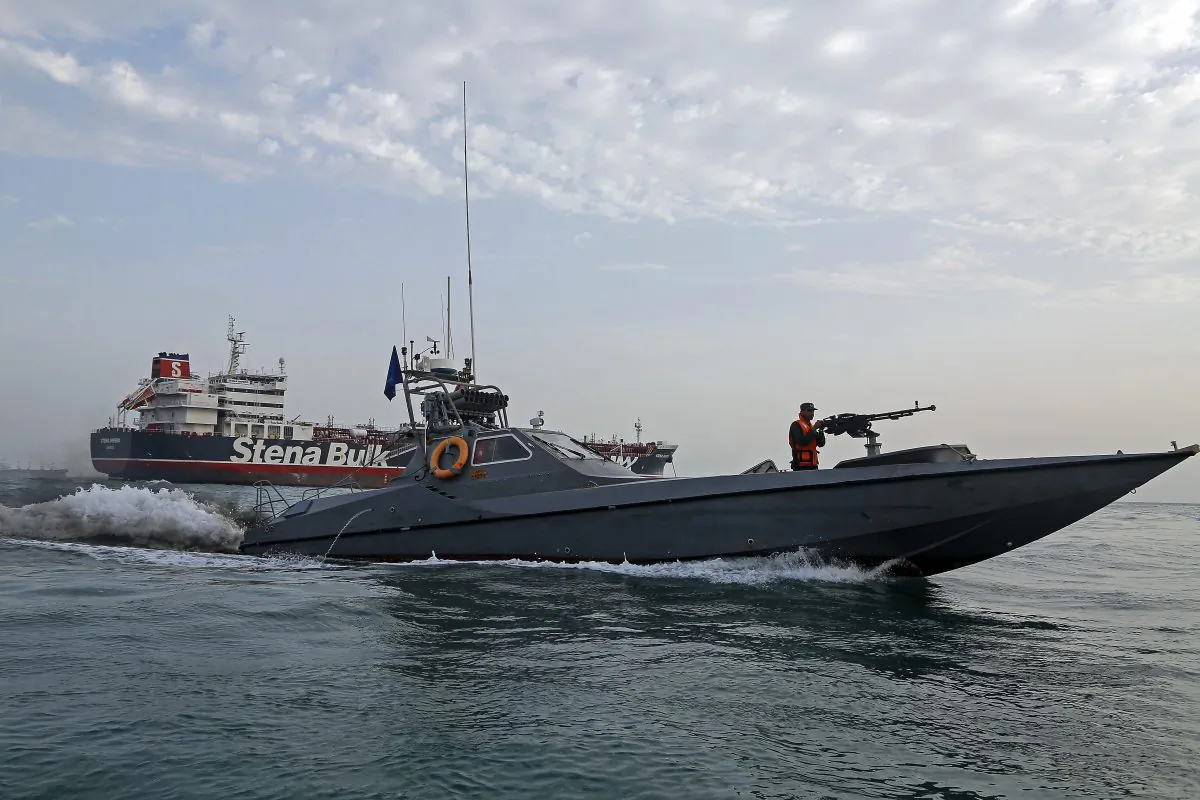

The U.S. military issued a fresh warning to Iranian forces on Jan. 30 to avoid provocative actions during an upcoming set of naval drills.
Iran’s Islamic Revolutionary Guard Corps (IRGC) plans to conduct a two-day live-fire drill in the Strait of Hormuz, starting on Feb. 1. These military drills come as President Donald Trump has raised pressure on Tehran, including by ordering U.S. warships to the Middle East.
The U.S. Central Command (CENTCOM)—which oversees U.S. military operations in the region—said it acknowledged Iran’s right to operate in international airspace and waters but urged Tehran against dangerous maneuvers near any U.S. forces, regional partners, or commercial vessels.
“We will not tolerate unsafe IRGC actions including overflight of U.S. military vessels engaged in flight operations, low-altitude or armed overflight of U.S. military assets when intentions are unclear, highspeed boat approaches on a collision course with U.S. military vessels, or weapons trained at U.S. forces,” CENTCOM said in an emailed statement on Friday.
The Pentagon has declined to specify the number of warships Trump has directed to the Middle East.
Recent military news releases indicate the aircraft carrier USS Abraham Lincoln has reached the CENTCOM area of responsibility, as have the guided-missile destroyers USS Frank E. Petersen Jr. and USS Delbert D. Black.
The U.S. Air Force also recently announced a multi-day airpower readiness exercise in the Middle East.
Trump directed the Middle East military build-up after recent protests in Iran devolved into deadly confrontations with Iranian security forces. More recently, the president has pressured Iran to make a deal to constrain its nuclear ambitions.
“As I told Iran once before, MAKE A DEAL!” Trump wrote in a Jan. 28 post on Truth Social. “They didn’t, and there was ‘Operation Midnight Hammer,’ a major destruction of Iran. The next attack will be far worse! Don’t make that happen again.”
U.S. forces carried out strikes on a trio of Iranian nuclear facilities in June.
Following those strikes, Iranian forces launched a salvo of ballistic missiles at a base hosting U.S. troops in Qatar. Trump said Tehran notified Washington in advance of the strikes, and U.S. forces were able to intercept the missiles without sustaining casualties.
After the June U.S. strike, Tehran also formally suspended its cooperation with the International Atomic Energy Agency.
While speaking with reporters at the White House on Friday, Trump said he had communicated a deadline for Tehran to come to a deal to avoid additional U.S. strikes, but declined to specify his timeline.
Trump also declined to say when he might pull U.S. warships back from the region.
 Friends Read Free
Copy
Facebook
Tweet
Friends Read Free
Copy
Facebook
Tweet