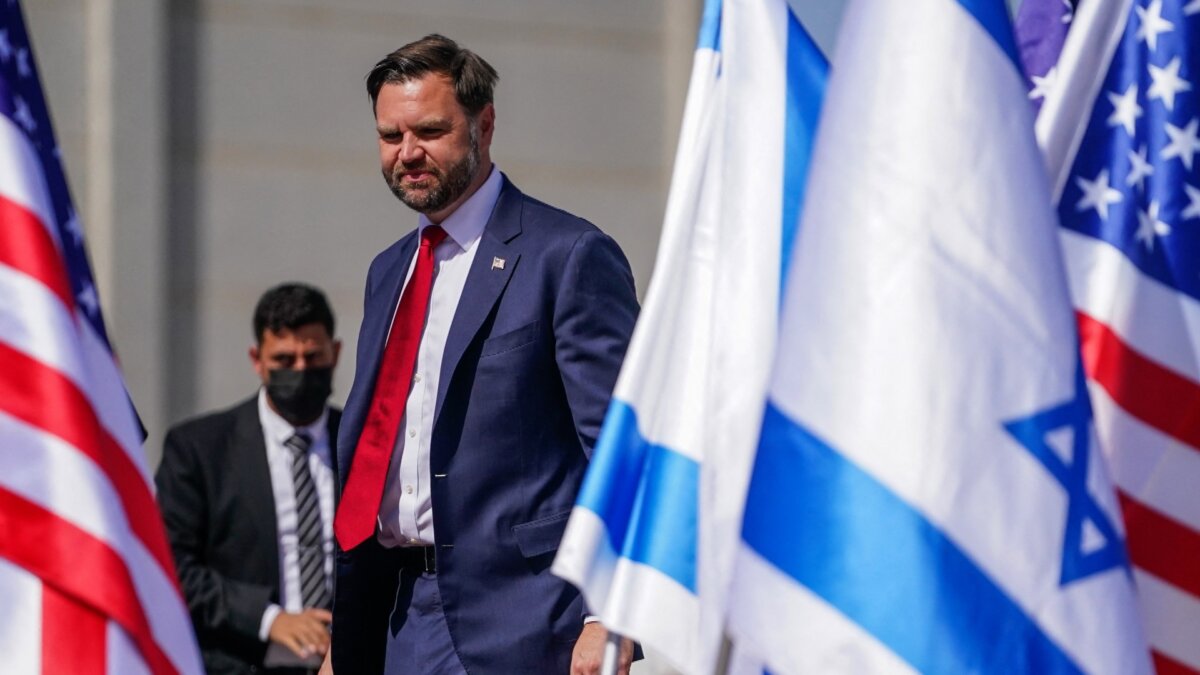

U.S. Vice President JD Vance held a press conference in Kiryat Gat, Israel, on Oct. 21 to announce the establishment of a Civilian Military Cooperation Center.
While U.S. troops will help operate the command center—a joint effort between Israeli and American governments meant to guide peace efforts in the Middle East—the vice president said they will not deploy to the Gaza Strip.
“The only real mediators are the United States of America, and so that’s the role that we’re going to play,” Vance said. “I think the American people should … should know, that there are going to be no American boots on the ground in Gaza.”
Military assistance from U.S. troops is limited to creating a reconstruction and redevelopment plan to support long-term stability in the region. Israelis and Americans will work together to “actually ensure that you have security forces on the ground in Gaza not composed of Americans, who can keep the peace over the long term,” he said.
Security forces from other nations, including troops from Turkey and Indonesia, could assist with peacekeeping operations, though the decision ultimately lies with Israeli officials, Vance said.
“We think everybody has a role to play here,” he said, noting the financial and logistical challenges of rebuilding Gaza. “We’re not going to force anything on our Israeli friends when it comes to foreign troops on their soil, but we do think that there’s a constructive role for the Turks to play, and frankly, they’ve already played a very constructive role.”
Resolving a conflict in the Middle East that dates back millennia “is going to take a very, very long time,” Vance said, rejecting media headlines from recent days that suggested the cease-fire was breaking down.
“There is this weird attitude I’ve sensed in the American media and the Western media, where there’s almost this desire to root for failure, that every time something bad happens, every time there’s an act of violence, there‘s this inclination to say, ‘Oh, this is the end of the cease-fire, this is the end of the peace plan,’” he said. “It’s not the end. It is, in fact, exactly how this is going to have to happen.”
Steve Witkoff, special envoy to the Middle East, said brokering the peace deal was the first step in a long process.
“Signing this deal up was a challenge in and of itself, but the implementation, that’s where it really is going to be the most important,” he said. “And I think we are exceeding where we thought we would be at this time.”
Lessons learned throughout the negotiations and rebuilding process will serve future leaders as they navigate other peace deals, Witkoff said.
Trump’s son-in-law Jared Kushner, who worked with Witkoff on the peace deal, said “things are going in accordance with both sides transitioning from two years of very intense warfare to now a peacetime posture.”
“It’s really been great coordination because everyone believes that it is possible to create something better in Gaza.”
Kushner added that Hamas-controlled areas will not receive reconstruction assistance or resources.
President Donald Trump announced on Oct. 8 that Israel and Hamas had agreed to a cease-fire deal and to exchange hostages and detainees.
Trump later said that Hamas would be “obliterated” if it failed to comply with the agreement.
 Friends Read Free
Copy
Facebook
Tweet
Friends Read Free
Copy
Facebook
Tweet