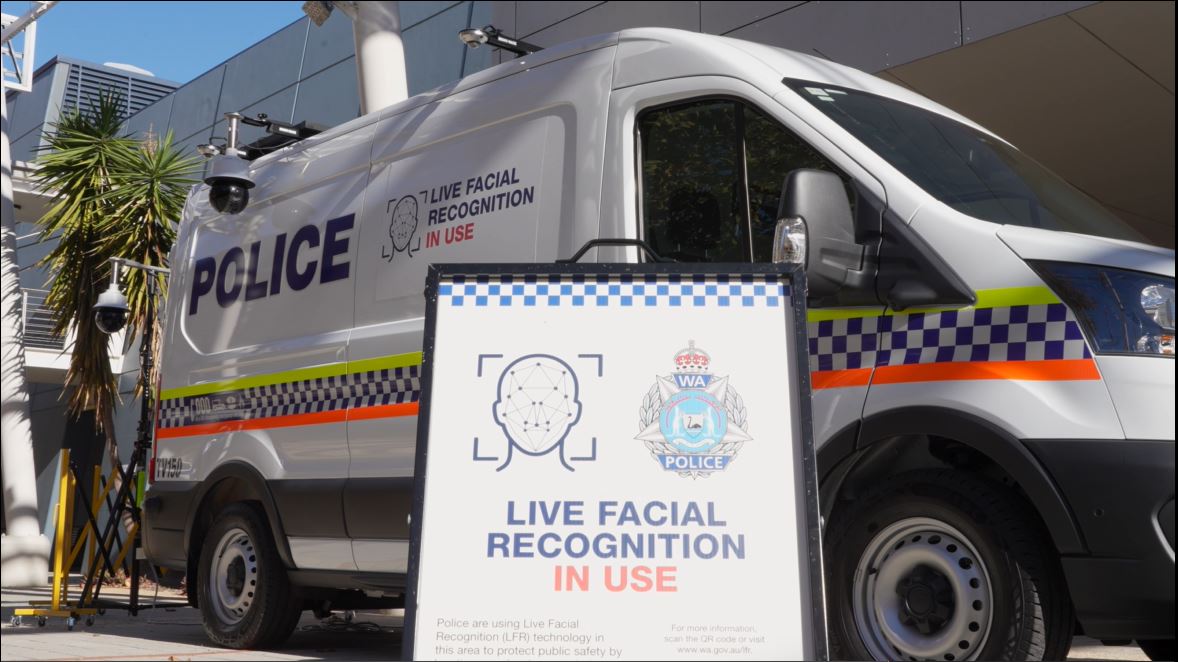

Western Australia (WA) Police have revealed their facial recognition van has scanned 131,478 faces in its first week, leading to 18 arrests.
The technology scans the faces of passers-by, instantly matching them against a database of wanted criminals and missing persons. The van was deployed to 10 different metropolitan locations between June 22 and 28, 2026.
Police says anyone not matched to the list has their face blurred on screen and that video of them is not stored.
The technology generated 33 alerts and one false positive—a rate of 0.0008 percent, “reflecting a high level of system accuracy,” WA Police said in a statement.
A total of 21 Registered Sex Offenders (RSO) were identified through the alerts “and subsequently engaged by officers,” it said.
Eighteen arrests were made, 16 of which were for outstanding warrants. The other two were of women who’d breached Short-Term Exclusion Orders in the Perth-Northbridge entertainment precinct.
A further two people were subject to welfare checks.
“Officers identified known offenders and responded rapidly to incidents within the vicinity of the OLFR (Overt Live Facial Recognition) van, resulting in additional investigative outcomes,” the statement said.
Police detailed several examples of how the technology had helped catch criminals.
In one case, a man had robbed an electronic repair store, verbally threatened a staff member, and then punching them until they were unconscious.
The next day—the first day the van was rolled out—the alleged offender was recognised and arrested. He was charged with one count of assault with intent to rob, stealing, and two counts of bail breaches.
Facial recognition technology is increasingly being used across Australia.
In New South Wales it is used to detect problem gamblers, and was floated by the federal Department of Home Affairs as a way to prevent underage access to porn sites.
The National Driver Licence Facial Recognition Solution (NDLFRS), first proposed 9 years ago, is also being rolled out this year.
In 2021, the City of Adelaide council resolved not to allow South Australian state police access to facial recognition which formed part of a new $3 million surveillance system due to concerns about indiscriminate use and lack of regulation.
And in 2024, hardware chain Bunnings was found to have breached the privacy of hundreds of thousands of customers across 63 of its New South Wales and Victoria stores between 2018 and 2021 by deploying facial recognition without telling them.
 Friends Read Free
Copy
Facebook
Tweet
Friends Read Free
Copy
Facebook
Tweet