
News Analysis
The future of Iran’s nuclear program is at the heart of Israel’s current military operation against Tehran, and sensitive nuclear sites could be targeted by American bombs should the United States decide to join the war.
Yet the exact extent of Iran’s nuclear program and the question of whether it is being used to develop nuclear weapons remains a hotly contested debate among the international community, including among Israel’s closest allies.
That is partly because of a shroud of secrecy that Iran has used over the years to obfuscate the extent of its uranium enrichment activities.
But it is also in part due to the fact that there have been civilian requirements for enriched uranium in Iran for more than half a century.
To understand these complexities, it helps to dive into the history of how Iran’s nuclear program developed in the first place, and how far it has at times strayed from its initial purpose.
From Civilian Research to Covert Weapons Program
The Iranian nuclear program began in 1957 when then-President Dwight Eisenhower signed a civil agreement with the reigning monarch of Iran to provide Tehran with a nuclear research facility.
Ten years later, the Tehran Research Reactor came online, and was used for creating medical isotopes and supporting scientific research until 1979, when Iran’s historical monarchy was overthrown by an Islamist uprising.
Though the Iranian monarchy had pledged not to pursue nuclear weapons as it developed a more robust nuclear energy program, the new Islamist regime signed no such guarantee, and the United States subsequently stopped providing Tehran with uranium, thereby eliminating the use of its reactor for a number of years.
By 1989, however, Islamist leadership in Iran had begun a covert program to develop nuclear weapons and purchased additional centrifuge technologies through illicit networks linked to Pakistan and North Korea.
The program was discovered in 2002, when an exiled Iranian leader revealed previously secret nuclear enrichment facilities to the international community. Iran subsequently agreed not to pursue a nuclear weapon and to allow international inspectors into its nuclear facilities on a regular basis.
In the 23 years since, Iranian leadership has denied that it is developing nuclear weapons with the uranium it enriches. It says that its uranium enrichment program is for civilian purposes only, but that it retains the right as a sovereign nation to pursue nuclear weapons if it so chooses.
Whether Iran’s claims are true is a point of debate among the international community.
In the lead-up to Israel’s attack on Iran earlier this month, Israeli Prime Minister Benjamin Netanyahu said that there was evidence Iran was developing nuclear weapons and that this “existential threat” to Israel was the cause of the war.
Intelligence leaders in the United States, Israel’s closest ally, have expressed skepticism about Iran’s commitment to a nuclear weapon, however.
Director of National Intelligence Tulsi Gabbard testified to Congress in March that “Iran is not building a nuclear weapon and [Iranian Leader Ali] Khamanei has not authorized the nuclear weapons program he suspended in 2003.”
Likewise, the 2025 annual threat assessment released by Gabbard’s office found that Iran was not pursuing a nuclear weapon, though it had enriched some of its uranium to a degree that would make it much easier to do so if it chose to.
The report added that Khamenei was also likely under pressure by hawkish elements in his regime to resume the weapons program that it abandoned in the early 2000s, and that the Iranian leader would likely seek to use Iran’s expanded enrichment activities as a negotiating tool to bolster its regional influence.
Uranium Enrichment at the Heart of International Concern
Given the ambiguities in Iran’s commitment to developing a nuclear weapon, international focus has centered largely on Iran’s enrichment of uranium, and to what extent it is producing enriched uranium of a sufficient purity to build nuclear weapons.
To that end, the United Nations’ nuclear watchdog said in a report earlier this year that Iran had accelerated its production of near-weapons-grade uranium.
The report by the Vienna-based International Atomic Energy Agency said that Iran had developed roughly 605 pounds of uranium enriched up to a 60 percent threshold.
That level of purity is a technical step away from being converted to the 90 percent required for a nuclear weapon, the report said, and the 605-pound mark presented about a 40 percent increase in the quantity of Iran’s enriched uranium six months earlier.
According to the report, it requires about 92.5 pounds of enriched uranium at that level to produce a nuclear warhead, suggesting Tehran had about enough uranium to create half a dozen nuclear weapons.
The International Atomic Energy Agency and many critics of Tehran have pointed out that modern nuclear reactors only require uranium that is enriched to between three and five percent to operate effectively.
There are two key caveats to that, however.
The first caveat is that some of Iran’s aging nuclear facilities were not designed to use uranium of such low purity.
The reactor built with the help of the United States, for example, originally operated using uranium that had been enriched to 93 percent. That only changed in the 1990s when, with the help of Argentina, Iran covertly modified the facility to operate with uranium enriched to a 20 percent level.
The second caveat is that civilian nuclear reactors operate more efficiently the higher the enrichment level of the uranium.
This is because highly-enriched uranium produces more energy per unit than low-enriched uranium owing to its higher concentration of the fissile isotope U-235, which is essential for sustaining nuclear chain reactions.
Complicating matters further, however, is Iran’s handling of its own international nuclear agreements, particularly the Joint Comprehensive Plan of Action, which was signed by Iran, the United States, the EU, China, Russia, France, Germany, and the UK in 2015.
That agreement limited Iran’s enrichment activities so that the nation would only enrich up to the 3.67 percent mark.
President Donald Trump unilaterally withdrew from that program in 2018, however, saying that Iran had not fully divulged all required information about its previous nuclear weapons program that was terminated in the early 2000s.
In response, Iran ceased its adherence to the enrichment limitations set in the deal, despite technically still being a signatory and intermittently allowing international inspectors into its nuclear facilities.
According to the CIA, there is also the issue that less than two percent of Iran’s electricity currently comes from nuclear sources. It is therefore unclear why Iran would need significant amounts of highly enriched uranium other than for weapons development.
Iran Unlikely to Develop A Nuclear Weapon Soon
Despite its advancements in uranium enrichment, Iran faces significant challenges in developing the necessary technology and infrastructure required to actually use that uranium to build a weapon.
Beyond possessing uranium enriched to a 90 percent threshold, Tehran would also need to successfully miniaturize a nuclear warhead in order to mount it onto a bomb or missile.
Nuclear miniaturization includes both the process of making nuclear weapons small enough to be mounted on ballistic missiles, as well as the creation of technologies to ensure the weapon can survive the stresses of launch and re-entering the atmosphere.
Miniaturization is just as complex and even more expensive than the process of enriching uranium, and there is little evidence Iran has committed the resources necessary to complete the research and development of such a weapon in the near term.
In addition, Iran has never conducted a nuclear test, and it is unclear which of its ballistic missiles could be modified to successfully carry a nuclear warhead.
The most likely contender for that purpose is the Emad, a missile introduced in 2015 and featuring a cone-shaped head and maneuverable reentry vehicle that would be better suited to delivering nuclear strikes than Iran’s other missiles.
Thus, while Iran has made significant strides in uranium enrichment, miniaturizing a nuclear weapon is a highly complex task, requiring an immense amount of advanced knowledge in nuclear physics and engineering. Iran appears to have mostly dedicated that knowledge to enrichment rather than weapons development.
As such, it’s unlikely Iran could develop a nuclear weapon in the very near term, even if it fully enriched the uranium at its disposal.
Little Left of Iran’s Nuclear Facilities After Israeli Strikes
What remains then is the issue of whether Iran’s nuclear facilities remain capable of supplying sufficient uranium to develop nuclear weapons in the near term.
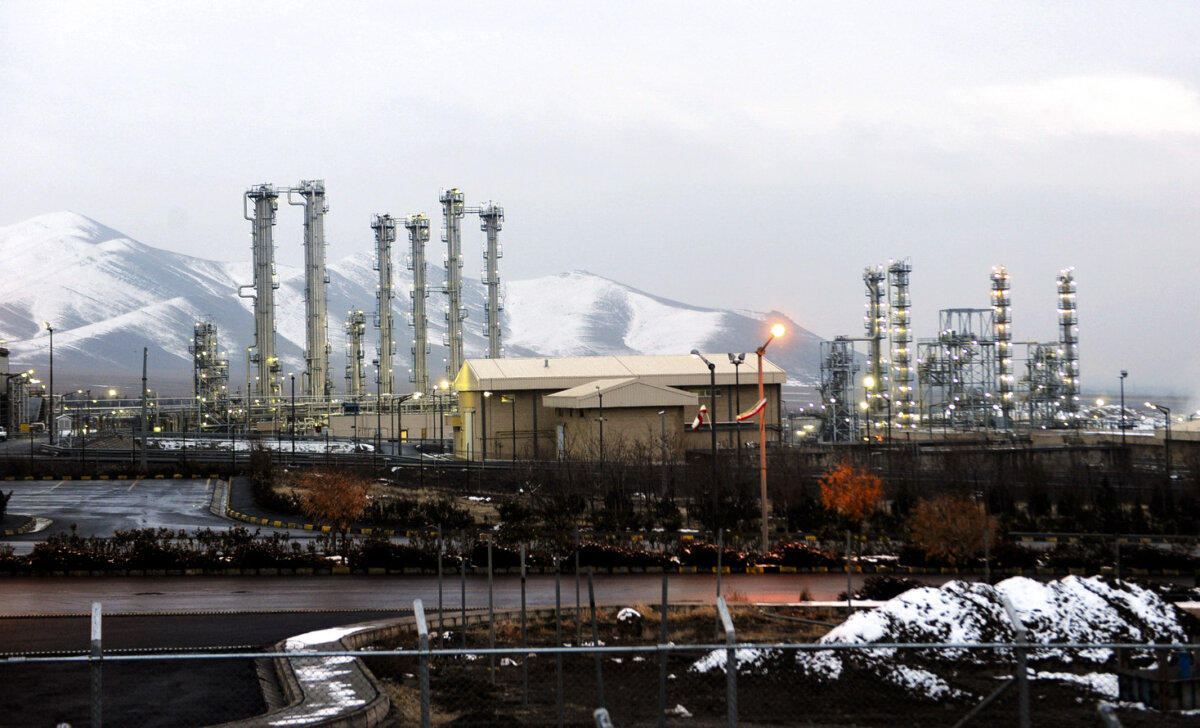
There are four key sites related to that issue. They are the enrichment facilities at Natanz and Fordo, the Bushehr nuclear power plant, and the Arak heavy water reactor, in addition to several research facilities in Tehran and Isfahan.
All of the sites except the facilities at Fordo were severely damaged in the first week of Israel’s campaign, which targeted more than 200 sites throughout Iran.
The facilities at Natanz were the cornerstone of Iran’s nuclear infrastructure and served as the nation’s central facility for enriching uranium.
The enrichment complex itself was located deep underground and behind reinforced concrete walls designed to protect the facility from missile attacks.
The facilities at Natanz also conducted research and development related to the development of advanced centrifuges, and, as such, any changes to Natanz’s operations would likely have a direct impact on the amount of time required for Tehran to produce a nuclear weapon.
Natanz was among the first sites attacked by Israel. Its above-ground facilities have been confirmed to have been largely destroyed, while those underground have been significantly damaged.
The enrichment facility at Fordo is Iran’s second-largest nuclear facility and is located about 60 miles southwest of the capital of Tehran.
The facility is Iran’s most well-defended and appears to have been constructed to withstand missile attacks.
Fordo hosts advanced uranium centrifuge cascades, which are essential for producing nuclear fuel. Many analysts have also long suspected that Fordo is where the Iranian regime would conceal any clandestine attempts to develop nuclear warheads.
Constructed between 2007 and 2009, the Fordo facility is built into the side of a mountain, roughly 260 feet underground, and reinforced with artificial barriers.
Fordo’s expansive natural and man-made defenses mean that there are steep requirements for the type of ordnance capable of destroying the facility via airstrike.
The only available ordnance likely to fit that bill is the GBU-57A/B Massive Ordnance Penetrator, a precision munition designed for the U.S. Air Force in the early 2000s and modified in the 2010s for the explicit purpose of targeting Fordo.
Like Natanz, Iran’s civilian nuclear power plant at Bushehr and the heavy water reactor at Arak have been significantly damaged by Israeli airstrikes, thus eroding Tehran’s ability to use nuclear energy or to create the necessary plutonium used in the creation of nuclear weapons.
Similarly, the Isfahan Nuclear Technology Center and Tehran Research Reactor have both been damaged, and several key nuclear scientists have been killed.
Given current damage assessments, Fordo is Iran’s only enrichment site that will likely be able to continue operating in the coming weeks. However, it, too, may be targeted by a U.S. airstrike or an Israeli ground operation.
U.S. President Trump recently said he will make a final decision in approximately two weeks on whether the United States should be militarily involved in the Israel–Iran conflict.
 Friends Read Free
Copy
Facebook
Tweet
Friends Read Free
Copy
Facebook
Tweet