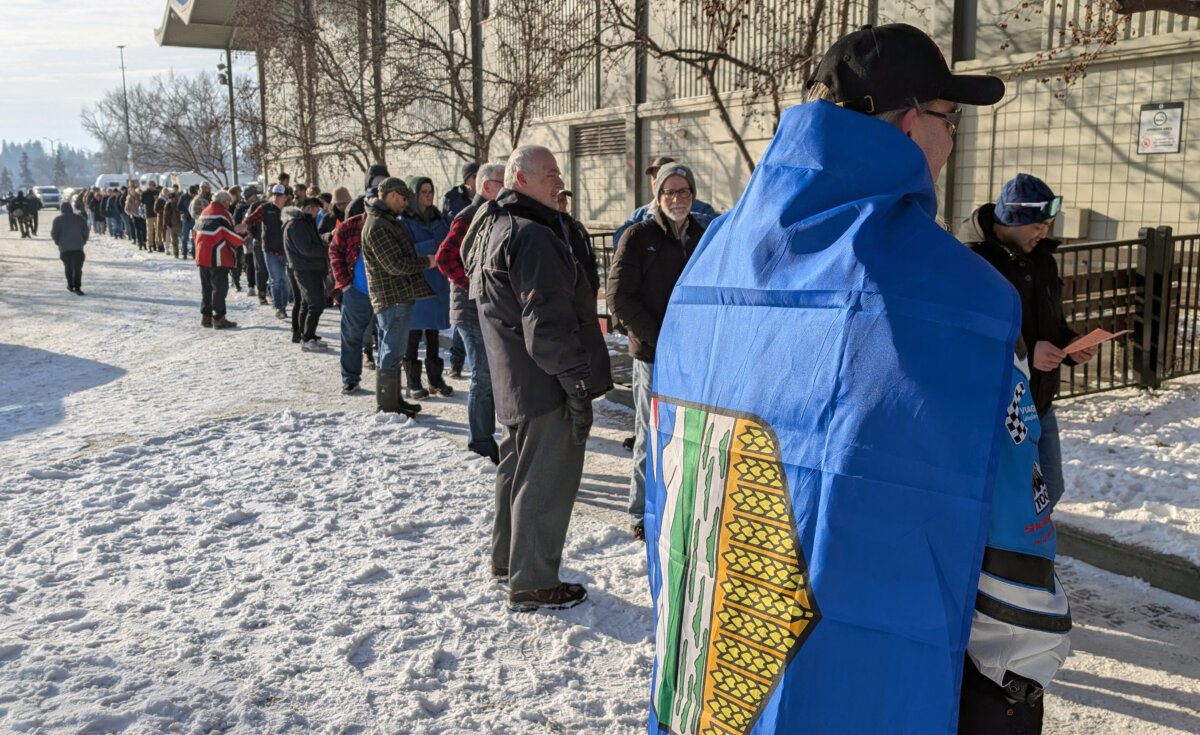

Supporters of Alberta independence are racing to gather the required number of signatures for a referendum that would decide whether the province should pursue sovereignty and become a fully independent nation.
Elections Alberta has approved a petition question on provincial independence, and 177,732 valid signatures in favour of independence must be collected to trigger a vote. Two organizers involved in the movement say they are progressing well in their efforts to collect the necessary signatures for a referendum.
The ballot question reads, “Do you agree that the province of Alberta should cease to be a part of Canada to become an independent state?”
Alberta Prosperity Project (APP) legal counsel Jeffrey Rath told The Epoch Times the group is currently collecting roughly 12,000 signatures a week.
“We’re well on track to crush 200,000 signatures at the pace we’re at right now,” he said.
However, Rath said he did not want to comment on exactly how many signatures the campaign currently has.
“We’re just focused on everybody getting as many signatures as possible,” he said. “We don’t want them slacking off when we reach 178,000.”
Take Back Alberta founder David Parker is assisting with the signature collection process. He said there are approximately 5,000 canvassers working to collect signatures, as well as town halls and other events being held across the province to attract supporters.
Alberta Premier Danielle Smith has said a referendum on independence will be held later in 2026 if the petition is successful and meets legislated requirements. Smith previously said her government would put several different questions that also meet legislated requirements onto a referendum ballot. Rath has said he is opposed to this approach.
Two independence referendums held by Quebec decades ago led to the federal government passing the Clarity Act, which gives the House of Commons the power to decide whether a referendum question—and the level of support for it—are sufficient to allow for secession negotiations.
Signature Collection
Elections Alberta announced on Dec. 22, 2025, that it had approved a petition question regarding Alberta seceding from Canada and becoming an independent nation. In early January, the agency announced that supporters of Alberta independence would have until May 2 to collect 177,732 signatures—which is 10 percent of the total votes cast in the 2023 provincial election—in order for a referendum to be held.
Rath said the APP has been holding events in different cities to collect signatures, as well as travelling “on the road getting people signed up.” He said the group intends to set up 10 permanent signature collection locations in both Calgary and Edmonton, as well as “half a dozen” in other cities like Red Deer, Fort McMurray, and Lethbridge.
Rath also said the APP is looking to gather 10,000 canvassers to go “door-to-door” to collect signatures. He said his goal is to scale up the signature collection numbers to 62,500 a week, which would garner over a million signatures and “send a really strong message to the government.”
Parker estimated that more than 75,000 signatures have already been collected, but said the tally could exceed 100,000 because he knows “individual canvassers who already have 100 [signatures] in the first month.”
He said he has learned from previous campaigns and events that “over 50 percent of everything that you collect will happen in the last two weeks every time,” saying he believes the number of signatures will accelerate as the May 2 deadline approaches.
Parker said he wants to see Alberta separate from Canada because he does not “want to live in a nation that promotes values that I oppose.” He cited federal immigration, abortion, and Medical Assistance in Dying policies, and said separation is “a question of cultural survival.”
Rath said he is in favour of separation because he believes it would make Alberta more prosperous due to less taxation and regulation from the federal government.
Referendum
While Smith has said she does not support Alberta separating from Canada, she has also said her United Conservative Party (UCP) government would allow a referendum on Alberta separation if it met all the requirements for a vote to be held.
Smith announced in May 2025 she would chair the “Alberta Next” panel to hold Alberta-wide consultations on how the province could secure its economy and assert its sovereignty within Canada. She said her government would likely place some of the more popular ideas discussed with the panel on a provincial referendum “so all Albertans can vote on them sometime in 2026.”
The premier said she would continue to use the Alberta Sovereignty within a United Canada Act and other measures to “fight through much of Ottawa’s damaging interference.” That legislation, passed in December 2022, seeks to address federal laws and policies that the Albertan legislature believes is unconstitutional or harmful to Albertans.
Smith said if the citizen-led referendum petition was successful, then her government would “respect the democratic process” and include that question on the 2026 provincial referendum ballot.
Rath said he would not “tolerate” a multi-question referendum, and there could be a sit-in protest at the Alberta legislature if independence is not a standalone question on the ballot.
“But we’re not there yet. We’re a long way away from that,” he said. “Right now we’re just focused on getting signatures.”
Several political leaders have spoken out against the push for separation in Alberta.
Alberta NDP Leader Naheed Nenshi recently said separatism discussions “put our economy and prosperity at risk.” Nenshi said on Jan. 30 that Alberta separatism would not reduce the cost of living, could scare off investment and cost jobs, and would threaten constitutionally protected treaty rights with First Nations.
Former Alberta Premier Jason Kenney is also opposed to separation and has urged national unity, adding that separation would landlock the province and reduce investor confidence. Following Rath’s previous statement that some UCP MLAs had signed the petition for Alberta to separate, he said that MLAs have “no business signing a petition to separate the country.”
Conservative Leader Pierre Poilievre, who was born in Calgary and is the MP for a rural Alberta riding, said in a Jan. 30 speech in Calgary during his leadership review that federal leaders needed to listen to the grievances of those calling for separation in both Alberta and Quebec, instead of blaming them, to address their concerns and preserve national unity.
Prime Minister Mark Carney has said he realizes there are frustrations, but has said the country is stronger united.
According to a Jan. 23 Ipsos survey, 28 percent of Albertans support separating from Canada.
Clarity Act
Quebec’s past independence referendums prompted the federal government to pass legislation on how to deal with secession demands.
Quebec held a referendum in 1980 on whether it should pursue a path toward sovereignty, which, if successful, would grant it the authority to create its own laws and foster relationships with other nations, while still preserving an economic partnership with Canada. The vote failed, with 59.5 percent of voters rejecting sovereignty and 40.4 percent endorsing it.
A second referendum on independence was held in 1995, featuring a ballot question that addressed the province’s desire to become sovereign while suggesting a new political and economic pact with Canada. This vote also failed, with 49.4 percent of the province voting in favour of independence, while 50.5 percent voted against it.
The Supreme Court of Canada ruled in 1998 that Quebec could not unilaterally secede from Canada. The court said a “clear vote on a clear question” would be needed to start negotiations with Ottawa for its exit from Canada, and a constitutional amendment would also be necessary.
The federal government then introduced the Clarity Act which became law in 2000. The legislation gives the House of Commons the power to determine whether a clear majority had expressed itself following any independence vote. It also states that all provinces and indigenous peoples would need to be part of negotiations, and gives the House the power to override a referendum decision if it violates any of the tenets of the Clarity Act.
John von Heyking, professor emeritus of political science at the University of Lethbridge, said the Clarity Act implies it is the responsibility of the federal government to determine whether to engage in negotiations that could result in secession. He said a greater majority of Albertans may be required to vote in favour of independence for the province to achieve separation.
The Clarity Act states that the Supreme Court ruled a “clear majority in favour of secession would be required to create an obligation to negotiate secession.” The act does not declare what percentage of a vote in favour of secession would constitute a “clear majority,” but states that elected representatives would take into account the size of the majority, the percentage of eligible voters that voted in the referendum, and other relevant circumstances.
The House of Commons would also take into account the views of all political parties represented in the province’s legislative assembly, other provinces, the Senate, and aboriginal peoples, according to the Clarity Act.
“If the federal government decides, for whatever reason, that the [referendum] question is no good and the majority isn’t big enough, then they’re going to say no,” said von Heyking.
Stéphane Dion, the former leader of the Liberal Party who sponsored the Clarity Act when he was a cabinet minister in the government of former Prime Minister Jean Chrétien, recently wrote that the federal and provincial governments would be under no “legal obligation” to reach an agreement on secession, but the “political pressure would be strong not to keep in Canada a provincial population that clearly wanted to leave.”
Dion also said that the negotiated terms would need to address potential changes to the borders of the provinces, the division of assets and liabilities, and issues related to indigenous peoples.
 Friends Read Free
Copy
Facebook
Tweet
Friends Read Free
Copy
Facebook
Tweet