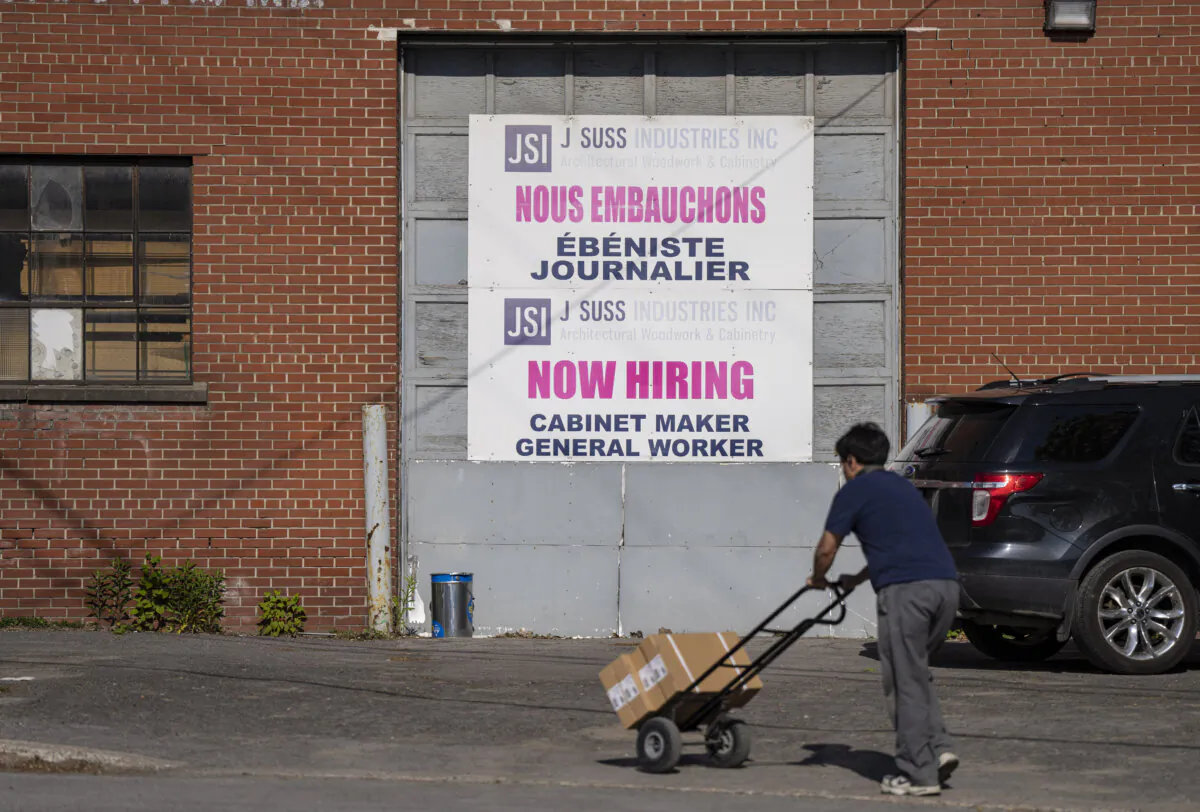

Statistics Canada’s labour numbers from July indicate that the country’s youth unemployment rate is continuing to climb, reaching numbers not seen since the 2008 recession.
While the country’s overall unemployment rate remained at 6.9 percent for that month, the rate among those aged 15 to 24 rose from 14.2 percent in June to 14.6 percent in July. This is the highest rate for that age group since September 2010, barring the COVID-19 pandemic in 2020 and 2021.
Canada saw employment fall by 41,000 jobs in July, but the decline was mainly concentrated among youth, who saw 34,000 jobs lost. Meanwhile, employment among “core-aged” working Canadians, between 25 and 54, changed very little.
The difficult situation facing Canada’s youth was highlighted at this year’s Canadian National Exhibition (CND) in Toronto, running from Aug. 15 to Sept. 1. The CNE received a record of more than 54,000 online applications for around 5,000 seasonal positions.
Economists say the youth unemployment rate is elevated due to general economic stagnation stemming from uncertainties around U.S. trade tensions, as well as higher immigration rates and the aftereffects of the pandemic slowdown.
Jack Mintz, president’s fellow at the School of Public Policy at the University of Calgary, said July’s employment numbers indicate “a slow bleeding of the Canadian economy” that is particularly impacting young Canadians, who are less likely to be chosen for job opportunities.
Livio Di Matteo, a professor of economics at Lakehead University in Thunder Bay, Ont., said youth unemployment is typically higher than average due to a lack of job experience and training. But he said additional factors are squeezing young Canadians looking for work, such as the pandemic which froze hiring opportunities and closed down businesses that tend to hire young Canadians.
Employment Data
Statistics Canada’s Labour Force Survey released Aug. 8 indicated that the unemployment rate for returning students aged 15 to 24 was at 17.5 percent in July, marking the highest rate for the month of July since 2009, excluding July 2020 during the pandemic. This unemployment rate was virtually unchanged on a year-over-year basis, but it was still up from a low of 11.2 percent in July 2022.
The national statistical agency said students aged 15 to 16, who were of high school age, “continued to face the most difficulties finding work,” with an unemployment rate of 31.4 percent in July. For returning students aged 17 to 19 and 20 to 24, their rates were a more modest 18 percent and 10.4 percent, respectively.
Mintz noted that the country’s youth unemployment rate has “jumped up quite a bit” since the beginning of 2025, when it was at 13.6 percent while the overall unemployment rate was 6.6 percent. This means that since January 2025, the overall unemployment rate has risen by 0.3 percentage points while the youth rate has risen by 1 percentage point.
Mintz also said that since the beginning of the year, Canada has seen a reduction in jobs in the goods sector, which encompasses resources, construction, and manufacturing, while employment in the services sector has increased. He attributes this to the series of tariffs imposed on Canada by U.S. President Donald Trump.
“The main point is that it’s not disastrous in terms of employment, but it’s not looking particularly robust,” he said.
Immigration and COVID-19
Mintz said that in early 2022, following the COVID-19 pandemic, the youth unemployment rate was hovering around 9 percent, which was lower than it was from 2017 to 2019. But he said the growth in Canada’s immigration rates in 2022 has led to higher unemployment rates for all age groups.
Canada’s population grew from 38 million in July 2020 to an estimated 41.3 million in July 2024, with the vast majority of the growth coming from immigration. Then-Immigration Minister Mark Miller said in November 2022 that the updated targets would allow businesses to fill worker shortages. The country’s population currently stands at an estimated 41.7 million as of Aug. 15, 2025.
Mintz said that while Ottawa has since eased back on its immigration targets, the population surge has impacted youth unemployment numbers. He said the latest Statistics Canada data indicated that the youth unemployment rate was highest among the five largest ethnic groups: Arabs (26.4 percent), blacks (23.4 percent), Chinese (20.5 percent), Filipinos (19.4 percent), and South Asians (17.1 percent), while the rate for non-racialized and non-indigenous youth was 12 percent in July.
Di Matteo said youth unemployment in Canada is typically elevated due to factors like a lack of experience and training, but it is currently higher than usual. He said this is partially because during the pandemic, lockdowns and restrictions prevented many young Canadians from getting “some of the experience needed to compete in the labour market.”
He also said many jobs in the service sector were eliminated, as businesses like restaurants closed down and never reopened. “As well, the labour market is much more competitive and opportunities have diminished as the economy and GDP growth have slowed, as a result of population growth in the major cities,” he said.
Di Matteo noted that Canada’s youth unemployment rates were worse in the early 1980s and 1990s, when they reached over 17 percent.
Employment and Social Development Canada told The Epoch Times that Canada’s youth are facing “challenges as well as new opportunities” due to new and emerging technologies, an aging workforce, and a rise in “gig” work. The department said some sectors like agriculture, STEM, and environmental sciences are facing labour shortages that could benefit youth, while others such as skilled trades, residential housing construction, and green jobs are more in demand.
The federal government has several youth programs, such as the Youth Employment and Skills Strategy, the Student Work Placement Program, and the Supports for Student Learning Program.
Ottawa also recently announced it was creating up to 6,000 more Canada Summer Jobs opportunities on top of the 70,000 jobs it had earlier said it was creating, with Minister of Jobs and Families Patty Hajdu saying on June 6 that the summer jobs program “helps young people get meaningful, paid work experience that builds skills, confidence, and connections.”
Conservative Leader Pierre Poilievre has blamed high taxes, the blocking of resource projects, and “out-of-control” immigration for the high youth unemployment.
 Friends Read Free
Copy
Facebook
Tweet
Friends Read Free
Copy
Facebook
Tweet