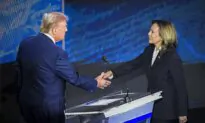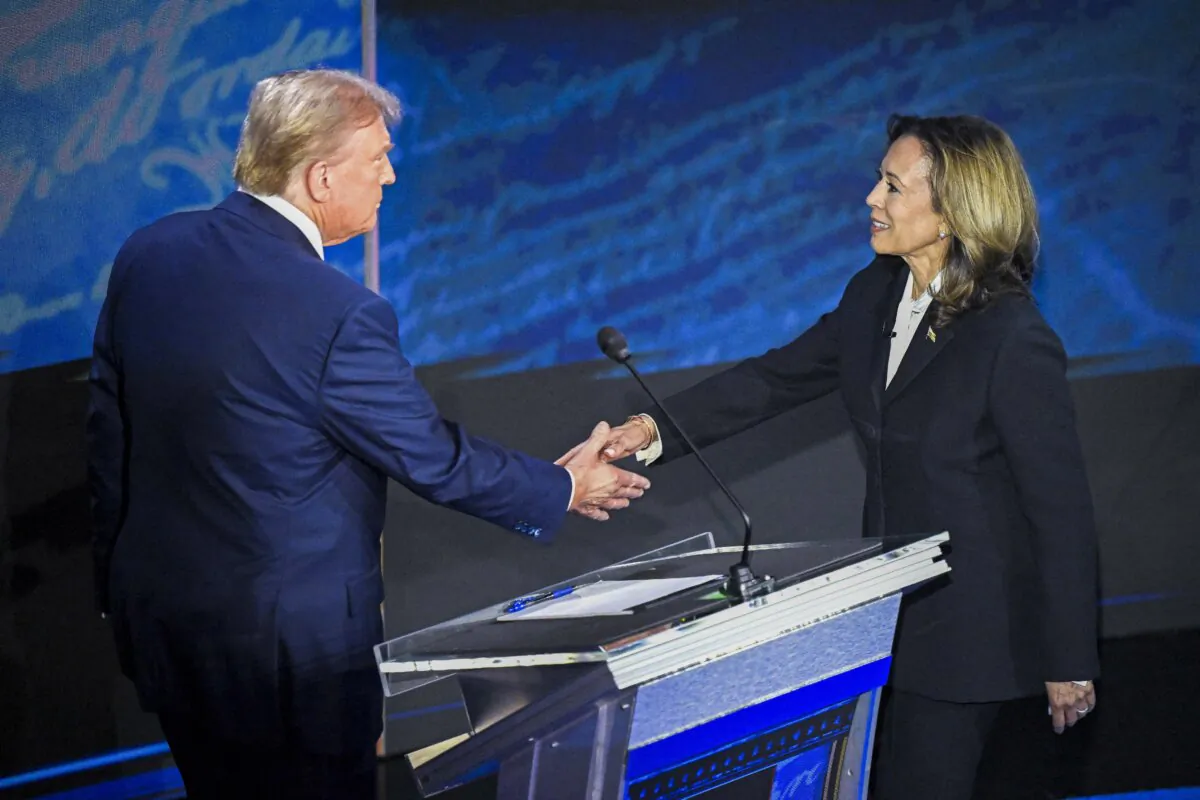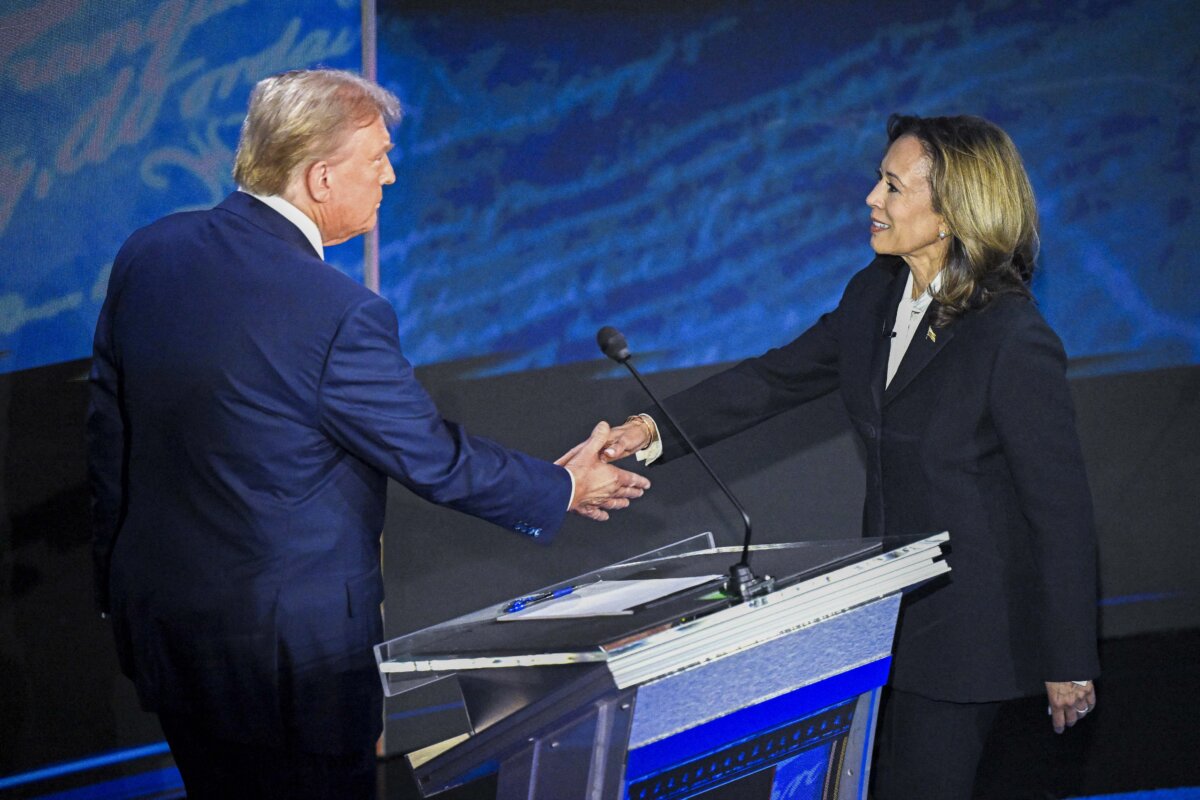




PHILADELPHIA—Americans had a chance to hear from both sides in a debate that saw Vice President Kamala Harris square off against former President Donald Trump for the first time.
The Sept. 10 ABC News broadcast from Philadelphia was contentious at times, with both candidates speaking over each other and lobbing personal attacks. No new policy specifics were provided by either candidate, and Trump and Harris presented contrasting visions on the economy, abortion, and foreign policy.
After the debate, Republicans in the spin room alleged that moderators David Muir and Linsey Davis showed bias toward Harris. Former GOP candidate Vivek Ramaswamy described the debate as a “three-on-one fight” against Trump, while Rep. Mike Waltz (R-Fla.) questioned the fairness of ABC’s fact-checking.
Democrats, meanwhile, accused Trump of looking defensive against a new and yet familiar candidate. Also in the spin room, California Gov. Gavin Newsom said Harris “exceeded all expectations.”
Here are some of the main themes that emerged from the first presidential debate with Harris as the Democratic candidate.
Harris Distances Herself From Biden as Trump Links Them
While the election previously pitted the former president against incumbent President Joe Biden, Harris sought to carve out her own place while garnering credit for what she characterized as a positive record from her administration.
“Remember this—she is Biden,” Trump said toward the end of the debate. He attributed high inflation and the administration’s energy policies to Harris, along with its border policies.
“Clearly, I am not Joe Biden,” Harris said, adding that she would provide “a new leadership for our country” while touting her administration’s record on energy, the economy, and more.
Harris’s remarks echoed comments earlier in the evening amid a discussion on foreign policy.
After saying the world was on the verge of World War III, Trump questioned Biden’s fitness for office, asking, “Where is our president?”
“You’re not running against Joe Biden. You’re running against me,” Harris said a few moments later.
In his closing remarks, Trump focused on Harris’s role in the current administration, pointing out that she has had a full term as vice president to implement the changes that she promises to make.
“She’s been there for 3 1/2 years. They’ve had 3 1/2 years to fix the border. They’ve had 3 1/2 years to create jobs and all the things we talked about. Why hasn’t she done it?” Trump said.
Abortion Focus
Harris and Trump clashed on life issues, a topic that has remained especially significant in the years since the Supreme Court overturned Roe v. Wade. States have negotiated the new landscape through referenda and other measures, yielding a patchwork of different abortion laws across the country.
Harris, who backs a federal right to abortion, said her opponent would sign “a national abortion ban” if it came to his desk while in office. She cited language from Project 2025, a Heritage Foundation policy guidebook from which the former president has repeatedly distanced himself.
“I’m not signing a ban, and there’s no reason to sign a ban,” Trump said, defending the return of abortion legislation to the states after the reversal of Roe.
When pressed on the issue, he did not commit to vetoing legislation that would impose nationwide restrictions on abortion.
“Would you veto a national abortion ban?” Davis asked Trump.
“I won’t have to,” he responded, arguing that the issue wouldn’t make it through a closely divided Senate, which requires 60 senators to move legislation because of the filibuster.
Trump challenged Harris on whether she supports abortion in the third trimester, saying that Roe v. Wade did not restrict abortions at that stage. He alluded to former Virginia Gov. Ralph Northam’s controversial comment on a 2019 late-term abortion bill that he backed. Northam suggested that a living newborn, likely with “severe deformities,” might be delivered and killed. The bill failed.
“Why don’t you ask the question?” the former president asked the moderators.
They didn’t push Harris to respond to her opponent’s question, instead turning to a different topic.
Trump Highlights Tariffs as Harris Touts Her Economic Plan
The economy—a top voter issue—kicked off the presidential debate.
Trump touted his plan to raise tariffs on imported goods, while Harris shared parts of her agenda intended to lower costs for families and small businesses.
Harris highlighted her plan to expand the child tax credit to $6,000 so “young families can afford to buy a crib, buy a car seat, buy clothes for their children.” She also reiterated her proposal for a $50,000 tax deduction to start a small business.
Trump said his tariff vision would generate billions of dollars in revenues. The former president has proposed imposing 10 percent across-the-board tariffs on all products imported into the United States from overseas.
“Other countries are going to finally, after 75 years, pay us back for all that we’ve done for the world, and the tariff will be substantial,” Trump said.
He also dismissed criticisms that his tariffs would resuscitate inflationary pressures.
“I had tariffs, and yet I had no inflation,” Trump said, adding that persistent inflation in recent years has been a “disaster for people, for the middle class.”
Neither Candidate Outlines New Policies
The debate saw few key policy advances from either candidate.
While fielding questions on topics including the economy, foreign affairs, energy, abortion, immigration, climate change, and health care, Harris and Trump mostly restated their established positions.
In response to a question about combating climate change, both candidates appeared either to deflect or pivot. Harris criticized Trump for calling climate change a hoax before she alluded to high home insurance premiums in Florida because of hurricanes.
She then pivoted to touting manufacturing jobs and union endorsements. Trump did not answer the question and instead criticized the Biden administration and the president himself for relationships with other countries.
Davis pressed Trump on his previous promises to repeal and replace the Affordable Care Act, known as Obamacare.
“We are working on things. We’re going to do it. We’re going to replace it,” he said.
Although Trump does not yet have a finalized proposal, he said he has the “concepts of a plan.”
“But if we come up with something, I would only change it if we come up with something that is better and less expensive,” he said.
Janice Hisle and Jan Jekielek contributed to this report.
 Friends Read Free
Copy
Facebook
Tweet
Friends Read Free
Copy
Facebook
Tweet